Cisco SD-WAN vs Cisco SD-Routing: How to Choose, Migrate, and Save
A practical decision guide to the two IOS XE WAN edge modes managed through Catalyst SD-WAN Manager, from overlay requirements and migration planning to licensing and total cost.
In This Lesson
Follow the decision from one central question through architecture, platform fit, migration sequencing, automation, licensing, and a final deployment recommendation.
Quick Learning Map
Keep these three decisions in view before selecting a mode or beginning a migration.
Decide if an overlay is required
App-aware routing, SLA steering, segmentation, Cloud OnRamp, and SASE point to SD-WAN controller mode.
Match the mode to each site
Keep routing-only locations autonomous while assigning full overlay capabilities where they create measurable value.
Migrate in controlled waves
Replace vEdge with cEdge, validate routing first, then enable controller mode and advanced services site by site.
Cisco SD-WAN and SD-Routing at a Glance
The same supported cEdge hardware can serve two different operational goals. Controller mode adds the encrypted SD-WAN overlay and centralized policy; autonomous mode keeps standard IOS XE routing while remaining visible and configurable through Catalyst SD-WAN Manager.
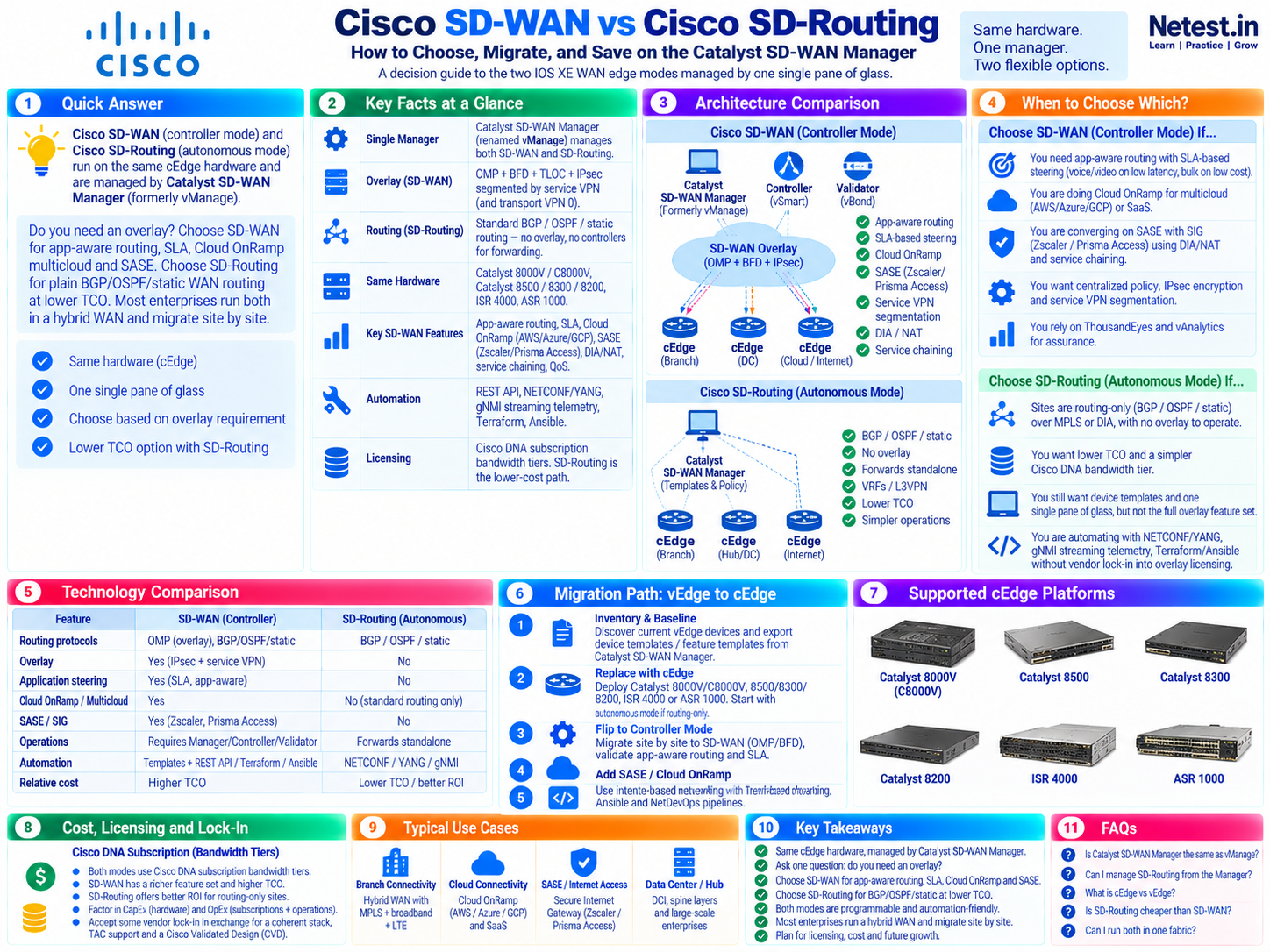
Quick Answer: One Platform, Two Operating Modes
Cisco SD-WAN uses IOS XE SD-WAN in controller mode. Cisco SD-Routing uses IOS XE in autonomous mode. Both can run on supported cEdge platforms and can be administered from Catalyst SD-WAN Manager, the current name for vManage.
Choose SD-WAN
Use controller mode when application-aware routing, SLA-based steering, secure overlays, service VPN segmentation, Cloud OnRamp, or SASE is part of the requirement.
Choose SD-Routing
Use autonomous mode when a site only needs BGP, OSPF, static routing, VRFs, and familiar IOS XE operations without an SD-WAN overlay.
Use both where appropriate
A hybrid estate can keep simple sites autonomous and move higher-value locations into the overlay, all managed through one operational pane.
The One Question That Decides It: Do You Need an Overlay?
Cisco SD-WAN builds an encrypted overlay across transports such as MPLS, broadband, and LTE. A cEdge joins the management, control, and validation system; advertises reachability through OMP; identifies transport locations with TLOCs; measures paths with BFD; and carries segmented service VPN traffic through IPsec tunnels. See the SD-WAN architecture and component guide for a deeper control-plane walkthrough.
Cisco SD-Routing does not build that overlay. It forwards with standard BGP, OSPF, or static routes and can use familiar IOS XE features such as VRFs and ACLs. The device can continue forwarding independently if management connectivity is interrupted.
SD-WAN controller mode
Control model: Catalyst SD-WAN Manager works with the Controller and Validator roles to create the overlay, distribute policy, and coordinate secure connectivity.
Forwarding model: OMP, BFD, TLOCs, IPsec tunnels, service VPNs, and centralized policy support application-aware traffic steering across multiple transports.
SD-Routing autonomous mode
Control model: the router runs standard routing protocols locally while Catalyst SD-WAN Manager supplies templates, configuration, monitoring, and lifecycle operations.
Forwarding model: BGP, OSPF, static routes, VRFs, and L3VPN behavior remain standalone. There is no SD-WAN control plane or overlay to operate.
When to Choose SD-WAN or SD-Routing
Choose SD-WAN controller mode if...
- You need application-aware routing with SLA thresholds for latency, loss, and jitter.
- You are using Cloud OnRamp for AWS, Azure, Google Cloud, or SaaS connectivity.
- You are converging on SASE or secure internet access through services such as Zscaler or Prisma Access.
- You need centralized policy, IPsec encryption, service VPN segmentation, DIA/NAT, or service chaining.
- You rely on assurance and visibility from ThousandEyes or vAnalytics.
Choose SD-Routing autonomous mode if...
- The site is routing-only over MPLS or direct internet access and needs no overlay.
- You want a lower-complexity operating model and better economics for straightforward branches.
- You still want templates, lifecycle control, and a single management view.
- You are automating with NETCONF/YANG, gNMI telemetry, Terraform, or Ansible without requiring overlay services.
- Local standalone forwarding is more important than centralized path policy.
Cisco SD-WAN vs SD-Routing Technology Comparison
This matrix separates the capabilities that require the overlay from the functions available in autonomous routing mode.
| Requirement | SD-WAN (controller mode) | SD-Routing (autonomous mode) |
|---|---|---|
| Routing protocols | OMP overlay with BGP, OSPF, and static routing at the service side | BGP, OSPF, and static routing |
| Overlay and segmentation | IPsec overlay with service VPN segmentation | No SD-WAN overlay; use VRFs or L3VPNs as designed |
| Application steering | Application-aware routing with SLA policy | Standard route-table and policy-based decisions |
| Cloud and security | Cloud OnRamp, SASE/SIG integration, DIA/NAT, and service chaining | Standard IOS XE routing and security features |
| Operational dependency | Manager, Controller, and Validator support the fabric control model | Forwards standalone while the Manager supplies centralized operations |
| Automation | Templates, REST APIs, Terraform, Ansible, NETCONF/YANG, and telemetry | Templates, NETCONF/YANG, gNMI, Terraform, Ansible, and NetDevOps workflows |
| Typical fit | Hybrid WAN, multicloud, segmented branches, SASE, and SLA-sensitive applications | Routing-only branches, hubs, data centers, and simple WAN sites |
| Relative cost and complexity | Richer features with higher subscription and operational demands | Lower-complexity path with potential TCO savings |
Migration Path: vEdge to cEdge, Autonomous to Controller
Treat hardware replacement and operating-mode change as separate decisions. A site can move from vEdge to cEdge first, stabilize in autonomous routing mode where appropriate, and join the SD-WAN overlay later.
1. Inventory and establish a baseline
Discover vEdge and cEdge devices, software releases, licenses, circuits, route tables, segmentation, application dependencies, and performance baselines. Export current device templates, feature templates, and configuration groups from Catalyst SD-WAN Manager.
Exit criterion: every site has an owner, rollback plan, dependency map, and measurable success criteria.
2. Replace vEdge with cEdge in waves
Deploy the supported Catalyst 8000V, 8500, 8300, 8200, ISR 4000, or ASR 1000 platform selected for the site. Start in autonomous mode when the immediate requirement is routing-only.
Exit criterion: routing adjacency, reachability, QoS, NAT, security policy, telemetry, and management are stable.
3. Enable controller mode where the overlay adds value
Migrate selected sites into SD-WAN controller mode, onboard them to the fabric, and validate OMP routes, TLOC reachability, BFD sessions, IPsec tunnels, segmentation, and application-aware policy.
Exit criterion: intended applications meet their SLA and failover targets under normal and degraded path conditions.
4. Add Cloud OnRamp and SASE after the WAN is stable
Integrate multicloud, SaaS optimization, secure internet gateways, DIA/NAT, and service chaining after the base underlay and overlay are proven.
Exit criterion: cloud and security traffic follows the intended path, policy, identity, logging, and failover behavior.
5. Automate the repeatable journey
Use the Manager REST API, NETCONF/YANG, gNMI streaming telemetry, Terraform, and Ansible to standardize discovery, deployment, validation, reporting, and rollback. The network automation tools guide can help map those interfaces to a practical toolchain.
Precaution: protect credentials, review changes, use canary sites, and stop promotion when health checks fail.
Cost, Licensing, and Lock-In
Both modes use Cisco subscription licensing shaped by platform and bandwidth tiers. SD-WAN normally carries the richer feature set and a higher total cost, while SD-Routing can improve ROI for routing-only sites. Exact entitlements and packaging can change, so validate the current Cisco offer for the selected hardware and release.
Model CapEx
Include the router, modules, optics, cellular hardware, spares, and any platform replacement needed for the target IOS XE release.
Model OpEx
Include subscriptions, support, Manager operations, controller hosting, circuits, cloud security, telemetry, training, and change effort.
Price by site archetype
Compare small branches, critical branches, hubs, data centers, and cloud edges separately instead of using one average site.
- Buy the feature set you will operate: unused overlay capabilities do not create value.
- Count complexity: policy design, controller lifecycle, troubleshooting, and security integration are part of TCO.
- Account for lock-in: a coherent Cisco stack can simplify design and support, but it also concentrates hardware, software, licensing, and skills in one ecosystem.
- Protect the migration: stage entitlements, support coverage, spares, rollback capacity, and software compatibility before each wave.
Final Take
Ask one question first: does this site need an overlay? Choose Cisco SD-WAN when app-aware routing, SLA steering, secure segmentation, Cloud OnRamp, or SASE materially improves the service. Choose Cisco SD-Routing when dependable BGP, OSPF, or static routing meets the requirement at lower complexity and cost.
The most practical enterprise design is often hybrid: manage both modes through Catalyst SD-WAN Manager, replace vEdge with cEdge in controlled waves, move only qualified sites into controller mode, and automate repeatable checks with APIs, Terraform, Ansible, and streaming telemetry.
Cisco SD-WAN and SD-Routing Frequently Asked Questions
Is Catalyst SD-WAN Manager the same as vManage?
Yes. Catalyst SD-WAN Manager is the current name for vManage and provides centralized management for both SD-WAN controller-mode and SD-Routing autonomous-mode edges.
Can I manage Cisco SD-Routing from Catalyst SD-WAN Manager?
Yes. Autonomous-mode devices can be onboarded and configured through templates and configuration groups, providing one operational view without requiring the SD-WAN overlay.
What is the difference between cEdge and vEdge?
cEdge is the IOS XE-based successor and migration target for older vEdge fleets. Supported cEdge families include Catalyst 8000V, 8500, 8300 and 8200, plus selected ISR 4000 and ASR 1000 platforms.
Is Cisco SD-Routing cheaper than Cisco SD-WAN?
It can be for routing-only sites because it avoids overlay and SASE features and can use a simpler subscription choice. Compare hardware, bandwidth tier, support and operational effort for the exact design.
Can I run SD-WAN and SD-Routing in the same managed environment?
Yes. Enterprises can manage SD-WAN branches and SD-Routing sites from Catalyst SD-WAN Manager, then migrate sites individually when an overlay requirement appears.