Introduction to Cisco DNA Center
The earlier lessons built the vocabulary for automation: APIs carry requests, CRUD describes the action, data models describe the payload, and Git protects the change process. Cisco DNA Center brings those ideas into a controller platform for designing, provisioning, securing and observing enterprise networks.
Network Automation and Programmability Series
Move from controller-based networking to repeatable infrastructure automation, one practical concept at a time.
In This Lesson
See Cisco DNA Center as an operating workflow rather than a single dashboard. Follow design, policy, provisioning, and assurance from intent to validated network state.
Quick Learning Map
Keep these three decisions in view as you work through the detailed lesson.
Design and define policy
Model sites, addressing, identity, segmentation, and intended behavior.
Provision consistently
Onboard devices and translate policy into controlled configuration.
Assure the outcome
Use telemetry and context to verify experience and investigate deviations.
Cisco DNA Center and SD-Access at a Glance
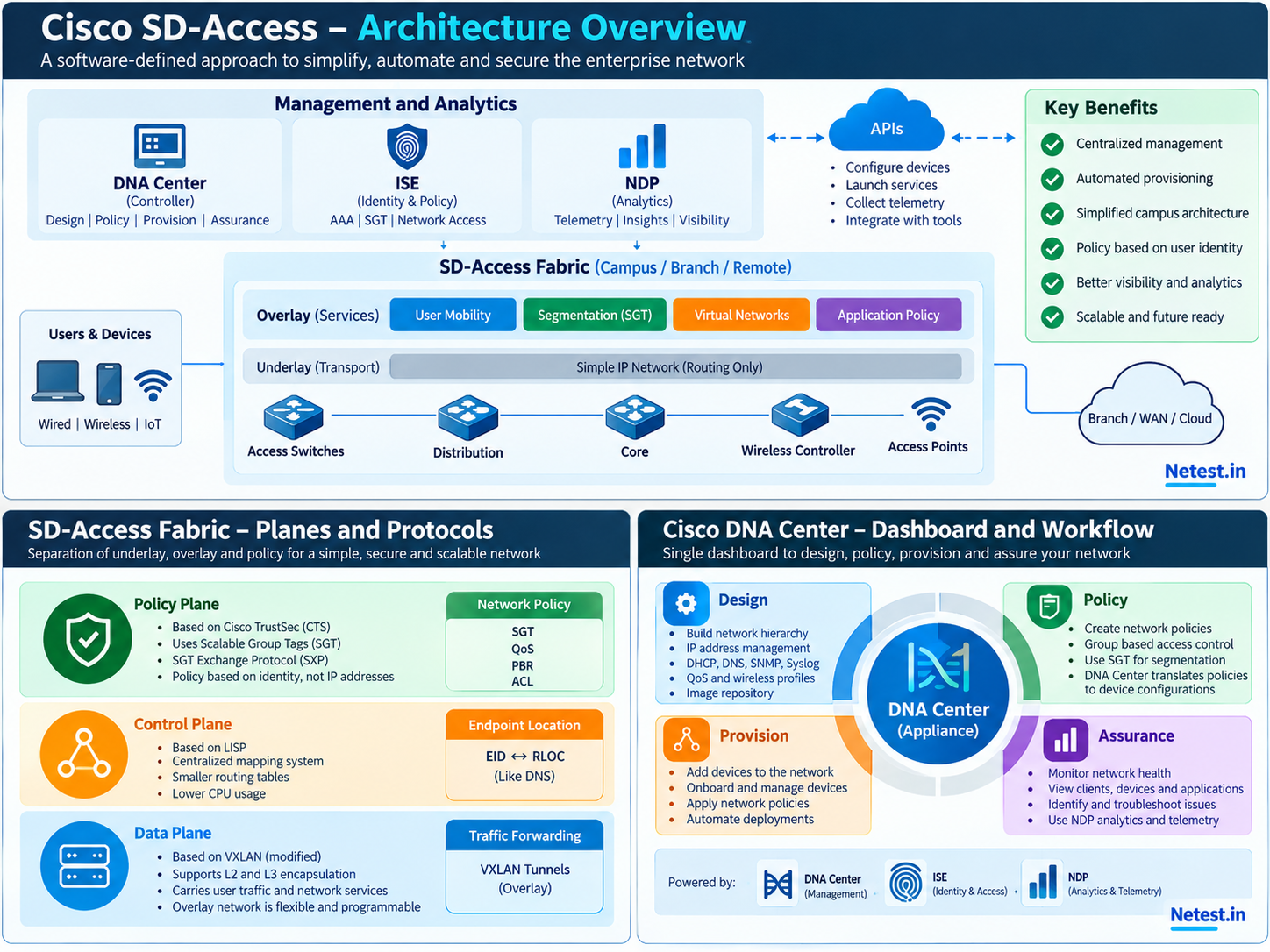
Think of Cisco DNA Center as the place where an operator describes the network and its intent. The platform coordinates inventory, site hierarchy, policies, provisioning and assurance, while switches, routers, wireless systems and identity services continue to perform their specialized jobs.
What Cisco DNA Center Actually Does
Cisco DNA Center is a controller and management platform, not a replacement for the network devices themselves. It keeps a model of the network, communicates with supported devices and services, and gives engineers workflows for making changes consistently.
That distinction helps set realistic expectations. A controller can simplify discovery, policy and provisioning, but it cannot make an incorrect topology safe by itself. Engineers still need to understand addressing, routing, switching, wireless, identity, security and the operational effect of a proposed change.
The platform becomes most useful when an organization agrees on a common way to describe sites, device roles, policies and intended outcomes. Without that shared model, the controller can become another dashboard full of inconsistent objects. With it, the same platform can reduce repeated device-by-device work and make the state of the environment easier to explain.
Design, Policy, Provision and Assurance
The four workflow areas are easier to remember as a loop rather than four isolated menu names.
Design
Build the site hierarchy, address pools, device roles, network settings and software image choices. Design gives the platform context about where a device belongs and what kind of work it should perform.
Policy
Describe who or what should be allowed to access which resources. Policies can use identity, device type, group membership and security intent instead of relying only on IP addresses.
Provision
Discover, onboard and configure devices using the approved design and policy. Provisioning turns the model into device-level configuration and records the result.
Assurance
Observe health, clients, applications, paths, wireless experience and policy outcomes. Assurance helps an engineer move from “the device is reachable” to “the service is working.”
The loop is iterative. A device can be provisioned successfully and still reveal an addressing mistake during assurance. That finding should improve the design or policy model, not lead to an unrelated manual fix that disappears from the controller's intended state.
SD-Access: Underlay, Overlay and Policy
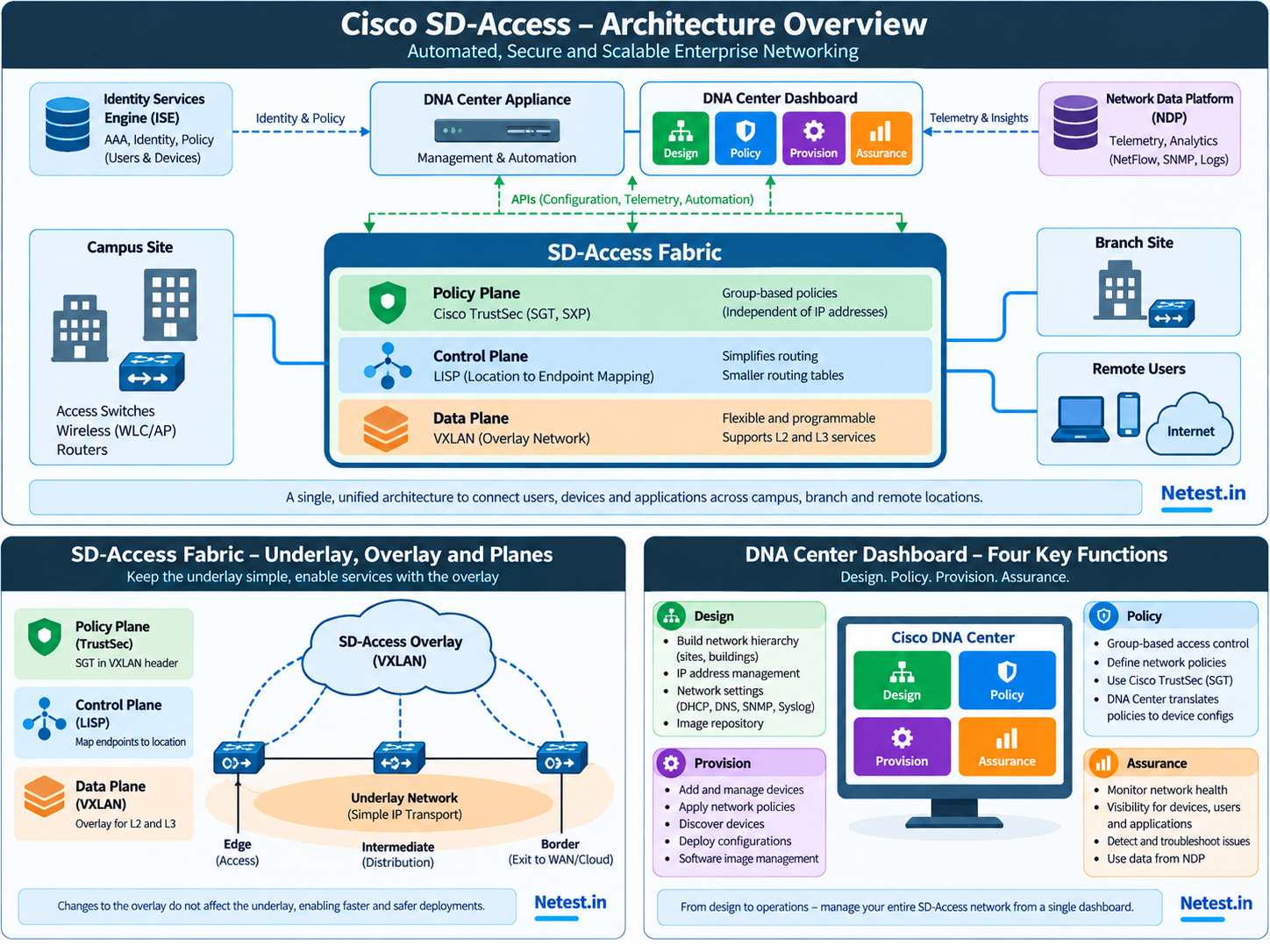
SD-Access separates the transport network from the services carried across it. The underlay is the routed foundation that provides stable reachability between fabric nodes. The overlay adds services such as endpoint mobility and segmentation without requiring every policy decision to be encoded directly into the physical topology.
The control plane maintains information about where endpoints are located. The data plane carries traffic across the fabric, commonly using an encapsulated overlay. The policy plane applies identity-aware or group-based decisions so access can follow a user or device role rather than only an address that may change.
This separation is powerful, but it creates dependencies. If the underlay is unstable, the overlay cannot be reliable. If identity information is missing, a policy may classify a user incorrectly. If the fabric edge is mapped to the wrong site, a valid policy can still produce the wrong user experience.
How the Supporting Services Fit Together
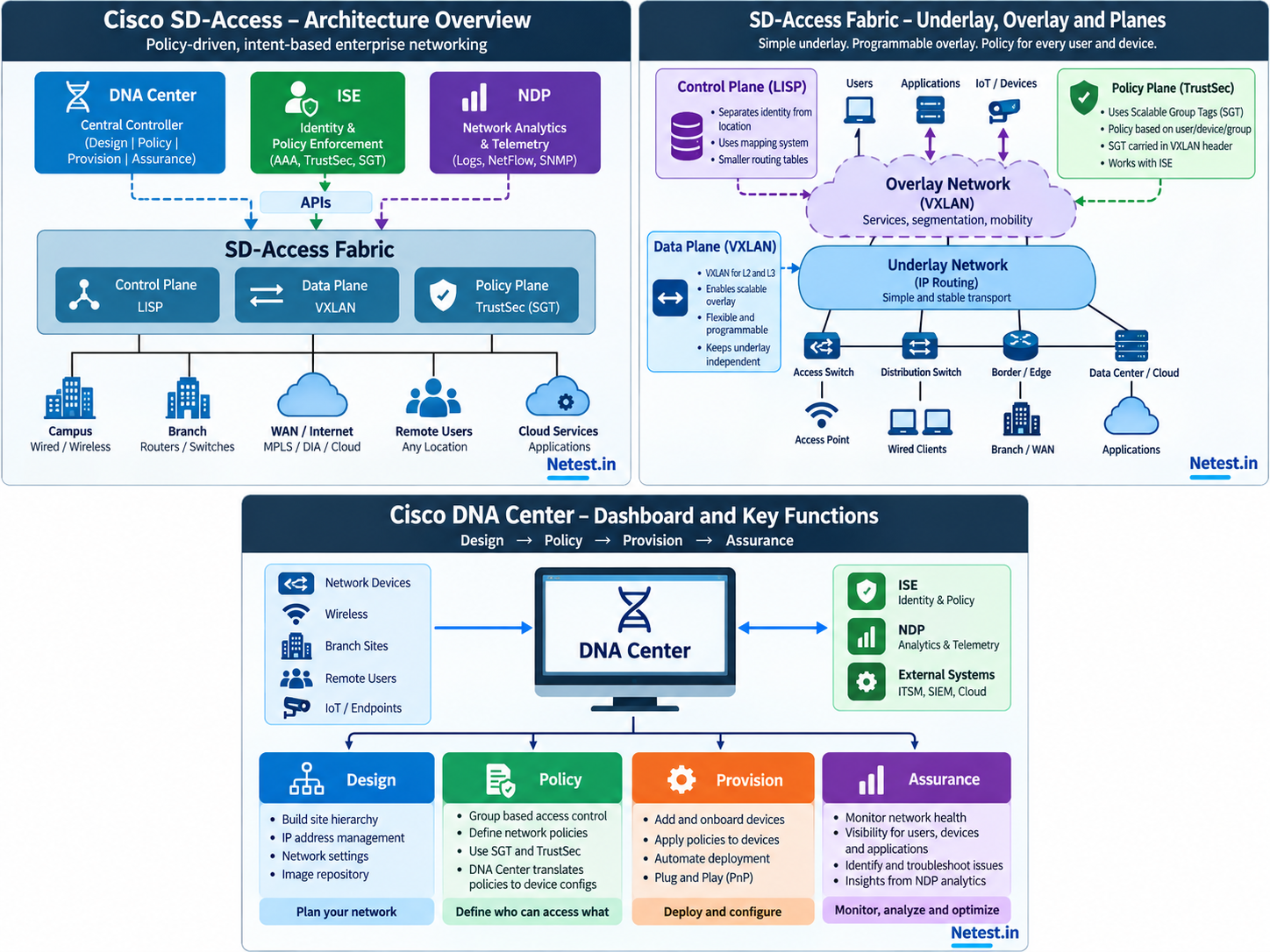
DNA Center rarely operates alone. Identity services help answer who or what is connecting and which policy group applies. Analytics and telemetry services provide the observations needed for assurance. APIs connect the controller to service desks, automation pipelines, inventory systems and other operational tools.
| Service area | Question it answers | Operational value |
|---|---|---|
| Controller | What is the intended design and how should it be deployed? | Centralized inventory, workflow and configuration orchestration. |
| Identity and policy | Who or what is connecting, and what should it access? | Authentication, authorization and group-based policy. |
| Analytics | What is happening across devices, clients and applications? | Telemetry, experience visibility, trends and troubleshooting clues. |
| APIs | How can another system request or consume controller data? | Integrations, repeatable workflows and machine-readable operations. |
When a workflow fails, identify which service owns the missing fact. A device onboarding error may be a credential or reachability issue, while a client policy problem may belong to identity or authorization. Keeping those boundaries clear prevents an engineer from changing a switch configuration when the real issue is a missing identity attribute.
Device Onboarding as a Controlled Process
Before onboarding a device, confirm its management address, default gateway, DNS, NTP, credentials, software compatibility, licensing and intended role. Decide which site, building, floor and network hierarchy should contain it. These details may feel administrative, but they affect how later templates, policies and assurance views find the device.
- Prepare. Verify reachability, credentials, prerequisites and the expected site assignment.
- Discover. Add the device and confirm that the controller can communicate with it.
- Assign. Place it in the correct hierarchy and identify its role, image and policy context.
- Provision. Apply the approved settings during a controlled maintenance window.
- Verify. Check device state, interfaces, neighbors, clients and the services that depend on it.
Start with a small group. A pilot exposes platform differences, missing licenses and inaccurate assumptions before they affect an entire campus. Save the job result and post-change checks so another engineer can understand what happened without replaying the workflow.
Assurance Is More Than a Green Dashboard
Assurance should help answer a user-impact question: can the right person or device reach the right service with acceptable performance? Device reachability is only one signal. A switch may be up while a client has failed authentication, a wireless user has poor experience, or an application path is degraded.
Use assurance to form a hypothesis, then verify it with the underlying evidence. Check the client identity, VLAN or group, policy result, path, interface counters, neighbor state and relevant logs. Controller insights can shorten the search, but they should lead to a testable explanation rather than replace engineering judgment.
DNA Center APIs and the Automation Series
The earlier REST API lessons now have a concrete platform to work against. An automation script can authenticate to the controller, read inventory, filter devices by role, start a supported workflow or retrieve assurance data. The data model determines the fields and relationships, while Git and configuration management provide review and repeatability around the request.
Client -> authenticated API request -> DNA Center workflow -> device or service change -> assurance dataUse the API for repeatable integration, not for bypassing the platform's safety model. Read the resource representation, validate identifiers, handle status codes, log the request outcome and avoid storing tokens in source code. A small script that is observable and reversible is more valuable than a clever script that cannot be explained during an incident.
Introduction to Cisco DNA Center Frequently Asked Questions
What is Cisco DNA Center?
It is a controller and management platform for designing, provisioning, operating and assuring Cisco enterprise networks through centralized workflows and APIs.
What are Design, Policy, Provision and Assurance?
Design models the network, Policy expresses access intent, Provision deploys the approved result, and Assurance observes health and experience.
Is DNA Center a replacement for switches and routers?
No. It coordinates management and automation. Network devices still forward traffic and provide connectivity.
What is SD-Access?
SD-Access uses a routed underlay and fabric services for endpoint location, mobility, segmentation and identity-aware policy.
What should be checked before device onboarding?
Check reachability, credentials, software, licensing, DNS, NTP, device role, site hierarchy and interface prerequisites.
How do APIs fit into DNA Center?
APIs allow scripts and systems to read inventory, start workflows, retrieve assurance data and integrate the controller with other tools.