SD-WAN Architecture Explained: Components, Diagram and How It Works
SD-WAN architecture uses centralized software policy and distributed edge devices to connect branches, data centers and clouds across MPLS, broadband, dedicated internet, LTE or 5G. A secure overlay abstracts those transports so applications can use the best eligible path.
What Is SD-WAN Architecture?
Instead of configuring every branch router as an isolated system, an enterprise SD-WAN solution distributes reusable templates and policies from central services. WAN edges identify applications, measure link health and steer traffic according to business intent.
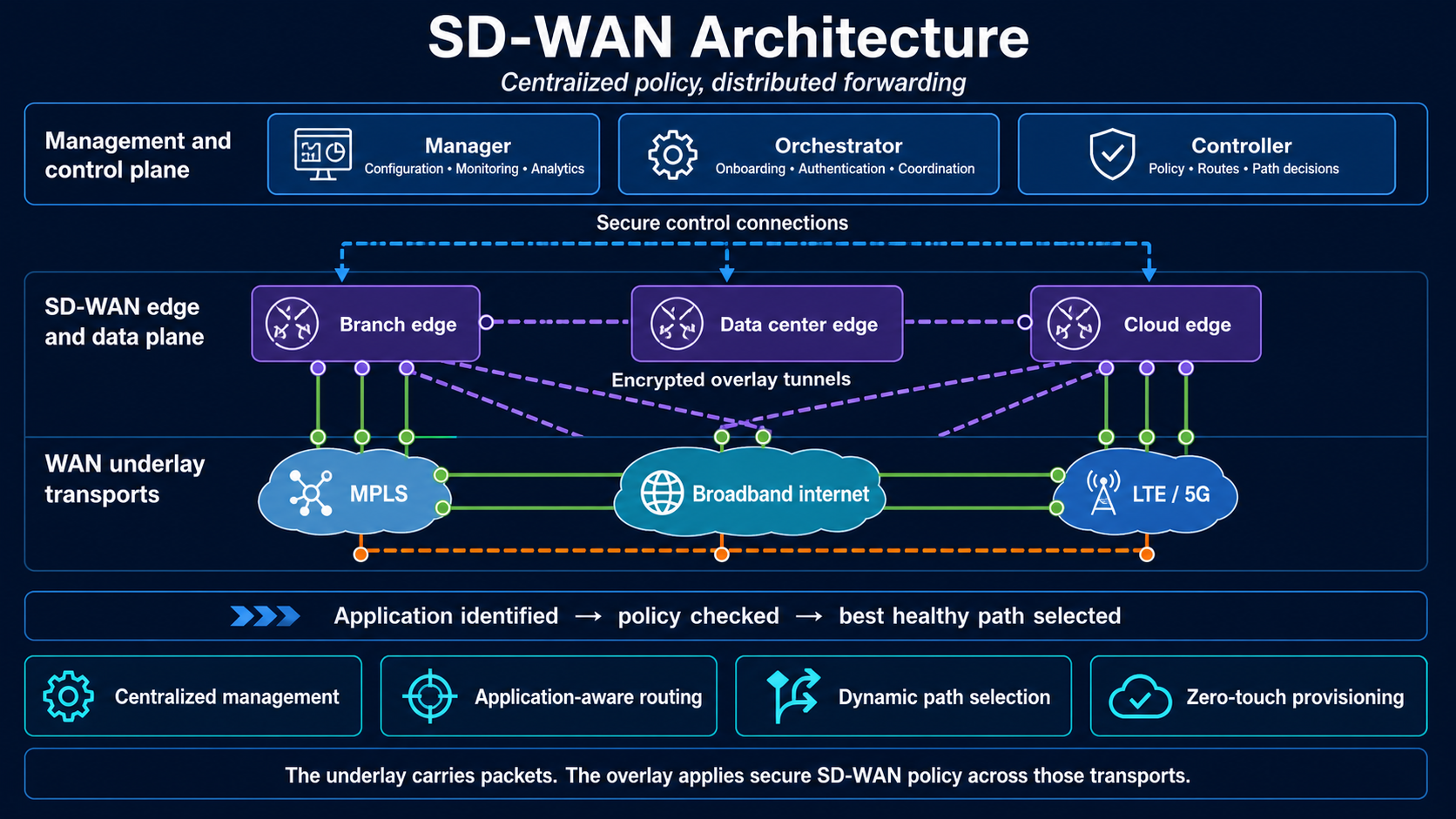
SD-WAN Architecture Diagram Explained
Controllers and managers normally do not sit in the user-data path. Once policy and reachability are learned, edge devices send application packets directly across overlay tunnels. This preserves distributed forwarding while making intent and operations centrally manageable.
The Four SD-WAN Architecture Planes
Management plane
Provides configuration templates, dashboards, software lifecycle, alarms, analytics and centralized operations.
Orchestration plane
Authenticates new edges, assists discovery and establishes the secure relationships required to join the fabric.
Control plane
Distributes routes, topology, segmentation, tunnel and policy information without carrying normal application traffic.
Data plane
Lives on WAN edges and forwards packets through overlay tunnels according to routes, policies and current path health.
Core SD-WAN Architecture Components
| Component | Role | Design considerations |
|---|---|---|
| SD-WAN edge | Physical or virtual device that terminates transports, forms tunnels, identifies applications, enforces policy and forwards traffic. | Throughput, tunnel scale, encryption performance, local services, high availability and WAN interfaces. |
| SD-WAN manager | Centralized management for templates, monitoring, reporting, software images and operational workflows. | Role-based access, audit logs, backup, API access, redundancy and administrative isolation. |
| SD-WAN controller | Maintains overlay reachability and distributes routing, topology, segmentation and centralized policy. | Controller scale, regional placement, redundancy, control connections and route policy. |
| SD-WAN orchestrator | Supports secure device onboarding, discovery and initial connectivity to control services. | Certificate lifecycle, trust anchors, NAT traversal, availability and deployment workflow. |
| Underlay transports | Provide basic IP connectivity between edges and control services. | Carrier diversity, shared failure domains, bandwidth, SLA, addressing and last-mile resiliency. |
| Overlay fabric | Creates logical secure connectivity independent of individual carrier networks. | Tunnel scale, segmentation, MTU, encryption, topology, routing exchange and failover time. |
| Security services | Protect local breakout, east-west traffic and access to applications or the internet. | NGFW, IPS, DNS security, secure web gateway, cloud security, ZTNA and SASE integration. |
Underlay vs Overlay Network in SD-WAN
| Characteristic | Underlay network | SD-WAN overlay network |
|---|---|---|
| What it is | The physical carrier and IP transport | The logical fabric built between authenticated edges |
| Examples | MPLS, broadband, DIA, LTE, 5G, satellite | Encrypted tunnels, virtual segments and overlay routes |
| Main responsibility | Provide basic reachability and link capacity | Apply enterprise topology, routing, security and application policy |
| Visibility | Loss, latency, jitter, bandwidth and availability of each transport | Application flows, segments, paths, tunnels and business intent |
| Failure response | Carrier restores its service or routing | Edges can move eligible traffic to another healthy underlay path |
The overlay cannot repair a failed physical circuit; it can only use another reachable transport. Good SD-WAN network design therefore requires genuinely diverse underlays, not two circuits that share the same building entrance, provider backbone or upstream failure domain.
How Does SD-WAN Architecture Work?
- Provision the edge. A physical appliance, virtual network function or cloud edge receives minimal bootstrap information.
- Authenticate and onboard. Zero-touch provisioning uses device identity and certificates to contact orchestration and management services securely.
- Build the overlay. Edges establish encrypted tunnels across every permitted underlay transport.
- Learn routes and policy. Controllers distribute reachability, segmentation, topology and traffic-engineering intent.
- Measure every path. Edges continually monitor loss, latency, jitter and availability across tunnels.
- Identify the application. Traffic is classified using addresses, ports, protocols and, where supported, deeper application recognition.
- Select an eligible path. Policy compares application requirements with live transport measurements and chooses a path.
- Adapt to change. When a path violates its SLA threshold, the edge can steer new or existing flows to a healthier link according to platform behavior and policy.
- Report and optimize. Central analytics reveal performance, availability, capacity and policy outcomes for continuous tuning.
Application-Aware Routing and Dynamic Path Selection
Traditional routing generally chooses a path from routing information and metrics. SD-WAN adds business policy and real-time link quality. A voice policy might require low loss, latency and jitter, while backups may prefer the least expensive available path.
Some platforms also use packet duplication, forward error correction, tunnel bonding or WAN optimization. These features can improve resilience or performance but consume bandwidth and should be applied selectively.
Traditional WAN vs SD-WAN Architecture
| Area | Traditional WAN | SD-WAN architecture |
|---|---|---|
| Configuration | Often device-by-device with distributed policy | Central templates and policy distributed to edges |
| Transport choice | Frequently centered on one private WAN service | Can combine MPLS, internet, LTE, 5G and other IP transports |
| Path decisions | Based primarily on routing metrics and static policy | Can include application identity and current loss, latency and jitter |
| Cloud access | Traffic may backhaul through a central data center | Policy can allow secure local or regional cloud breakout |
| Segmentation | Built with VRFs, VPN services and manual coordination | Central policy can extend logical segments across the overlay |
| Operations | Separate tools and per-router troubleshooting are common | Central visibility connects applications, paths, tunnels and sites |
| Provisioning | Significant on-site configuration may be required | Zero-touch provisioning can automate branch onboarding |
SD-WAN does not make routing fundamentals or carrier quality irrelevant. It adds abstraction and automation while still depending on sound IP design, adequate circuits, resilient DNS and security, and disciplined change control.
SD-WAN Deployment Architecture and Models
On-premises and branch
Physical or virtual edges connect offices, campuses and data centers. Control services may be customer-hosted or cloud-hosted.
Cloud and multicloud
Virtual edges or cloud-native integrations connect VPCs/VNets, regions and private applications to the enterprise fabric.
Cloud backbone
A provider backbone carries traffic between points of presence after sites reach the nearest service edge.
DIY
The enterprise designs, deploys and operates edge, controller, transport, security and lifecycle functions.
Managed SD-WAN
A service provider owns most deployment and operations under a defined service and support model.
Co-managed
The provider manages platform and circuits while the enterprise retains selected policy, segmentation or application controls.
Edge form factors can be dedicated appliances, software on universal CPE, virtual machines in data centers, or cloud-native instances. Select form factors from performance, availability, licensing, operational and security requirements—not from branch size alone.
SD-WAN Architecture and Design Checklist
- Application inventory: identify critical applications, traffic directions, cloud dependencies and performance objectives.
- Transport diversity: verify providers, physical entrances, last-mile media, upstream paths and cellular coverage.
- Overlay topology: choose hub-and-spoke, regional hubs, partial mesh or full mesh based on traffic and tunnel scale.
- Segmentation: map users, guests, voice, IoT, PCI, production and administration into intentional policy boundaries.
- Routing integration: plan redistribution, summarization, default routes, BGP/OSPF adjacency and loop prevention.
- Cloud connectivity: decide between virtual edges, direct cloud integration, colocation hubs and provider backbones.
- Internet breakout: attach firewall, DNS, secure web gateway and inspection policy wherever traffic exits.
- High availability: design redundant edges, controllers, power, circuits and failure-domain separation.
- Performance: size encrypted throughput, sessions, tunnels, application recognition and security inspection together.
- Operations: define certificates, software upgrades, API access, backups, telemetry retention and incident workflows.
SD-WAN Security and SASE
SD-WAN typically authenticates edges and encrypts overlay traffic, but tunnel encryption alone is not a complete security architecture. Direct internet and SaaS access must still receive DNS security, firewall policy, intrusion prevention, malware controls, web filtering and data protection appropriate to the risk.
SASE combines WAN connectivity with cloud-delivered security capabilities such as secure web gateway, cloud access security broker, firewall as a service and Zero Trust Network Access. SD-WAN is commonly the branch-connectivity element of a SASE design, while security service edges apply protection near users and applications.
SD-WAN Architecture Benefits
Centralized management
Templates and reusable policy reduce repetitive branch-by-branch configuration.
Application performance
Dynamic path selection can avoid links that violate application SLA targets.
Transport flexibility
Enterprises can mix MPLS, broadband, dedicated internet, cellular and other links.
Cloud connectivity
Local and regional breakout can shorten paths to SaaS and cloud applications.
Faster branch rollout
Zero-touch provisioning and templates simplify repeatable deployment.
Operational visibility
Central analytics connect application behavior to sites, tunnels and transports.
Cost savings are possible but not automatic. Licensing, managed services, security inspection, controller hosting, circuit overlap, migration and operations must all be included in the business case.
SD-WAN Implementation Challenges
- Poor underlay quality: an overlay cannot manufacture bandwidth or eliminate every shared carrier failure.
- Application misclassification: incorrect identity can send traffic into the wrong policy or security path.
- Routing complexity: redistribution between legacy WAN and overlay domains can create loops or unexpected preference.
- Security gaps: direct breakout without consistent inspection expands exposure.
- MTU and fragmentation: tunnel overhead reduces usable packet size and can expose path-MTU problems.
- Migration risk: voice, payment, legacy and asymmetric applications need staged testing and rollback plans.
- Vendor portability: policy models, routing protocols, APIs and licenses differ substantially between solutions.
- Skills and operations: teams must understand routing, applications, cloud, security, certificates and automation together.
SD-WAN Architecture Frequently Asked Questions
What is SD-WAN architecture?
It is a software-defined approach that centralizes WAN management and policy while distributed edges carry traffic through secure overlays across one or more physical transports.
What are the main SD-WAN architecture components?
Typical components are edge devices, centralized management, an orchestrator, controllers, underlay transports, secure overlay tunnels, monitoring and security services.
How does SD-WAN choose the best path?
Edges classify applications, measure loss, latency, jitter and availability, compare those measurements with policy thresholds, and select an eligible transport. They can steer traffic when conditions change.
Does SD-WAN replace MPLS?
Not always. MPLS can remain one underlay alongside broadband, dedicated internet or 5G. Replacement decisions should follow application and resiliency testing.
What is zero-touch provisioning?
It allows a new edge to authenticate, reach orchestration or management services, download approved configuration and join the overlay with minimal local work.
Is SD-WAN secure?
It commonly encrypts tunnels and authenticates devices, but security also requires segmentation, software maintenance, access control, safe internet breakout, inspection and monitoring.
What is the difference between SD-WAN and SASE?
SD-WAN controls WAN connectivity. SASE combines connectivity with cloud-delivered security capabilities such as SWG, CASB, firewall services and ZTNA.
Can SD-WAN use 5G?
Yes. 5G can provide primary or backup underlay connectivity for branches, temporary sites and mobile use cases. Coverage, carrier diversity, addressing, data plans and performance variability still require evaluation.