iSCSI Initiator Explained: How Block Storage Works
Understand how a server receives a remote disk over an ordinary IP network, without confusing iSCSI with a shared folder.
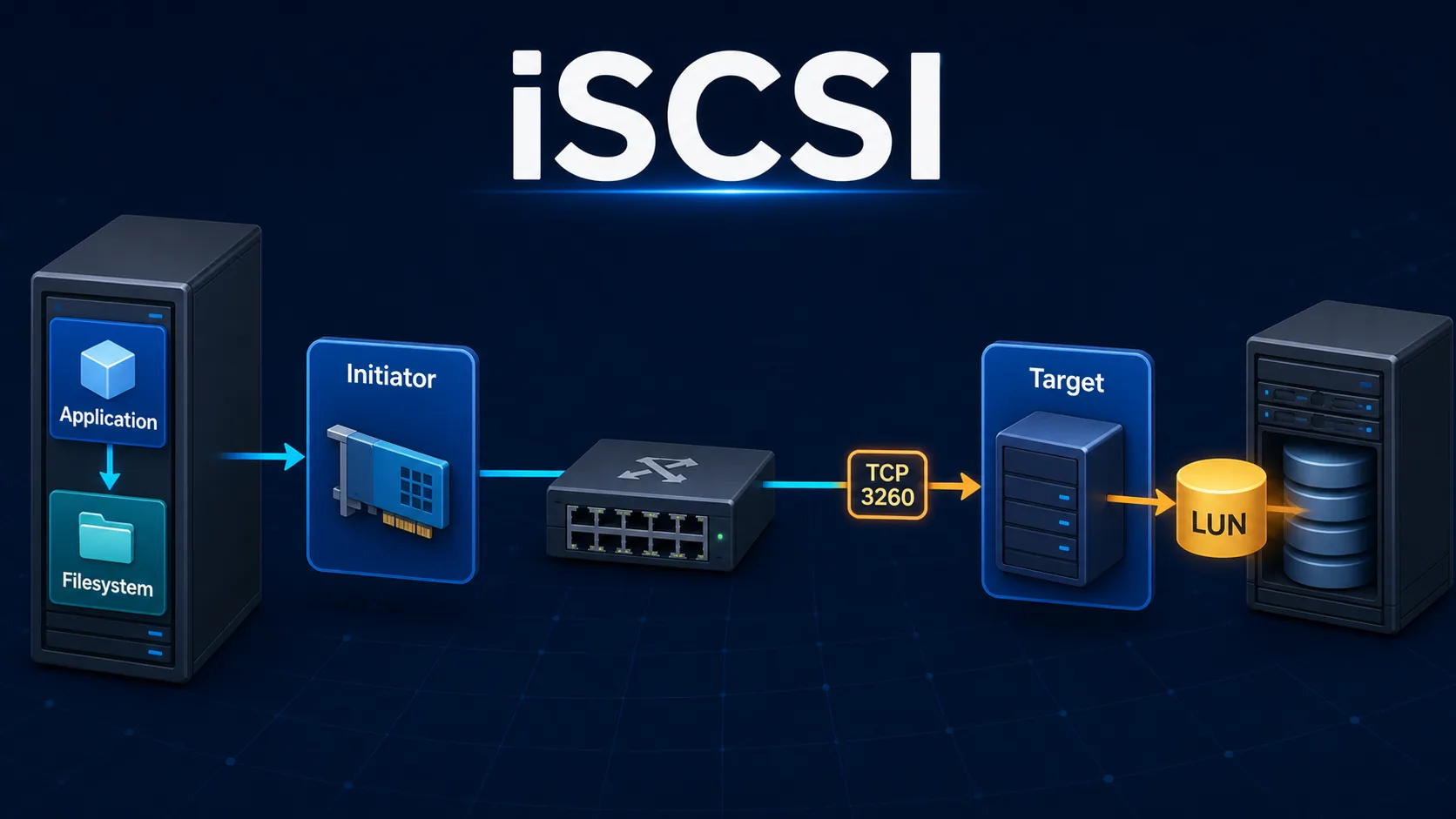
iSCSI in one minute
iSCSI stands for Internet Small Computer Systems Interface. It carries SCSI storage commands inside TCP packets. The client is the initiator; the storage provider is the target.
After login, the target presents one or more logical units, or LUNs. Linux may show a LUN as /dev/sdb; Windows may show it as Disk 1. The operating system treats it much like a locally attached disk.
Table of contents
What does an iSCSI initiator do?
The initiator discovers targets, proves it is authorised, opens an iSCSI session, sends read and write commands, reconnects persistent sessions after restart, and can manage redundant paths when multipathing is enabled.
Software initiator
Open-iSCSI on Linux and Microsoft iSCSI Initiator on Windows use the server's normal network adapter.
Hypervisor initiator
VMware ESXi and other hypervisors can attach shared block storage for datastores and clustered workloads.
Hardware HBA
An iSCSI host bus adapter can offload parts of storage and network processing from the host CPU.
iSCSI vs SMB and NFS
| Question | iSCSI | SMB or NFS |
|---|---|---|
| What is presented? | A raw block device or LUN | Files and directories |
| What does the client see? | A disk | A shared folder or mount |
| Who manages the filesystem? | Usually the initiator | The file server |
| Typical use | Hypervisors, databases, clusters, server volumes | User shares, team files, home directories |
Main iSCSI components and terms
Target and portal
The target exports storage. A portal is its listening IP address and TCP port—normally 192.168.50.10:3260.
IQN
An iSCSI Qualified Name uniquely identifies an initiator or target, for example iqn.2026-08.in.netest:storage.target01.
Backstore and LUN
The backstore is the physical disk, LVM volume, RAID set or image file. The LUN is the block device mapped to the initiator.
ACL and CHAP
An ACL permits a specific initiator IQN. CHAP adds username-and-secret authentication, but does not encrypt traffic.
How an iSCSI write works in real time
- An application asks the local filesystem to save data.
- The operating system converts that operation into block I/O.
- The initiator places the SCSI write command inside an iSCSI PDU.
- TCP carries the PDU across the IP network to port 3260.
- The target writes the blocks to its backend storage and returns a status response.
The application sees a disk operation; the network carries storage commands underneath it.
Lab topology and prerequisites
Target:      192.168.50.10
Linux host:  192.168.50.20
Windows:     192.168.50.30
Target IQN: iqn.2026-08.in.netest:storage.target01
Port: TCP 3260- Use a dedicated, empty target disk such as
/dev/sdb. - Confirm forward and return IP connectivity.
- Permit TCP 3260 only from authorised storage clients.
- Record each initiator IQN before creating target ACLs.
- Use a dedicated storage VLAN in production.
iSCSI Initiator Explained: How Block Storage Works Frequently Asked Questions
What is an iSCSI initiator?
It is the client-side software or hardware that discovers a target, authenticates, opens a session and sends SCSI commands over TCP/IP.
Which port does iSCSI use?
iSCSI targets normally listen on TCP port 3260.
Is iSCSI the same as network file sharing?
No. iSCSI presents a disk-like block device. SMB and NFS present files and directories from a server-owned filesystem.
Can multiple servers use the same LUN?
Only when the operating system, application and filesystem are designed for shared block storage and coordinate access. Ordinary standalone filesystems should not be mounted read-write by unrelated hosts.
Does CHAP encrypt iSCSI traffic?
No. CHAP authenticates a peer. Use isolation or IPsec when the traffic itself must be encrypted.
Sources and next step
Protocol details are defined in RFC 7143. For an implementation reference, see the Red Hat iSCSI target guide.