Cisco Catalyst 9800 WLC Architecture and Configuration
Build a clear mental model of the controller before entering commands: what CAPWAP carries, what every profile controls, and how tags make an SSID appear on an access point.
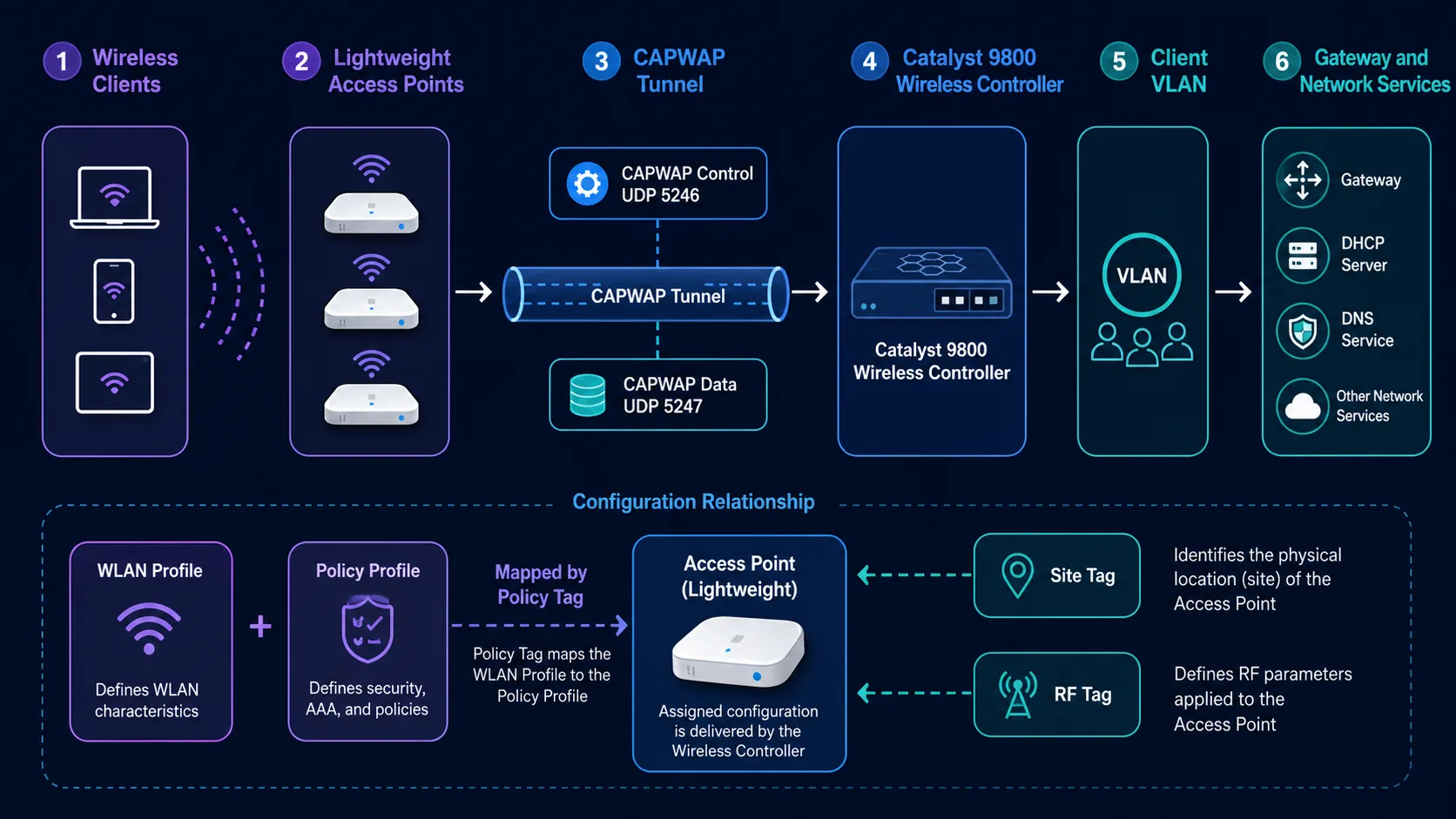
What is a Cisco Catalyst 9800 WLC?
A Cisco Catalyst 9800 Wireless LAN Controller is an IOS XE-based platform that centralizes enterprise wireless control. It manages AP discovery and CAPWAP joins, WLANs, policy profiles, tags, security, RF settings, client sessions and operational assurance.
What a wireless LAN controller does
A Catalyst 9800 centrally configures lightweight access points. It controls SSIDs, WPA2/WPA3 and 802.1X security, VLAN placement, roaming, radio channels, transmit power, QoS and whether client traffic is switched centrally or locally.
The configuration model
WLAN profile
Defines SSID, WLAN ID, Layer 2 security, authentication and radio policy.
Policy profile
Defines client VLAN, switching mode, DHCP handling, ACL, QoS and session policy.
Policy tag
Maps a WLAN profile to a policy profile and delivers that pair to an AP.
Site tag
Defines AP join behavior, local or FlexConnect mode, and the Flex profile.
RF tag
Applies 2.4, 5 and 6 GHz radio profiles, channels, power and data-rate policy.
Access point
Receives one policy, site and RF tag, then advertises the mapped WLANs.
What happens when an AP starts
- The AP receives an IP address, gateway, DNS and optional discovery information.
- It discovers a controller by broadcast, DHCP Option 43, DNS or stored information.
- It forms CAPWAP, and the controller validates certificate, model, software and country.
- The controller applies policy, site and RF tags.
- The AP advertises mapped SSIDs.
- A client authenticates, enters the policy-profile VLAN and requests an IP address.
Central switching or local switching?
Central switching
Client data crosses the CAPWAP tunnel to the controller, then exits through the VLAN on the WLC uplink. It is common on campus.
FlexConnect local switching
CAPWAP control still reaches the controller, but branch client data exits through the AP's local switch and gateway.
A Useful Operational Mental Model
The Catalyst 9800 separates several decisions that older wireless designs often made in one place. The WLAN profile describes the wireless service, the policy profile describes forwarding and access behavior, and the policy tag determines which combination is assigned to an AP. Keeping those responsibilities separate makes large deployments easier to reason about.
When an AP joins, ask three questions: did it reach the controller, did the controller authorize it, and did it receive the expected tags? Those questions divide discovery problems from policy problems. A joined AP with no SSID usually needs a tag or WLAN investigation, not another CAPWAP discovery attempt.
Choose central switching or FlexConnect based on traffic paths, WAN quality, survivability and security policy. The answer can differ by site. Document the decision so a future engineer understands why an AP is expected to tunnel traffic or switch locally.
Implementation Checklist
When reviewing a 9800 design, draw the object relationships before changing settings. Write down which WLAN profile is used, which policy profile supplies forwarding behavior, which policy tag maps them, and which AP or site receives that tag. This small map often reveals a missing association faster than a long configuration dump.
Keep site differences in the data that varies, not in a collection of nearly identical policies. Consistent naming, documented tag assignments and a small test group make it easier to compare one site with another. When a client problem appears, you can then ask whether the policy is wrong or simply assigned to the wrong AP.
Cisco Catalyst 9800 WLC Explained: Architecture and Tags Frequently Asked Questions
What is a Catalyst 9800 WLC?
It is Cisco's IOS XE wireless controller family for centrally managing lightweight access points and wireless services.
Which CAPWAP ports must be permitted?
Permit UDP 5246 for control and UDP 5247 for data between APs and the controller as required by the design.
Why can an AP join but not broadcast the SSID?
The WLAN or policy profile may be disabled, the policy-tag mapping may be missing, or the correct policy tag may not be assigned to the AP.