Catalyst 9800 FlexConnect, RADIUS and WLAN Security
Choose the correct client data path for campus and branch sites, configure FlexConnect local switching, and replace shared passwords with identity-based access.
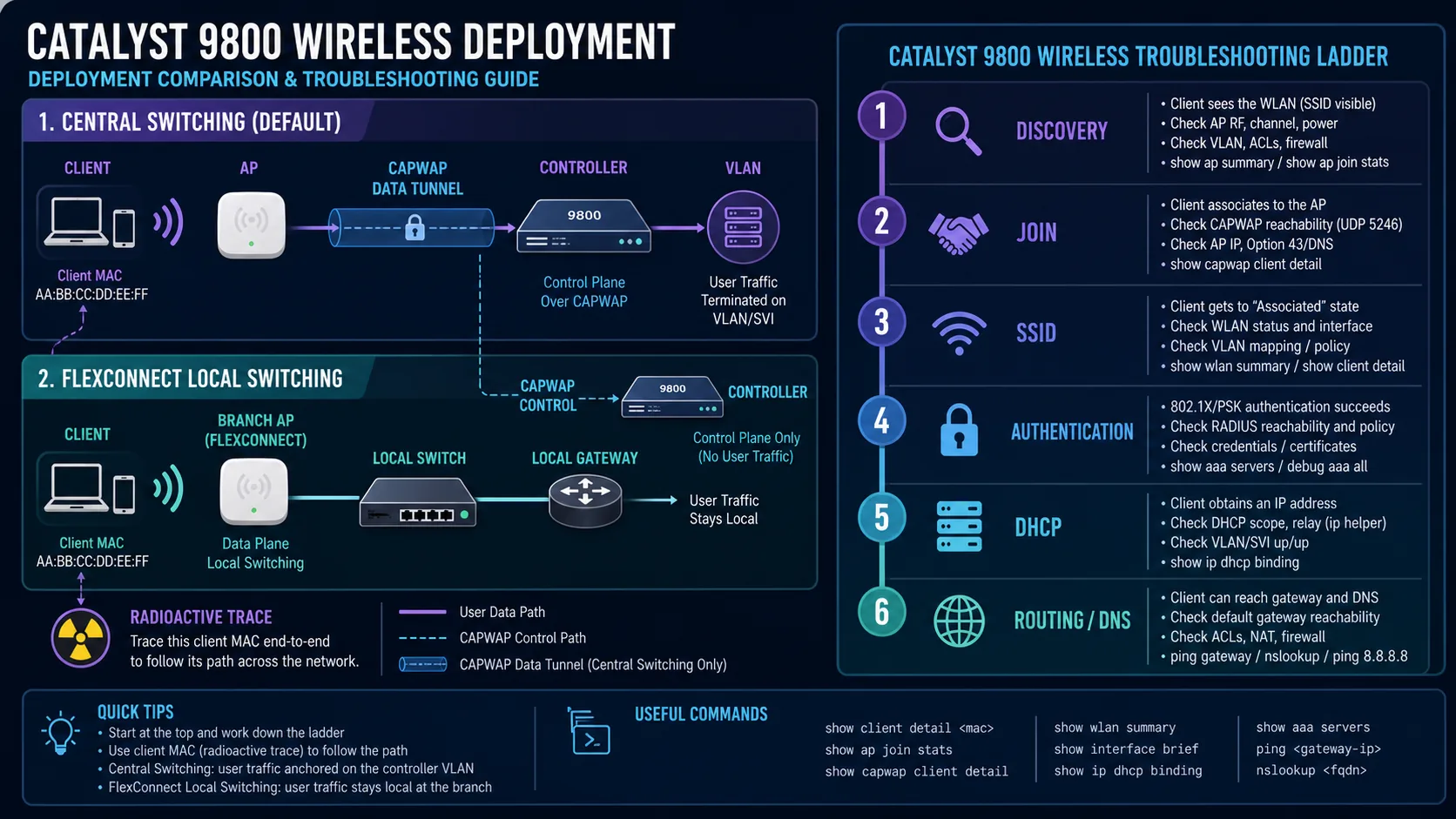
Central switching vs FlexConnect
| Decision | Central switching | FlexConnect local switching |
|---|---|---|
| Client data path | AP → CAPWAP → WLC → VLAN | AP → local switch → branch gateway |
| Control path | CAPWAP to controller | CAPWAP to controller |
| AP switch port | Usually management access VLAN | Trunk with native AP VLAN and client VLANs |
| Best fit | Campus and central enforcement | Branches, WAN efficiency and local survivability |
Configure FlexConnect local switching
configure terminal
wireless profile policy BRANCH-WIFI-POLICY
 no central switching
 vlan 30
 no shutdown

wireless profile flex BRANCH-FLEX-PROFILE
 native-vlan-id 20
 vlan-name WIFI-CLIENTS
 vlan-id 30

wireless tag site BRANCH-SITE-TAG
 flex-profile BRANCH-FLEX-PROFILE
 no local-site

wireless tag policy BRANCH-POLICY-TAG
 wlan NETEST-CORP policy BRANCH-WIFI-POLICY

ap aaaa.bbbb.cccc
 policy-tag BRANCH-POLICY-TAG
 site-tag BRANCH-SITE-TAG
The three essential changes are no central switching, a Flex profile with VLAN mappings, and a site tag with no local-site.
Configure the branch AP port
interface GigabitEthernet1/0/10
 switchport mode trunk
 switchport trunk native vlan 20
 switchport trunk allowed vlan 20,30
spanning-tree portfast trunkMove production users to enterprise authentication
A corporate 802.1X WLAN sends authentication through the WLC to a RADIUS service such as Cisco ISE. The server can return permit or deny, VLAN, downloadable ACL, security group tag, QoS, session timeout or redirect policy.
Controller side
- RADIUS servers and server group
- Authentication and accounting method lists
- WPA2/WPA3-Enterprise WLAN
- Policy profile and policy tag
Identity side
- WLC defined as a network device
- Matching shared secret
- Certificate trust
- Identity and authorisation policies
Production hardening checklist
- Separate WLC, AP, employee, guest, IoT and management networks.
- Restrict GUI and SSH to trusted management subnets.
- Use HTTPS, SSH, SNMPv3, AAA administration, syslog, NTP and backups.
- Use meaningful WLAN, policy, site, RF and AP names.
- Avoid excessive SSIDs; use identity policy and dynamic VLANs.
- Choose a recommended IOS XE release after checking release notes, caveats and AP support.
- Base RF settings on a site survey and real device requirements.
Branch Design Notes
FlexConnect changes where traffic is switched, but it does not remove the need for a clear identity and VLAN design. Decide how a branch behaves during a WAN interruption, where DHCP and gateway services live, and whether authentication is expected to remain available.
For RADIUS troubleshooting, separate transport from policy. An unreachable server is a routing, ACL, DNS or shared-secret problem. A reachable server that rejects a user is an identity, certificate, method or authorization problem. Test those categories one at a time.
Protect local switching with management ACLs, strong AP credentials, secure RADIUS settings and a restricted native VLAN. Test both a normal login and a deliberate failure so operators know what a healthy rejection looks like.
Implementation Checklist
Write down the branch failure behavior before deployment. Decide whether users should keep local access, whether cached identity is permitted, how long it is valid, and which services must remain reachable if the WAN is unavailable. These are design decisions, not settings to discover during an outage.
Test a successful authentication, an invalid credential, an unavailable RADIUS server and a returned authorization attribute. Confirm that each result produces the intended VLAN and access behavior. Save the timestamps and logs so the identity team and network team can compare the same event.
Catalyst 9800 FlexConnect, RADIUS and WLAN Security Frequently Asked Questions
Does FlexConnect remove the controller?
No. The AP remains centrally controlled through CAPWAP; only the configured client data is switched locally.
Why does a FlexConnect AP port need a trunk?
The port must carry the AP management VLAN plus every locally switched wireless-client VLAN.
What can RADIUS assign dynamically?
Depending on the design, RADIUS can return a VLAN, ACL, security group tag, QoS, redirect and session policy.