Zero Trust Network Architecture Explained for Beginners
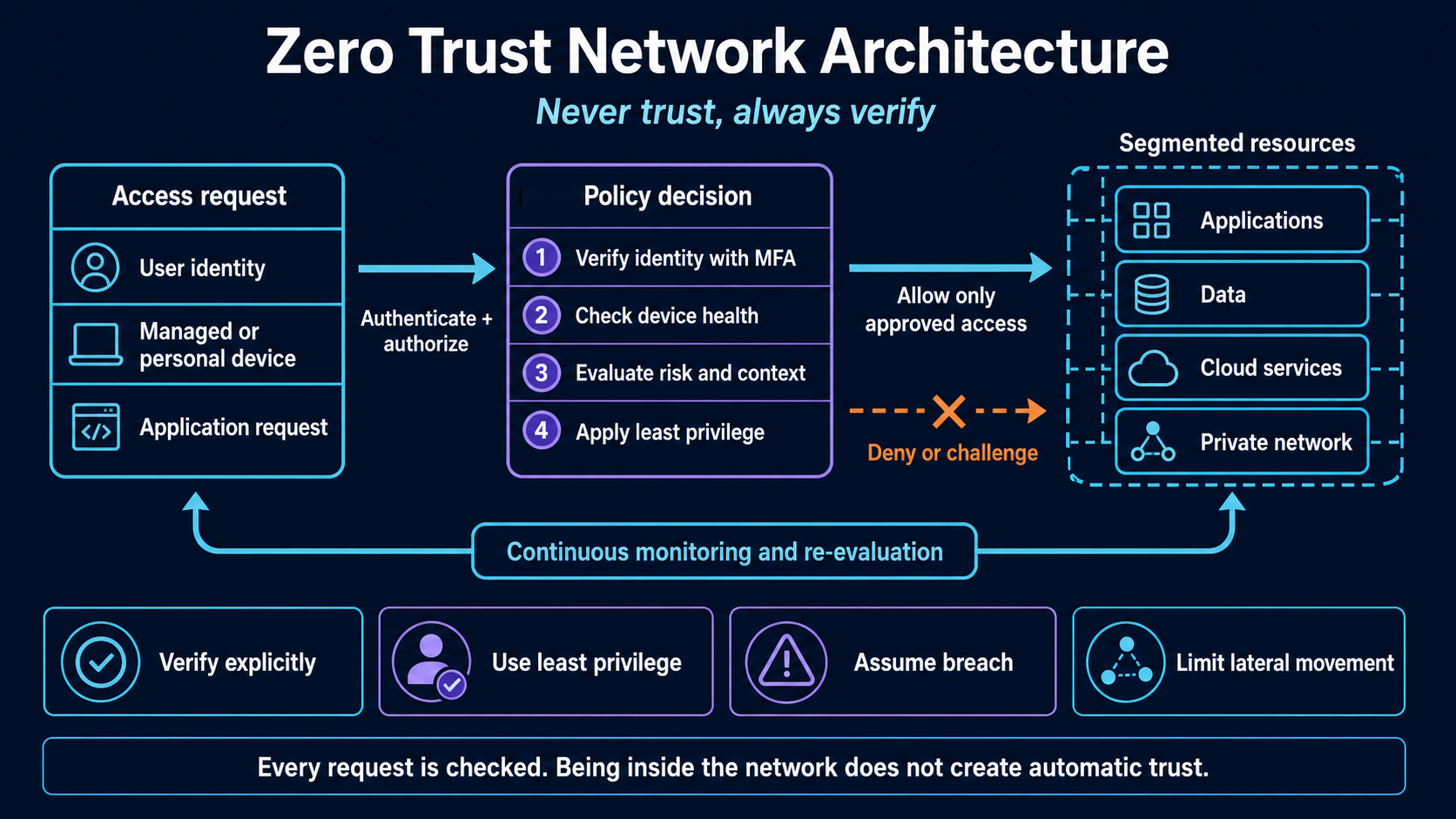
Zero Trust Network Architecture (ZTA) is a cybersecurity model that removes automatic trust based on network location. Every request is evaluated using identity, device health, resource sensitivity, behavior and context before the minimum necessary access is granted.
What Is Zero Trust Network Architecture?
The familiar phrase “never trust, always verify” summarizes the mindset, but a real Zero Trust architecture goes further. It combines identity and access management (IAM), multi-factor authentication (MFA), endpoint security, policy-based access control, workload and network segmentation, data protection, logging and threat analytics.
Zero Trust is not one appliance, subscription or vendor feature. It is a cybersecurity architecture and operating model that coordinates multiple controls around protected resources.
Why Businesses Need Zero Trust Security
Traditional “castle-and-moat” security concentrates trust inside a network perimeter. That assumption breaks down when employees work remotely, contractors use personal devices, applications span multiple clouds, APIs connect services and compromised accounts can appear legitimate.
Hybrid and multicloud
Resources no longer sit behind one firewall or inside one trusted data center.
Remote work
Users connect from unmanaged networks and locations outside enterprise control.
Identity attacks
Stolen passwords and session tokens can bypass a strong network perimeter.
Lateral movement
Broad internal access lets one compromised endpoint reach additional systems.
Zero Trust shifts the central question from “Is this request inside our network?” to “Should this identity, using this device, in this context, perform this action on this resource right now?”
Core Zero Trust Security Principles
Verify explicitly
Authenticate and authorize using identity, device posture, location, behavior, resource sensitivity and current threat signals.
Least privilege access
Grant only the resource, action and duration required for an approved task; review and remove unnecessary privileges.
Assume breach
Design controls as though an attacker may already have a credential, endpoint or foothold, then limit blast radius and lateral movement.
Continuous evaluation
Reassess sessions when risk changes instead of treating a successful login as permanent trust.
Protect resources
Center policy on data, applications, services and workloads rather than treating an entire network segment as the security boundary.
Observe and improve
Collect useful telemetry, detect anomalies, automate response where safe and refine policy using evidence.
How Zero Trust Architecture Works Step by Step
- Identify the request. Determine the human or machine identity, requested resource and intended action.
- Authenticate strongly. Validate credentials and use MFA, phishing-resistant authentication or certificate-based identity where risk warrants it.
- Check device posture. Confirm management status, OS and patch state, endpoint protection, encryption and signs of compromise.
- Evaluate context and policy. Consider location, time, behavior, resource classification, previous activity and threat intelligence.
- Enforce a narrow decision. A policy enforcement point permits only the approved application, data and action—or denies the request.
- Monitor continuously. Record activity and reassess the session when identity, device or behavioral risk changes.
Key Components of a Zero Trust Architecture
| Component | Role in the Zero Trust model | Example controls |
|---|---|---|
| Identity and access management | Establishes user, service and machine identity and applies access policy. | IAM, SSO, MFA, federation, privileged access management |
| Device posture and endpoint security | Measures whether a requesting device is known, managed and sufficiently healthy. | Endpoint management, EDR/XDR, certificates, disk encryption, patch checks |
| Policy engine and administration | Combines policy and real-time signals to make and carry out access decisions. | Risk engines, identity-aware proxies, access policy services |
| Policy enforcement points | Allow, deny, limit or end connections close to protected resources. | ZTNA gateways, firewalls, proxies, API gateways, service mesh controls |
| Segmentation and microsegmentation | Restricts east-west movement and separates applications, workloads and sensitive data. | VLAN/VRF boundaries, host firewalls, workload labels, security groups |
| Monitoring and analytics | Detects risky behavior, validates policy outcomes and supports response. | SIEM, UEBA, network telemetry, endpoint telemetry, threat intelligence |
| Data protection | Classifies sensitive information and controls how it is accessed, used and transferred. | Encryption, DLP, rights management, key management, data classification |
The Five Pillars of Zero Trust Security
A practical Zero Trust framework organizes work across five connected protection areas. Visibility, analytics, automation and governance support every pillar.
1. Identity
Verify people and non-human identities, strengthen authentication and govern privileges.
2. Devices
Inventory endpoints, assess posture and contain unmanaged or compromised devices.
3. Networks
Encrypt traffic, segment environments and inspect communication between trust zones.
4. Applications
Authorize access per application and secure APIs, workloads and service identities.
5. Data
Discover, classify and protect information according to sensitivity and business need.
Zero Trust vs Traditional Network Security
| Area | Traditional perimeter model | Zero Trust security model |
|---|---|---|
| Trust basis | Network location often influences trust | No implicit trust from location or ownership |
| Access scope | Broad network access may follow login or VPN connection | Resource-specific, least-privilege access |
| Verification | Strongest at the perimeter or initial login | Explicit at access time and reassessed during sessions |
| Device state | May be checked inconsistently | Device posture is a regular policy signal |
| Segmentation | Coarse zones and trusted internal networks | Granular segmentation around resources and workloads |
| Breach response | Emphasis on keeping attackers outside | Assumes compromise is possible and limits blast radius |
| Cloud and remote access | Backhaul through a central perimeter is common | Consistent policy can follow users and resources across locations |
Zero Trust does not eliminate perimeter defenses. Firewalls, secure gateways and network controls remain useful, but being “inside” no longer substitutes for explicit authorization.
Zero Trust Network Access (ZTNA) Explained
ZTNA is an access-control capability that connects an authenticated, authorized user or device to a specific private application without placing that requester broadly on the internal network. It is one useful part of a Zero Trust Network Architecture, not the complete architecture.
| Term | Scope | Main purpose |
|---|---|---|
| Zero Trust Architecture (ZTA) | Enterprise-wide strategy covering identities, devices, networks, applications and data | Remove implicit trust and protect resources with consistent, contextual policy |
| Zero Trust Network Access (ZTNA) | Private application access | Provide identity-aware, application-specific connectivity |
| Virtual Private Network (VPN) | Encrypted network tunnel | Connect a remote device or site to another network; authorization still requires careful design |
Benefits of Zero Trust Architecture
Smaller attack surface
Applications and data are exposed only to identities with a verified need.
Reduced lateral movement
Segmentation and narrow permissions constrain what a compromised identity can reach.
Better visibility
Central identity, device and access telemetry helps teams investigate behavior.
Consistent hybrid access
Policy can protect on-premises, SaaS and multicloud resources without assuming one perimeter.
Controlled remote access
Employees, partners and contractors receive time- and resource-limited access.
Data protection support
Granular policy and audit evidence can support compliance and governance programs.
Common Zero Trust Use Cases
| Use case | How Zero Trust helps |
|---|---|
| Remote and hybrid work | Checks identity and device posture before providing application-specific access from any location. |
| Contractor and partner access | Limits third parties to approved resources, time windows and actions without broad network connectivity. |
| Cloud and multicloud security | Applies identity-aware policy to workloads, services and data beyond an enterprise-owned perimeter. |
| Privileged administration | Uses strong authentication, just-in-time privileges, session oversight and narrowly scoped administrative paths. |
| BYOD and unmanaged devices | Uses posture and context to deny, isolate or provide reduced browser-only access. |
| Insider-risk containment | Restricts unnecessary access and improves visibility into unusual data or application activity. |
| Ransomware resilience | Segmentation, least privilege and endpoint signals make large-scale lateral spread more difficult. |
Zero Trust Implementation Guide for Beginners
Do not start by trying to replace the entire network. Begin with a valuable resource and a measurable access workflow, then expand as identity, inventory, telemetry and policy quality improve.
- Define business outcomes. Select risks to reduce, such as remote administrator access, contractor exposure or sensitive-data movement.
- Inventory identities, devices, applications and data. You cannot create precise policy around unknown assets or unmanaged accounts.
- Map transaction flows. Record who needs each resource, from which devices, through which applications, for what purpose and at what sensitivity.
- Strengthen identity. Centralize lifecycle management, require MFA, reduce shared accounts and control privileged access.
- Establish device trust signals. Combine asset inventory, endpoint management, certificates, patch status and detection telemetry.
- Write least-privilege policies. Replace broad groups and permanent rights with specific resources, actions, conditions and time limits.
- Place enforcement near resources. Use ZTNA, proxies, gateways, host controls, cloud security groups or service-mesh policy as appropriate.
- Segment and protect critical paths. Prioritize crown-jewel data, administrative interfaces and high-impact workload communication.
- Monitor, test and tune. Measure denied requests, risky sessions, stale privileges, help-desk impact and incident containment.
- Expand iteratively. Reuse successful patterns across applications and business units while maintaining clear exception governance.
Inventory, MFA, basic device hygiene and centralized logs.
Mapped flows, resource classification and stronger telemetry.
Context-aware access, segmentation and shorter privileges.
Continuous risk decisions, safe automation and measured improvement.
Zero Trust Challenges and Common Mistakes
- Treating Zero Trust as a product: buying ZTNA alone does not address data, workloads, privileged access or governance.
- Automating poor identity data: stale accounts and inaccurate group membership create equally inaccurate policy.
- Ignoring user experience: unnecessary prompts encourage workarounds; use risk-based, phishing-resistant authentication and clear communication.
- Creating policy without flow knowledge: aggressive blocking before dependencies are mapped can interrupt legitimate work.
- Overlooking service identities: APIs, workloads and automation accounts need lifecycle, credential and least-privilege controls too.
- Collecting logs without response: telemetry creates value only when teams can investigate and act on useful signals.
- Using location as the only signal: Zero Trust is context-aware, not simply “trust nothing” or “block the internal network.”
Zero Trust Architecture Frequently Asked Questions
What is Zero Trust Network Architecture?
It is a cybersecurity approach that removes automatic trust based on network location. Identity, device posture, resource sensitivity, context and policy are evaluated before access is granted.
How does Zero Trust security work?
It verifies the requester, checks device and contextual risk, applies least-privilege policy at an enforcement point, then monitors the session for changes that require restriction or termination.
Is Zero Trust a product or a strategy?
It is a strategy and architecture. IAM, MFA, endpoint security, ZTNA, segmentation, data protection and analytics are controls that can support it.
What is the difference between ZTA and ZTNA?
ZTA is the broad enterprise architecture. ZTNA is a narrower technology category that supplies identity-aware access to specific private applications.
How does ZTNA differ from a VPN?
A VPN creates an encrypted network tunnel and may provide broad network reachability. ZTNA usually connects an approved identity and device only to an authorized application, while hiding unrelated resources.
Can a small business implement Zero Trust?
Yes. Start with managed accounts, MFA, endpoint updates, backups, device inventory, least privilege and centralized logging. Segmentation and advanced automation can follow as maturity grows.
Does Zero Trust replace firewalls?
No. Firewalls and segmentation gateways can be policy enforcement points. Zero Trust adds identity, device, application, data and contextual decisions around those network controls.
What does NIST say about Zero Trust?
NIST SP 800-207 describes Zero Trust as moving away from implicit trust based on network location and focusing security on enterprise resources, identities and explicit access decisions.