SIEM Threat Detection and Incident Response Explained
Learn how SIEM technology collects security data, correlates events, supports compliance, and helps security teams detect, investigate, and manage cyber threats faster.
In This Lesson
See how a SIEM turns distributed logs into investigation-ready security evidence. The lesson covers data collection, normalization, detection, triage, tuning, and the handoff to response.
Quick Learning Map
Keep this three-step view in mind as you work through the detailed lesson.
Collect useful telemetry
Prioritize identity, endpoint, network, cloud, application, and control-plane events.
Detect with context
Normalize and correlate events into explainable rules, baselines, and cases.
Investigate and improve
Triage alerts, preserve evidence, measure outcomes, and tune noisy detections.
SIEM Threat Detection and Incident Response Explained at a Glance
Use this summary to establish the big picture before moving into the detailed explanations, commands, and checks.
Core focus
See how a SIEM turns distributed logs into investigation-ready security evidence.
Key connection
Collect useful telemetry → Detect with context → Investigate and improve
Practical outcome
The lesson covers data collection, normalization, detection, triage, tuning, and the handoff to response.
How does SIEM improve threat detection?
A SIEM centralizes events from endpoints, identity systems, network devices, cloud platforms and applications, then correlates those events into prioritized detections. Analysts use the surrounding timeline and context to investigate, contain and document an incident more quickly.
What Is SIEM?
SIEM stands for Security Information and Event Management. A SIEM platform collects logs, events, and security telemetry from many systems, normalizes the data, correlates related activity, and alerts security teams when behavior looks suspicious or violates policy.
The original idea combined two older functions: Security Information Management, which focused on log collection and reporting, and Security Event Management, which focused on real-time event monitoring. Modern SIEM brings both together so a security operations team can see what is happening across endpoints, users, networks, cloud services, applications, and security tools.
Why Is SIEM Important?
Modern environments create more security data than a human team can review manually. Firewalls, identity providers, cloud platforms, servers, endpoint tools, DNS systems, web gateways, VPNs, databases, and applications all produce events that may matter during an attack.
Without SIEM, teams often investigate each system separately and lose time connecting clues. With SIEM, related activity can be grouped into a higher-confidence incident. For example, a suspicious login, unusual privilege change, endpoint malware alert, and outbound connection to a risky destination may become one prioritized investigation instead of four disconnected alerts.
Logs and alerts from different systems are searchable from one place.
Correlation rules and analytics reveal attack patterns that one tool may miss alone.
Retention, reporting, and audit trails support security and regulatory requirements.
How Does SIEM Work?
A SIEM workflow starts with collection. The platform ingests logs and security events from devices and services across the environment. It then parses those events into a common format, enriches them with context, correlates related signals, and applies detections to decide what needs analyst attention.
| Stage | What happens | Why it matters |
|---|---|---|
| Ingest | Collect logs from firewalls, IDS/IPS, EDR, servers, cloud platforms, identity systems, applications, routers, switches, and SaaS tools. | Broad data collection reduces blind spots across the environment. |
| Normalize | Convert different vendor log formats into consistent fields such as source IP, user, device, action, result, and timestamp. | Analysts can search and compare events without learning every raw log format. |
| Correlate | Connect related events across time, systems, users, hosts, and network paths. | Weak signals can become a meaningful incident when viewed together. |
| Alert and report | Generate alerts, dashboards, incident records, compliance reports, and investigation timelines. | Security teams can prioritize response and preserve useful evidence. |
Advanced SIEM deployments may add user and entity behavior analytics, machine learning assisted anomaly detection, threat intelligence enrichment, automated case management, and integrations with SOAR playbooks.
Common SIEM Data Sources
A SIEM becomes more useful as coverage improves. The goal is not to collect every possible log forever, but to collect the events that support detection, investigation, response, and reporting.
- Network security devices: firewalls, web filters, secure web gateways, IDS, IPS, VPN concentrators, WAFs, and DNS security tools.
- Infrastructure: routers, switches, wireless controllers, hypervisors, operating systems, servers, and database platforms.
- Endpoints: EDR, antivirus, operating system event logs, process activity, file changes, and device health signals.
- Identity and access: directory services, MFA systems, IAM platforms, privileged access systems, SSO, and cloud identity logs.
- Cloud and SaaS: audit logs, API calls, configuration changes, storage access, workload events, and administrative activity.
- Applications: authentication attempts, transaction logs, admin actions, errors, API gateway events, and business-critical application activity.
SIEM vs SOAR, EDR, XDR, and SOC
SIEM is often discussed with other security operations technologies. They overlap in daily use, but each solves a different part of the detection and response workflow.
| Technology | Primary focus | How it relates to SIEM |
|---|---|---|
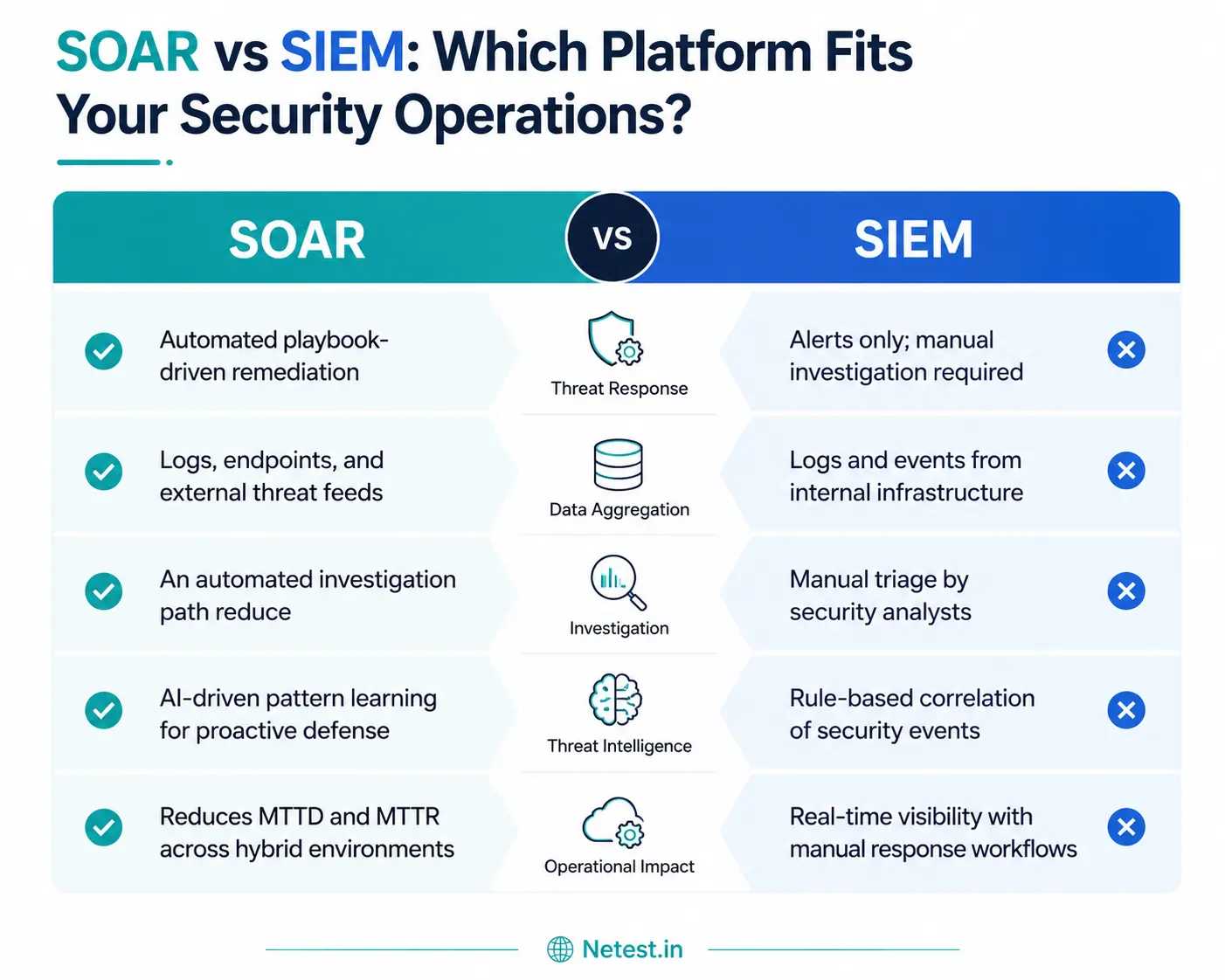
| SOAR | Security orchestration, automation, and response. | SOAR can take SIEM alerts and run playbooks such as enrichment, ticketing, blocking, isolation, or notification. |
| EDR | Endpoint detection and response for workstations, servers, and user devices. | EDR sends endpoint telemetry to SIEM and can receive response actions during an investigation. |
| XDR | Extended detection and response across endpoints, network, email, identity, and cloud layers. | XDR can provide integrated detection across selected controls, while SIEM remains a broader log and event analytics hub. |
| SOC | The people, process, and operating model for cyber defense. | A SOC often uses SIEM as a core platform for monitoring, triage, investigation, reporting, and compliance support. |
Key SIEM Use Cases
Spot abnormal file activity, suspicious processes, privilege abuse, and lateral movement before encryption spreads.
Identify unusual access patterns, data movement, privileged actions, and activity outside normal behavior.
Correlate suspicious emails with user clicks, credential use, endpoint activity, and outbound connections.
Track risky configuration changes, abnormal API calls, exposed storage, account misuse, and administrative activity.
Use flow data, firewall logs, and infrastructure telemetry to distinguish attacks from legitimate traffic changes.
Centralize event retention, access history, incident records, and audit-ready reporting for security controls.
Key Advantages of SIEM
- Faster threat detection: Correlation across many systems helps teams identify suspicious behavior sooner.
- Improved investigation quality: Analysts can search related logs, timelines, users, assets, and alerts from one workspace.
- Reduced operational complexity: Central dashboards and rules reduce manual log collection during incidents.
- Prioritized response: Context such as asset value, user risk, vulnerability exposure, and threat intelligence helps rank alerts.
- Compliance support: SIEM helps document monitoring, log retention, alert handling, and incident response evidence.
- Continuous improvement: Alert tuning, metrics, and post-incident reviews help SOC teams improve detections over time.
SIEM Challenges in Modern Environments
SIEM can be powerful, but it needs careful implementation. A poorly tuned SIEM can become noisy, expensive, and difficult for analysts to trust.
Complex Integration
Every environment has different tools, log formats, applications, cloud platforms, and network segments. SIEM projects need a phased integration plan so the most important security use cases are covered first.
Alert Fatigue
Rules that are too broad can produce false positives. Too many low-value alerts can hide important incidents and slow response. Mature teams tune detections, group related alerts, and measure false positive rates.
Rules Alone Are Not Enough
Traditional rules are useful for known patterns, but modern attacks may avoid simple signatures. SIEM programs should combine rules, threat intelligence, behavior analytics, baselines, vulnerability context, and human review.
Storage and Retention Costs
More data can mean higher cost and slower searches. Teams should define retention by use case, risk, compliance requirements, and investigation value instead of collecting everything with no plan.
Best Practices for Implementing SIEM
- Start with clear objectives: Choose specific use cases such as privileged account monitoring, ransomware detection, VPN anomaly detection, or cloud admin activity.
- Prioritize high-value data sources: Begin with identity, endpoints, firewalls, servers, critical applications, DNS, and cloud audit logs.
- Normalize and enrich events: Add asset ownership, business criticality, user identity, geolocation, vulnerability context, and threat intelligence where useful.
- Tune detections continuously: Review false positives, missed incidents, noisy sources, rule quality, and alert severity on a routine schedule.
- Document response playbooks: Define what analysts should check, when to escalate, what evidence to preserve, and what actions are approved.
- Measure outcomes: Track mean time to detect, mean time to respond, alert volume, case quality, coverage gaps, and recurring root causes.
The Future of SIEM
SIEM is moving from static log search toward more context-aware security operations. The most useful platforms are adding stronger automation, behavior analytics, cloud-native visibility, identity context, threat intelligence, and AI-assisted investigation workflows.
That does not remove the need for skilled analysts. Instead, it changes their focus. Analysts spend less time collecting raw evidence and more time validating risk, understanding attack paths, deciding response actions, and improving detections.
SIEM FAQs
What is SIEM in cybersecurity?
SIEM is a security platform that collects, stores, analyzes, and correlates logs and security events from many systems. It helps teams detect threats, investigate incidents, and produce security reports.
How does SIEM detect threats?
SIEM detects threats by combining log collection, normalization, correlation rules, analytics, behavior baselines, threat intelligence, and alert prioritization. The strongest detections connect events across users, devices, networks, applications, and cloud services.
What is the difference between SOAR and SIEM?
SIEM focuses on event collection, correlation, analysis, dashboards, alerts, and reporting. SOAR focuses on orchestration and automation, such as enriching alerts, opening tickets, blocking indicators, isolating endpoints, or notifying teams.
What is the difference between SOC and SIEM?
A SOC is the security operations team or function responsible for monitoring and responding to threats. SIEM is one of the core tools a SOC uses to centralize visibility and investigation.
Is SIEM only for large enterprises?
No. Large enterprises often have complex SIEM deployments, but smaller organizations can also use cloud SIEM, managed SIEM, or SOC-as-a-Service models to gain centralized monitoring without building everything in-house.
Does SIEM help with compliance?
Yes. SIEM helps with compliance by collecting logs, retaining evidence, monitoring security events, tracking administrative activity, producing reports, and supporting incident investigation records.
What logs should be sent to SIEM first?
Start with logs that support important security use cases: identity and authentication, endpoint alerts, firewall traffic, VPN access, DNS activity, cloud audit logs, critical servers, and business-critical applications.
Can SIEM stop attacks automatically?
SIEM usually detects, correlates, alerts, and supports investigation. Automated blocking or containment is typically handled through integrations with SOAR, EDR, firewalls, identity systems, or other response tools.
SIEM for Enhanced Security: How It Detects and: Tags and Keywords
SIEM, Security Information and Event Management, SIEM security, log management, event correlation, threat detection, security analytics, SOC, SOAR, EDR, XDR, UEBA, incident response, compliance reporting, alert management, cloud SIEM, managed SIEM, cybersecurity monitoring.