What Is SecOps? Security Operations Defined
Learn how SecOps brings security and IT operations together to detect, disrupt, investigate, and respond to cyber threats faster.
In This Lesson
Understand SecOps as the operating model that connects security and IT operations around shared risk. You will see the people, process, telemetry, automation, and measurements needed to make that collaboration work.
Quick Learning Map
Keep this three-step view in mind as you work through the detailed lesson.
Share operational context
Give security and IT teams a common view of assets, identity, change, and risk.
Run a repeatable workflow
Define how alerts are enriched, owned, contained, recovered, and reviewed.
Measure the outcome
Track detection, response, recurrence, coverage, and business impact—not alert volume alone.
What Is SecOps? Security Operations Defined at a Glance
Use this summary to establish the big picture before moving into the detailed explanations, commands, and checks.
Core focus
Understand SecOps as the operating model that connects security and IT operations around shared risk.
Key connection
Share operational context → Run a repeatable workflow → Measure the outcome
Practical outcome
You will see the people, process, telemetry, automation, and measurements needed to make that collaboration work.
SecOps Definition
SecOps, short for Security Operations, is the practice of integrating cybersecurity work with IT operations. Instead of treating security as a separate team that reacts after something breaks, SecOps creates a shared operating model for preventing, detecting, investigating, and responding to threats across the technology environment.
A SecOps program includes people, processes, tools, automations, playbooks, metrics, and the daily workflows used inside or around a Security Operations Center. The goal is cyber resilience: the organization should be able to spot risk early, limit attacker movement, recover cleanly, and improve defenses after every incident.
Why SecOps Emerged
Traditional security operations often struggled because security teams and IT operations teams worked in separate lanes. Security might detect a problem, but infrastructure, identity, endpoint, or application teams were needed to contain and fix it. That separation slowed response and created gaps attackers could use.
SecOps closes that gap by making security a continuous operational discipline. It shifts the organization from reactive alert handling toward proactive monitoring, faster containment, automation, and shared accountability for security outcomes.
Security, network, endpoint, cloud, and operations teams follow common response paths.
Telemetry, threat intelligence, and analytics help teams identify attacker behavior early.
Repeatable investigation and containment steps are standardized to reduce delay and error.
What Does SecOps Do?
SecOps turns security signals into operational action. Teams monitor logs, endpoint activity, identity events, network flows, application behavior, email signals, vulnerability data, and threat intelligence. When suspicious activity appears, SecOps workflows help analysts validate the alert, understand the impact, contain the issue, and coordinate remediation.
Effective SecOps also strengthens the day-to-day security posture. It improves patch prioritization, detection tuning, incident playbooks, user awareness, forensic readiness, audit evidence, and communication between security and technology owners.
| SecOps activity | Purpose | Typical tools |
|---|---|---|
| Monitor | Collect security telemetry from endpoints, networks, cloud services, identities, applications, and logs. | SIEM, EDR, NDR, firewalls, cloud security tools |
| Detect | Find suspicious or malicious behavior using rules, analytics, threat intelligence, and behavior baselines. | SIEM, UEBA, threat intelligence platforms, IDS/IPS |
| Respond | Contain attacks, isolate systems, disable risky accounts, block indicators, and coordinate recovery. | SOAR, EDR, IAM, firewalls, ticketing systems |
| Improve | Use lessons from alerts and incidents to tune detections, improve controls, and reduce repeat risk. | Dashboards, metrics, playbooks, vulnerability scanners |
Common SecOps Challenges
SecOps teams operate under pressure because the attack surface keeps expanding. Cloud services, remote access, BYOD, IoT, operational technology, SaaS applications, exposed APIs, and AI-assisted attacker workflows all create more places to monitor and defend.
1. Tool Sprawl
Security teams often manage many products that produce disconnected alerts. Without integration, analysts lose time switching consoles, manually gathering evidence, and correlating data that should already be connected.
2. Alert Fatigue
High alert volume can bury important incidents among false positives. SecOps programs need prioritization, enrichment, suppression rules, and clear severity models so analysts focus on events that matter.
3. Skills Shortage
Many organizations do not have enough trained analysts, incident responders, detection engineers, and security architects for 24/7 operations. Automation and managed service support can reduce repetitive work, but skilled ownership remains critical.
4. Fast-Moving Threats
Ransomware, credential theft, supply-chain compromise, phishing, cloud misconfiguration, and lateral movement techniques change quickly. SecOps teams must continuously update detections, playbooks, and containment procedures.
Key Components of Modern SecOps
A mature SecOps capability combines trained people, integrated technology, clear process, and continuous improvement. The components below form the operating base for modern security operations.
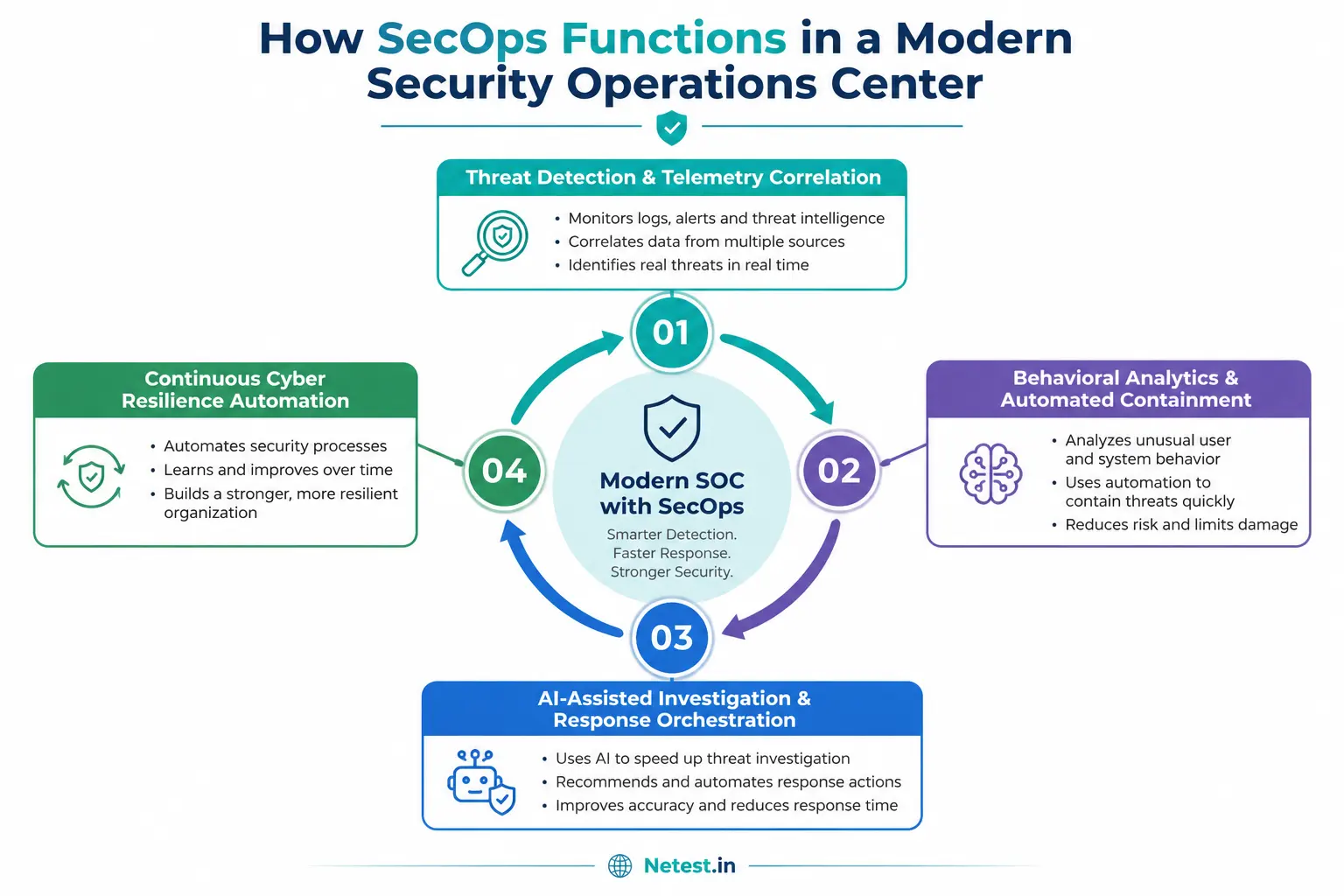
Behavior analytics help identify unusual activity across users, devices, files, networks, email, cloud, applications, and logs.
Common playbooks help teams triage, enrich, contain, remediate, and document incidents consistently.
Integrated SIEM, SOAR, EDR, NDR, firewall, sandbox, and email controls share intelligence and reduce manual work.
Internal teams can be supported by managed detection, SOC readiness assessments, incident response retainers, or SOC-as-a-Service.
SecOps Tools
SecOps tools help teams collect signals, prioritize incidents, automate repeatable work, and respond with evidence. The exact stack varies by organization, but several categories appear in most security operations programs.
- SIEM: Aggregates logs and alerts, correlates events, and creates a central investigation workspace.
- SOAR: Automates enrichment, ticketing, response playbooks, approval workflows, and reporting.
- EDR: Monitors endpoint activity and supports host isolation, process investigation, and remediation.
- NDR: Analyzes network traffic for suspicious flows, lateral movement, command-and-control activity, and data exfiltration.
- Threat intelligence: Supplies context about indicators, attacker techniques, malware families, campaigns, and emerging vulnerabilities.
- Vulnerability management: Identifies weak systems and helps prioritize remediation by exposure, exploitability, and business impact.
How SecOps Works
SecOps works by connecting detection, disruption, investigation, and response into one operational loop. Instead of waiting for a complete manual investigation before action begins, mature teams use analytics and automation to contain obvious risk quickly while analysts continue deeper analysis.
Early Detection and Prevention
SecOps uses sensors and telemetry across endpoints, users, networks, email, cloud services, applications, logs, and dark-web intelligence. These signals help teams detect suspicious behavior early and disrupt threat activity before it spreads.
Unified Threat Response
When detection tools share context, analysts can move faster. An alert from an endpoint can be enriched with identity data, firewall logs, threat intelligence, vulnerability information, and previous incident history. That context makes triage and containment more accurate.
Automation for Resilience
Automation handles repeatable tasks such as evidence collection, severity scoring, user lookup, host isolation, domain blocking, ticket creation, and notification. This improves consistency and lets analysts focus on complex investigation and decision-making.
Unified SecOps Platform View
A unified SecOps platform reduces friction by bringing analytics, automation, investigation, and response into a connected workflow. The value is not only having more tools; it is making sure the tools exchange context and support action from one incident timeline.
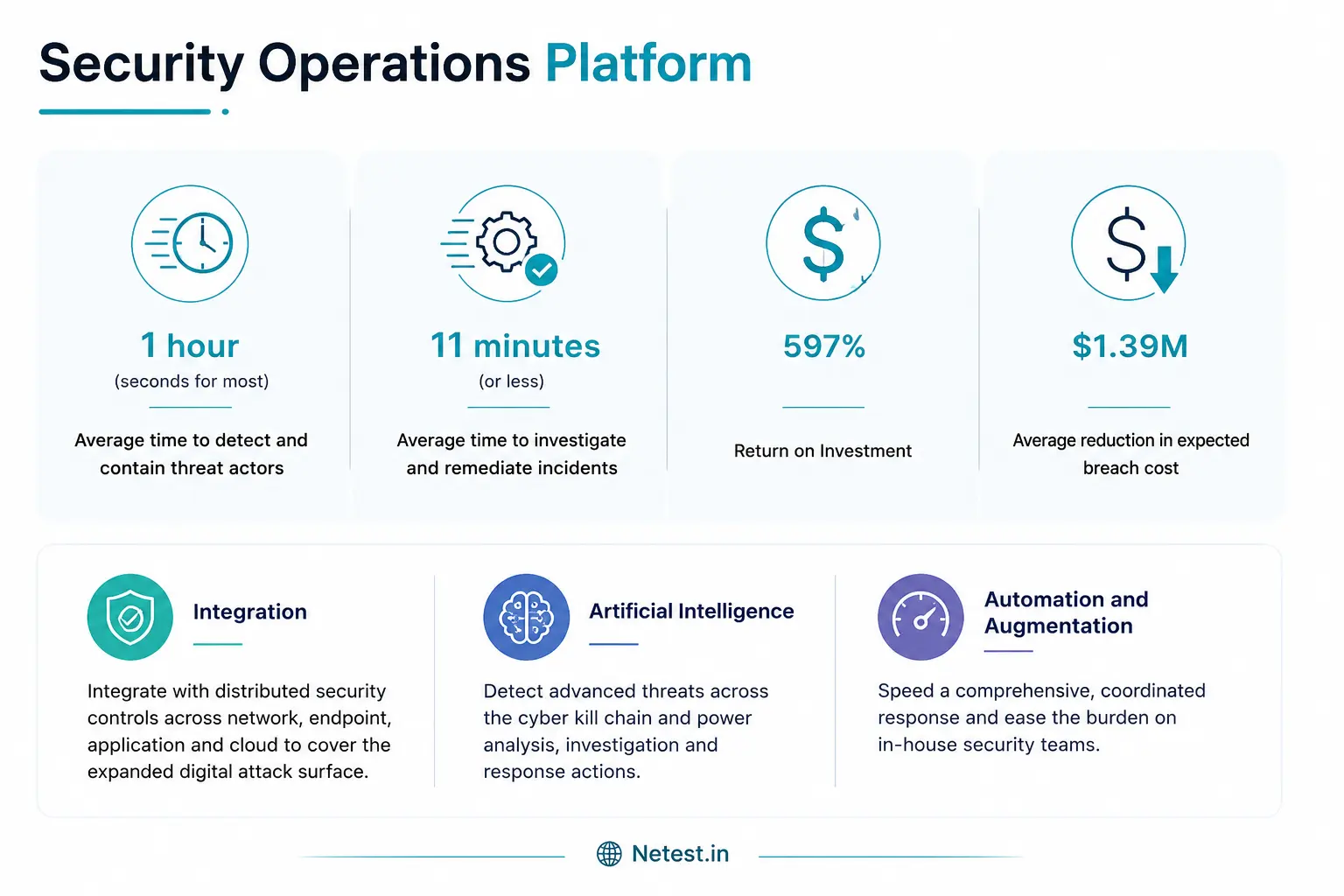
In practical terms, a unified approach helps teams close visibility gaps, reduce duplicate alerts, automate containment, support incident reporting, and measure security operations performance over time.
Benefits of SecOps
SecOps improves cybersecurity by aligning detection, response, remediation, and IT operations around shared workflows. The main benefits are operational speed, better visibility, reduced risk, and stronger resilience.
Correlated telemetry and analytics reveal suspicious behavior that isolated tools may miss.
Playbooks, automation, and cross-team ownership reduce response delay during active incidents.
Continuous monitoring and vulnerability remediation reduce exposure across critical systems.
Automation and integrated tooling reduce repetitive manual work and alert-handling overhead.
Lessons from incidents become better detections, policies, controls, and user guidance.
SecOps Best Practices
- Define ownership: Document who handles monitoring, triage, containment, recovery, communication, and final remediation.
- Integrate telemetry: Collect logs and alerts from identity, endpoint, network, cloud, application, email, and security platforms.
- Use threat intelligence: Convert current attacker behavior into detection rules, hunting queries, blocklists, and response actions.
- Automate carefully: Start with evidence collection and low-risk enrichment, then automate containment actions after playbooks are tested.
- Measure performance: Track mean time to detect, mean time to respond, false positives, alert volume, coverage gaps, and recurring root causes.
- Practice incidents: Run tabletop exercises and technical response drills so security and operations teams know what to do under pressure.
- Improve after every event: Feed incident lessons into detection tuning, patch priorities, user awareness, architecture reviews, and policy updates.
SecOps FAQs
What does SecOps mean?
SecOps means Security Operations. It is the strategy and operating model that brings cybersecurity and IT operations together to improve detection, response, recovery, and cyber resilience.
What are the key components of a SecOps solution?
The key components include trained analysts, continuous monitoring, behavior analytics, SIEM, SOAR, EDR, NDR, threat intelligence, vulnerability management, incident response playbooks, automation, and SOC services when additional coverage is needed.
What are the benefits of a SecOps strategy?
A SecOps strategy improves threat visibility, reduces response time, automates repeatable work, strengthens security posture, supports compliance evidence, and helps teams recover from incidents more consistently.
What is the difference between SecOps and SOC?
SecOps is the broader operating approach that connects security and IT operations. A SOC is the centralized team, function, or facility where monitoring, investigation, and response work is coordinated.
What is the difference between SecOps and DevSecOps?
SecOps focuses on security operations for running environments. DevSecOps focuses on adding security practices throughout the software development lifecycle, from design and code to testing, release, and maintenance.
What does a Security Operations Center do?
A SOC monitors security events, investigates suspicious activity, responds to incidents, coordinates containment and recovery, preserves evidence, and improves defenses based on what analysts learn.
What are the best practices for implementing SecOps?
Start with clear ownership, strong logging, prioritized telemetry, tested response playbooks, automation for repeatable work, threat intelligence, vulnerability management, stakeholder communication, and meaningful SecOps metrics.
What Is SecOps? Security Operations Defined: Tags and Keywords
SecOps, Security Operations, SecOps definition, security operations team, SOC, Security Operations Center, SIEM, SOAR, EDR, NDR, threat intelligence, incident response, vulnerability management, security automation, cyber resilience, threat detection and response.