OSPF LSA Types: Type 1 to Type 11 Explained
Link State Advertisements are the building blocks of the OSPF link-state database. Each LSA type answers a different question: which routers exist, which networks connect them, which prefixes live in another area, and which routes came from outside OSPF.
OSPF LSA Types Explained: Quick Summary
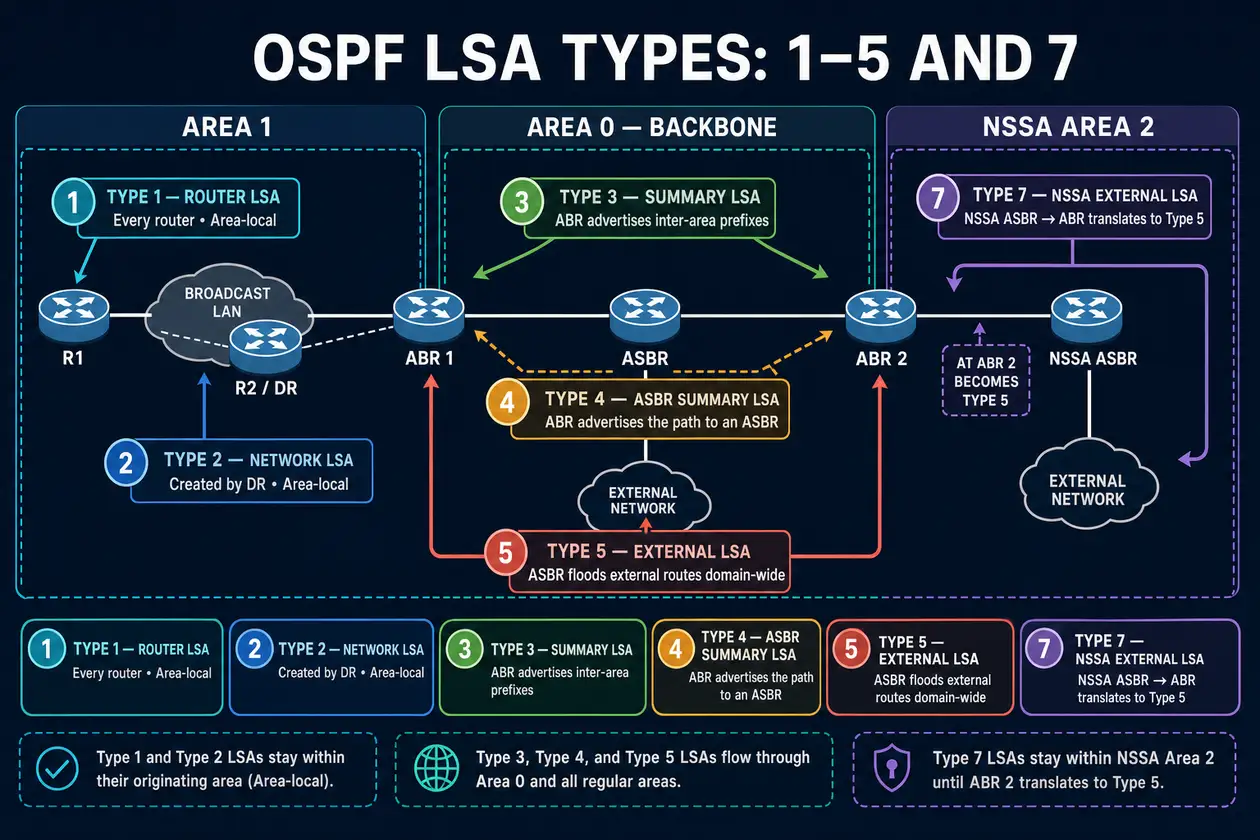
For everyday Cisco OSPF work, focus first on Type 1, Type 2, Type 3, Type 4, Type 5, and Type 7 LSAs. Type 1 and Type 2 describe topology inside an area. Type 3 and Type 4 are created by ABRs for inter-area reachability. Type 5 and Type 7 describe external routes redistributed by ASBRs.
OSPF LSA Types Explained: Table of Contents
1. How LSAs Build the LSDB
OSPF does not pass around complete routing tables like a distance-vector protocol. Instead, routers flood LSAs. When every router in an area has the same LSDB, each router runs SPF locally and installs the best routes from its own point of view.
2. LSA Types Summary Table
This table is the fast revision view. In real troubleshooting, always pair the LSA type with its flooding scope, because area rules decide whether the LSA should even be visible on a router.
| Type | Name | Generated By | Flooding Scope | Route Clue |
|---|---|---|---|---|
| 1 | Router LSA | Every OSPF router | Local area only | Builds intra-area topology |
| 2 | Network LSA | Designated Router | Local area only | Represents a broadcast or NBMA transit segment |
| 3 | Summary LSA | ABR | Advertised into other areas | O IA |
| 4 | ASBR Summary LSA | ABR | Advertised into other areas | Reachability to the ASBR |
| 5 | External LSA | ASBR | OSPF domain except stub areas | O E1 or O E2 |
| 6 | Multicast LSA | MOSPF legacy feature | Not used in modern OSPF | Obsolete in normal enterprise labs |
| 7 | NSSA External LSA | ASBR inside an NSSA | NSSA first, then translated by ABR | O N1 or O N2 |
| 8 | External Attribute LSA | Legacy external attribute use cases | Rarely implemented | Not normally seen on Cisco IOS |
| 9 | Opaque LSA | Router | Link-local | Extension information |
| 10 | Opaque LSA | Router | Area-local | Often used by traffic engineering features |
| 11 | Opaque LSA | Router | AS-wide | Domain-wide opaque information |
3. Type 1 and Type 2 Area-Local LSAs
Type 1 and Type 2 LSAs describe the topology inside a single area. They do not cross an ABR. This is why routers in different areas do not see each other's full internal topology.
- Type 1 Router LSA: Created by every router for each area where it has an OSPF interface. It lists local links, link types, metrics, and ABR or ASBR flags.
- Type 2 Network LSA: Created by the Designated Router on broadcast and NBMA segments. It lists routers attached to that transit network.
- Point-to-point note: Point-to-point links do not elect a DR, so they normally do not create Type 2 Network LSAs.
4. Type 3 and Type 4 Inter-Area LSAs
ABRs hide the internal detail of one area from another area. They advertise reachability instead of flooding Type 1 and Type 2 LSAs across the area boundary.
O IA- Type 3 Summary LSA: Advertises prefixes from one area into another. Routes learned this way appear as
O IA. - Type 4 ASBR Summary LSA: Tells other areas how to reach the ASBR that originated external routes.
- Regeneration behavior: ABRs regenerate inter-area LSAs. They do not simply forward the original Type 1 or Type 2 topology into every area.
5. Type 5 and Type 7 External LSAs
External LSAs appear when a router redistributes routes into OSPF from another source, such as static routes, connected routes, EIGRP, RIP, BGP, or another routing domain.
O E1 or O E2 routes| Route Code | Source LSA | Metric Behavior |
|---|---|---|
O E1 |
Type 5 External LSA | Adds internal OSPF cost to reach the ASBR plus the external metric. |
O E2 |
Type 5 External LSA | Uses the external metric as the primary metric. This is common as the default external type. |
O N1 |
Type 7 NSSA External LSA | NSSA version of E1 behavior before or during Type 7 to Type 5 translation. |
O N2 |
Type 7 NSSA External LSA | NSSA version of E2 behavior. This is common for NSSA redistributed routes. |
6. Type 6, Type 8, and Opaque LSAs
Some LSA types exist for legacy or extension use cases. They are worth recognizing, but they are not the center of normal CCNA or enterprise OSPF troubleshooting.
- Type 6 Multicast LSA: Related to MOSPF, which is not used in modern enterprise OSPF designs.
- Type 8 External Attribute LSA: Rare legacy external-attribute use case, not something most Cisco IOS labs expose.
- Types 9, 10, and 11 Opaque LSAs: Flexible containers for OSPF extensions. Type 9 is link-local, Type 10 is area-local, and Type 11 is AS-wide.
7. Cisco Verification Commands
When a route is missing, do not start with the routing table only. Confirm whether the expected LSA exists, whether the flooding scope is correct, and whether the route code matches the design.
show ip ospf database
Lists LSDB entries grouped by LSA type.
show ip ospf database router
Shows Type 1 Router LSAs and link details.
show ip ospf database network
Shows Type 2 Network LSAs created by DRs.
show ip route ospf
Confirms installed OSPF routes and route codes.
- For intra-area problems, check Type 1 and Type 2 LSAs first.
- For missing
O IAroutes, check ABR behavior and Type 3 LSAs. - For missing external routes, check ASBR redistribution, stub area rules, Type 5 LSAs, or Type 7 to Type 5 translation.