SOC (Security Operations Center): Scalable, Continuous Cyber Defense
Understand what a Security Operations Center is, how it monitors enterprise infrastructure, and how SOC teams defend against internal and external cyber threats.
In This Lesson
Explore how a security operations center turns telemetry and people into continuous detection and response. The lesson covers architecture, roles, workflows, service models, metrics, and scaling decisions.
Quick Learning Map
Keep this three-step view in mind as you work through the detailed lesson.
Collect the right evidence
Bring identity, endpoint, network, cloud, application, and threat context into view.
Triage and respond
Validate alerts, determine scope, contain impact, and coordinate recovery.
Learn and scale
Tune detections, automate safe steps, improve coverage, and measure meaningful outcomes.
SOC (Security Operations Center): Scalable, Continuous Cyber Defense at a Glance
Use this summary to establish the big picture before moving into the detailed explanations, commands, and checks.
Core focus
Explore how a security operations center turns telemetry and people into continuous detection and response.
Key connection
Collect the right evidence → Triage and respond → Learn and scale
Practical outcome
The lesson covers architecture, roles, workflows, service models, metrics, and scaling decisions.
SOC Meaning and Definition
A Security Operations Center, commonly called a SOC, is the central function responsible for monitoring, detecting, investigating, and responding to cyber threats across an organization's digital environment. That environment can include websites, databases, servers, applications, cloud workloads, networks, desktops, data centers, and endpoints.
A SOC does more than watch alerts. It turns raw telemetry into decisions: which events matter, which systems are at risk, which action should happen now, and what the organization should improve after the incident. A mature SOC gives the business a repeatable way to find risk early and act before a security issue becomes a business outage.
For network engineers, the SOC is also where operational evidence becomes security context. Firewall denies, VPN logins, DNS requests, endpoint events, cloud audit logs, and identity changes only become useful when they are correlated with asset value, user behavior, vulnerability exposure, and incident priority.
How Does a SOC Work?
Modern networks produce a huge amount of telemetry. Firewalls, intrusion detection systems, endpoint tools, cloud services, identity platforms, applications, and servers all generate logs and alerts. The SOC brings these signals together so analysts can identify unusual behavior, indicators of compromise, and active attacks.
A typical SOC uses a centralized hub-and-spoke model. The hub is often a SIEM platform that collects and correlates data from many systems. Other tools can include SOAR playbooks, endpoint detection and response, threat intelligence, vulnerability scanners, governance and compliance tools, and behavior analytics.
Ingest logs, alerts, events, network flows, endpoint data, and threat intelligence.
Connect weak signals into meaningful incidents and prioritize the riskiest activity.
Contain threats, isolate systems, preserve evidence, and restore safe operations.
SOC Architecture: What Data Should Feed the SOC?
A SOC is only as strong as the visibility behind it. The best tools will still miss attacks if critical systems are not sending logs, timestamps are inconsistent, assets are unnamed, or alerts lack owner information. Start with the systems that attackers commonly touch first: identity, endpoints, email, internet-facing services, VPN, DNS, firewalls, cloud control planes, and privileged administration paths.
| Telemetry source | What it helps detect | Why it matters |
|---|---|---|
| Identity and access logs | Impossible travel, brute force, MFA fatigue, privilege changes, risky service-account use. | Most modern attacks involve identity misuse at some point. |
| Endpoint and server telemetry | Malware execution, suspicious PowerShell, credential dumping, persistence, ransomware behavior. | Endpoints show what actually ran, changed, or touched sensitive data. |
| Network and firewall logs | Command-and-control traffic, lateral movement, unusual ports, denied traffic patterns, segmentation bypass attempts. | Network paths reveal how an attacker moves and what systems communicate unexpectedly. |
| Email and web security logs | Phishing, malicious attachments, suspicious URLs, business email compromise attempts. | Email remains a common entry point for compromise. |
| Cloud audit logs | Public storage exposure, new keys, risky IAM changes, unusual API calls, data exfiltration paths. | Cloud environments change quickly, so control-plane visibility is essential. |
A practical design rule is simple: every critical asset should answer three questions quickly during an incident: who accessed it, from where, and what changed?
The Role of a SOC Team in Cybersecurity
The SOC team protects digital assets such as customer records, employee data, intellectual property, brand systems, business applications, and production infrastructure. During an incident, the SOC becomes the coordination point for security, IT, application, network, legal, compliance, and leadership stakeholders.
The team is usually organized around clear responsibilities so alert triage, investigation, containment, recovery, and reporting do not depend on one person. Common SOC roles include:
| Role | Primary responsibility |
|---|---|
| SOC manager | Manages analysts, processes, tooling, reporting, escalation, and alignment with the CISO or security leadership. |
| Security analyst | Monitors alerts, investigates suspicious activity, identifies affected users or hosts, and starts containment work. |
| Threat hunter | Proactively searches for advanced threats that bypass automated detection or hide inside normal-looking activity. |
| Security engineer | Designs, tests, integrates, and maintains security tooling and architecture across networks, endpoints, cloud, and applications. |
| Forensic investigator | Collects evidence from compromised or damaged systems and reconstructs what happened during a security event. |
| Incident response lead | Coordinates communication, escalation, decision-making, and recovery steps during major incidents. |
SOC Analyst Tiers and Escalation
Many SOCs use analyst tiers so routine triage and advanced investigation do not compete for the same attention. Tier 1 analysts validate and enrich alerts. Tier 2 analysts investigate confirmed incidents, scope impact, and coordinate containment. Tier 3 analysts handle threat hunting, malware analysis, detection engineering, and complex incidents that require deeper technical work.
10 Key Functions Performed by a SOC
1. Take Stock of Available Resources
The SOC needs a clear inventory of what it protects and what it uses to protect it. Protected resources can include endpoints, servers, applications, cloud services, user identities, databases, IoT devices, and partner-facing systems. SOC tooling can include SIEM, EDR, firewalls, vulnerability scanners, threat intelligence, SOAR, and ticketing systems.
Visibility is the foundation. Without accurate inventory and telemetry, blind spots can hide attackers, misconfigurations, exposed services, and unmonitored assets.
2. Strengthen SOC Readiness
No team can prevent every attack, so readiness matters. SOC preparation includes understanding current threats, maintaining response plans, documenting escalation routes, planning disaster recovery, and testing what happens when systems, users, or critical applications are affected.
Preventive maintenance is part of readiness. Firewall rules, detections, blocklists, allowlists, patches, application controls, endpoint policies, and recovery plans must be reviewed regularly because attacker methods keep changing.
3. Continuous Proactive Monitoring
A SOC monitors continuously so suspicious activity can be identified early. Tools can look for known malicious patterns, abnormal behavior, risky authentication events, endpoint compromise indicators, suspicious network flows, or traffic that should not exist between zones.
Automation helps with scale. SIEM, EDR, IDS, IPS, and SOAR tools can trigger alerts, enrich them with context, and start repeatable response actions without waiting for a human to manually collect every detail.
4. Alert Ranking and Management
Security tools can generate hundreds or thousands of daily alerts. The SOC filters false positives, groups related alerts into incidents, assigns severity, and decides which alerts require immediate action. Good prioritization protects analyst time and prevents important incidents from getting buried. Severity should consider asset criticality, exploitability, confidence, user privilege, exposure, and whether the activity is spreading.
5. Threat Response
When a real threat is confirmed, the SOC acts quickly. Response can include isolating endpoints, blocking IP addresses or domains, disabling accounts, terminating malicious processes, stopping suspicious connections, deleting unsafe files, or escalating to infrastructure and application teams.
The goal is to contain the threat while minimizing business disruption. Strong response procedures let the organization continue operating while security teams remove the danger.
6. Recovery and Remediation
After containment, the SOC helps restore clean systems, validate that the attacker no longer has access, review affected data, and confirm normal service. For ransomware and destructive attacks, this can involve restoring from backups made before the compromise.
7. Log Management
Logs are essential evidence. The SOC collects, stores, searches, and correlates logs from endpoints, firewalls, servers, identity platforms, operating systems, cloud services, and applications. Logs show healthy baselines and reveal deviations that may indicate compromise.
8. Root-Cause Analysis
After an incident, the SOC answers the practical questions: what happened, how it happened, where it started, what was affected, and what must change. Root-cause analysis turns an incident into a prevention opportunity by improving controls, policies, detections, or user awareness.
9. Security Refinement and Improvement
A SOC improves continuously. Teams tune detections, review false positives, measure mean time to detect and respond, update playbooks, improve dashboards, and add new controls as attacker techniques evolve. The roadmap should change as the organization and threat landscape change.
10. Compliance Management
Many organizations must meet external requirements such as GDPR, HIPAA, PCI DSS, or industry-specific security rules. A SOC supports compliance by collecting evidence, enforcing monitoring practices, investigating security events, and helping translate policy into repeatable operational steps.
SOC Workflow: From Alert to Lesson Learned
A useful SOC workflow is predictable enough for speed but flexible enough for real incidents. The goal is not just to close tickets. The goal is to reduce uncertainty, contain risk, and improve the environment after every meaningful event.
Validate whether the alert is real, duplicate, expected activity, or a false positive.
Identify affected users, hosts, accounts, network paths, applications, and time range.
Disable accounts, isolate endpoints, block indicators, or apply temporary network controls.
Remove persistence, patch exploited weaknesses, rotate secrets, and close exposed paths.
Restore services, validate clean operation, and monitor closely for recurrence.
Update detections, playbooks, asset data, controls, and user guidance based on lessons learned.
Types of SOC Models
SOC design is not one-size-fits-all. The right model depends on budget, risk, staffing, geography, regulatory needs, and how much control the organization wants to keep internally.
| Model | How it works | Best fit |
|---|---|---|
| Internal or dedicated SOC | The organization uses its own people, processes, and tools to run security operations. | Teams that need full control, deep internal knowledge, and direct ownership of security operations. |
| Virtual SOC | Analysts work remotely without a single physical command room. | Distributed teams, cloud-first organizations, and companies with remote security staff. |
| Global SOC | A larger structure coordinates multiple SOCs across regions or business units. | Large enterprises with regional operations, follow-the-sun coverage, and complex governance. |
| Co-managed SOC | Internal staff and an external provider share monitoring, triage, investigation, or response duties. | Organizations that want internal context plus outside scale or specialized expertise. |
Common SOC Deployment Models
In-house SOC
An in-house SOC keeps knowledge and control inside the organization. It can be highly customized and deeply integrated with business workflows, but it usually requires significant investment in people, tools, training, and 24/7 operations.
Hybrid SOC
A hybrid SOC outsources selected work, such as level-one alert triage, while internal teams handle sensitive investigations and remediation. This model can improve coverage, but it depends on clear escalation, strong documentation, and tested communication paths.
Managed Security Services Provider (MSSP)
An MSSP monitors systems and security events for customers and alerts them when suspicious activity is detected. It is often used by teams that need monitoring coverage but cannot build a full SOC immediately.
SOC-as-a-Service (SOCaaS)
SOCaaS provides outsourced security operations with established analysts, technology, processes, and faster rollout. It can reduce operational complexity, but organizations still need internal owners for remediation, decision-making, and service-level management.
What Are the Benefits of a SOC?
The main benefit of a SOC is stronger security through continuous monitoring and faster response. A SOC helps detect threats sooner, investigate them with more context, and respond consistently across the environment.
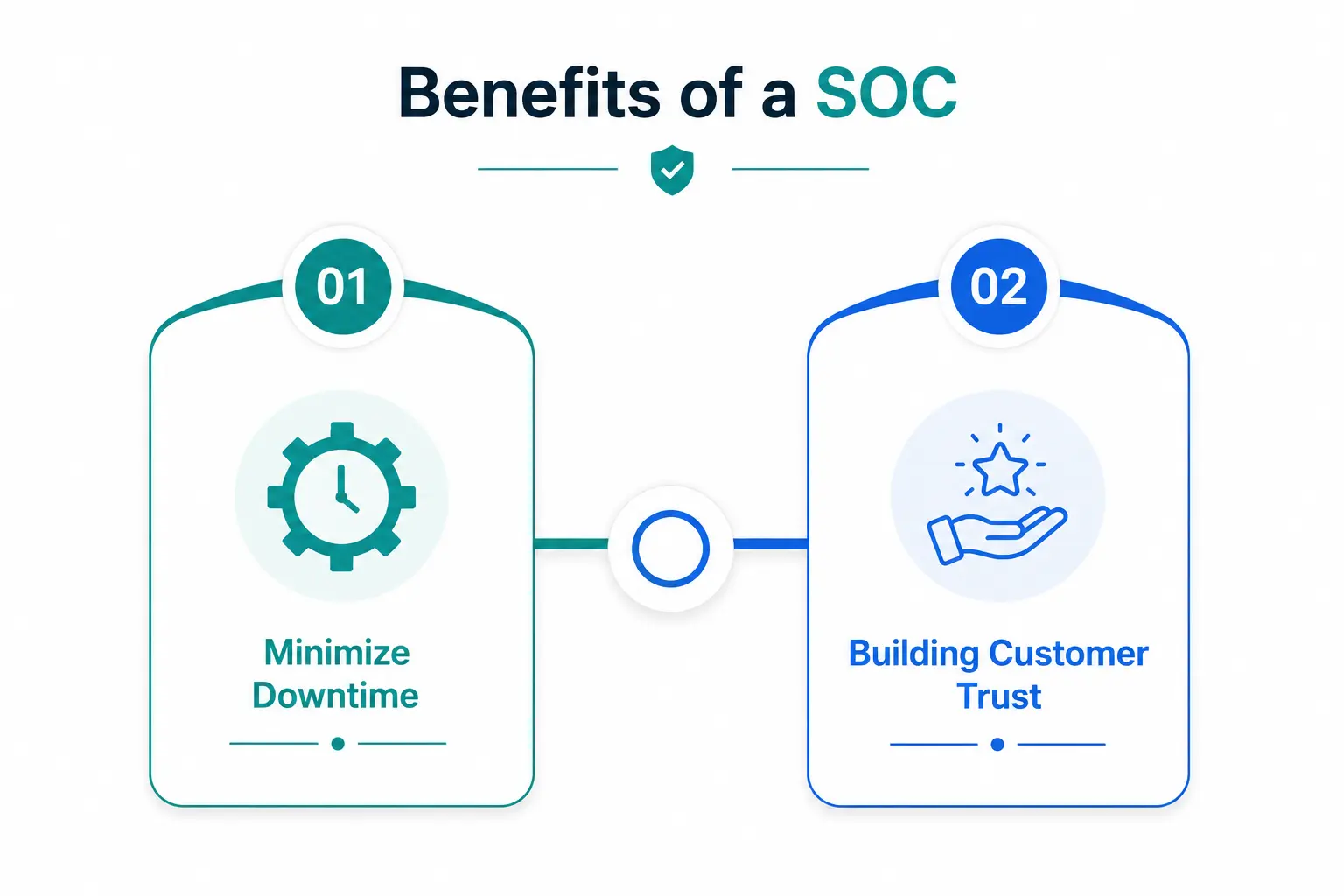
Threats are detected and triaged faster, reducing the chance that an incident turns into a prolonged outage.
Continuous monitoring helps protect customer data, brand reputation, and business-critical systems.
Lessons from incidents, alerts, and logs become improvements to controls, policies, and architecture.
SOC records, investigations, and monitoring processes can provide evidence for regulatory and internal requirements.
SOC Metrics That Actually Matter
SOC reporting should help leaders make decisions, not just count alerts. Useful metrics show whether coverage is improving, whether response is getting faster, and whether recurring risks are being removed.
| Metric | What it tells you | Watch out for |
|---|---|---|
| MTTD | Mean time to detect a real threat after activity begins. | A low number is meaningless if key systems are not monitored. |
| MTTR | Mean time to respond, contain, and move toward recovery. | Response time depends on authority, automation, and business approvals. |
| False positive rate | How much analyst time is spent on alerts that do not matter. | Over-tuning can hide weak signals, so measure detection gaps too. |
| Critical asset coverage | Percentage of important systems sending reliable logs and alerts. | Coverage should include identity, endpoint, network, cloud, and application layers. |
| Repeat incident rate | Whether the same root causes keep appearing. | Repeated incidents usually mean remediation is not reaching ownership teams. |
SOC Challenges
SOC teams must defend against a constantly changing threat landscape while keeping operations efficient. Three common challenges are especially important.
1. Cybersecurity Skills Shortage
Many organizations struggle to hire and retain enough skilled security staff. A shortage of analysts, engineers, and incident responders can increase risk, slow investigations, and make 24/7 coverage difficult.
2. Too Many Alerts
More tools can create more alerts. Without tuning, automation, enrichment, and prioritization, teams can waste time on false positives while serious activity waits in the queue.
3. Operational Overhead
Security tools that are not integrated create manual work and duplicated effort. A SOC needs unified workflows so analysts can move from alert to evidence to response without switching through disconnected systems all day.
SOC Best Practices
- Communicate with stakeholders: Build a practical understanding of business priorities, sensitive systems, unacceptable downtime, and incident communication expectations.
- Connect to threat intelligence: Use current intelligence sources to track new attacker techniques, malware campaigns, vulnerabilities, and indicators of compromise.
- Apply threat updates: Convert intelligence into updated detections, blocked indicators, tuned rules, and tested response procedures.
- Automate repeatable work: Use automation for enrichment, ticket creation, evidence collection, containment, and reporting where the process is stable.
- Address cloud visibility: Monitor cloud identities, workloads, storage, APIs, configuration changes, and cross-account access paths.
- Measure performance: Track detection accuracy, mean time to detect, mean time to respond, false positives, coverage gaps, and recurring root causes.
- Maintain incident playbooks: Create clear playbooks for phishing, malware, ransomware, credential theft, data exposure, insider risk, DDoS, and cloud misconfiguration.
- Keep asset context current: Enrich alerts with asset owner, environment, business criticality, internet exposure, vulnerability status, and data sensitivity.
- Run tabletop exercises: Test who makes decisions during a major incident before the pressure is real.
Boost Resilience with 24/7 SOC Coverage
Cyber threats can appear at any time. Continuous SOC coverage helps security teams identify and respond before a threat spreads across endpoints, cloud workloads, identity systems, or business applications. Organizations can run their own SOC, choose a managed model, or combine both approaches depending on risk, budget, staffing, and response requirements.
The strongest SOC programs combine skilled people, current intelligence, reliable tooling, tested playbooks, and clear ownership for remediation. Technology creates visibility, but the process and team turn that visibility into action.
Trending SOC FAQs
What does a SOC do every day?
A SOC reviews alerts, investigates suspicious activity, hunts for threats, tunes detections, coordinates response, tracks unresolved risk, preserves evidence, and reports security posture to the business.
Which tools are commonly used in a SOC?
Common SOC tools include SIEM, SOAR, EDR or XDR, IDS and IPS, firewalls, vulnerability scanners, threat intelligence platforms, email security, cloud security logs, identity logs, packet capture, and ticketing systems.
What is the difference between SOC and NOC?
A Network Operations Center focuses on uptime, performance, connectivity, and service-level targets. A Security Operations Center focuses on cyber threats, vulnerabilities, incidents, and risk reduction.
What are SOC Tier 1, Tier 2, and Tier 3 analysts?
Tier 1 analysts triage and enrich alerts. Tier 2 analysts investigate confirmed incidents, scope impact, and coordinate containment. Tier 3 analysts handle threat hunting, detection engineering, malware analysis, and complex response.
What are the most important SOC metrics?
Useful SOC metrics include mean time to detect, mean time to respond, false positive rate, critical asset coverage, incident closure time, escalation quality, detection coverage, and repeat incident rate.
Should a company build an in-house SOC or use SOC-as-a-Service?
An in-house SOC gives more control and internal context. SOC-as-a-Service can provide faster 24/7 coverage and specialist skills. Many organizations choose a hybrid model so internal teams keep ownership while an external provider adds scale.
How does a SOC respond to ransomware?
The SOC validates the alert, isolates affected systems, disables compromised accounts, blocks command-and-control indicators, preserves forensic evidence, identifies the entry point, coordinates restore activity, and watches for reinfection.
What is a SOC maturity model?
A SOC maturity model measures how well the SOC performs across visibility, staffing, detection engineering, automation, incident response, threat hunting, metrics, compliance, and continuous improvement.
SOC (Security Operations Center): Scalable,: Tags and Keywords
Security Operations Center, SOC, SOC cybersecurity, SOC team roles, SOC analyst tiers, SIEM, SOAR, EDR, XDR, threat intelligence, threat hunting, incident response, ransomware response, log management, root-cause analysis, SOC workflow, SOC metrics, MTTD, MTTR, SOC maturity model, SOCaaS, MSSP, hybrid SOC, compliance management, 24/7 security monitoring.