Network Access Control (NAC): How It Works and Use Cases
Learn how NAC authenticates users and devices, checks endpoint posture, enforces access policies, and helps organizations control BYOD, IoT, guest, contractor, and unknown device access.
In This Lesson
See how network access control identifies endpoints, evaluates posture, and assigns appropriate access. Use cases and implementation guidance connect policy to real onboarding and exception handling.
Quick Learning Map
Keep this three-step view in mind as you work through the detailed lesson.
Identify the endpoint
Combine user, device, certificate, location, and connection context.
Evaluate policy
Check ownership, posture, risk, and the access level required.
Enforce and review
Assign a role or segment, monitor the session, and handle exceptions safely.
Network Access Control (NAC): How It Works and Use Cases at a Glance
Use this summary before moving into the detailed explanations, examples, commands, and checks.
Core focus
See how network access control identifies endpoints, evaluates posture, and assigns appropriate access.
Key connection
Identify the endpoint → Evaluate policy → Enforce and review
Practical outcome
Use cases and implementation guidance connect policy to real onboarding and exception handling.
What is network access control?
Network Access Control (NAC) identifies users and devices, checks whether they meet security policy, and then permits, limits, quarantines or denies network access. A NAC system commonly combines authentication, device posture, authorization and continuous visibility.
Network Access Control Meaning
Network Access Control, often shortened to NAC, is a security approach that decides who and what can connect to a network. It checks the identity of users, the trust level of devices, the health of endpoints, and the access policy that applies before allowing full connectivity.
NAC is also called network admission control. In practical terms, it helps answer three important questions every time something connects: who is this user, what is this device, and what should it be allowed to reach?
How Does NAC Work?
A NAC system discovers devices, identifies users, evaluates endpoint posture, assigns an access policy, and then enforces that policy through network infrastructure such as switches, wireless controllers, VPN gateways, firewalls, and identity systems.
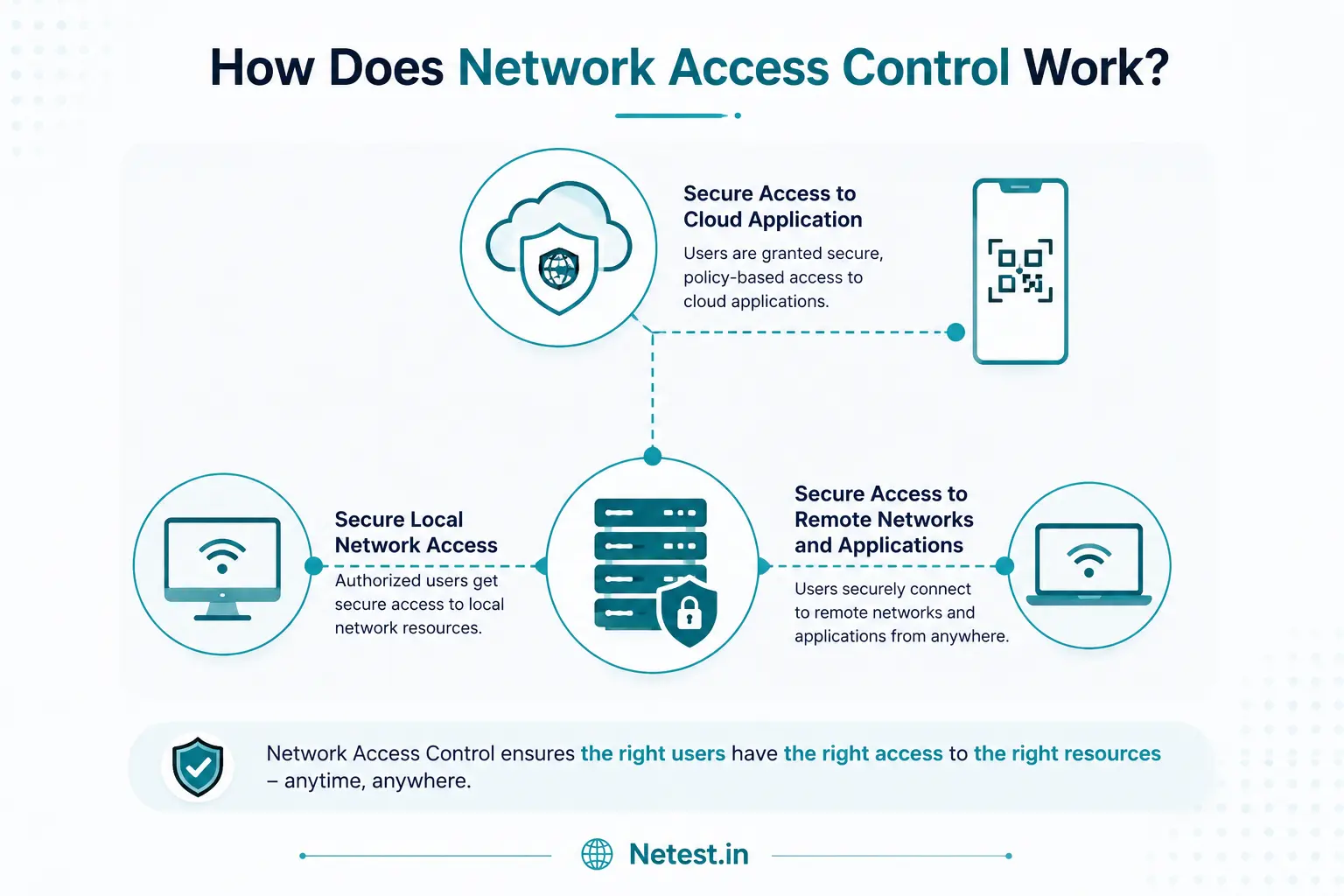
| Step | What NAC checks | Possible result |
|---|---|---|
| Discover | Detect a new endpoint connecting through wired, wireless, VPN, or remote access paths. | The device is added to inventory and prepared for classification. |
| Authenticate | Validate user identity, device identity, certificates, directory membership, or guest credentials. | The user or device is accepted, challenged, or denied. |
| Profile | Identify device type, operating system, ownership, location, risk level, and expected behavior. | The device is mapped to a category such as employee laptop, printer, camera, guest phone, or unknown endpoint. |
| Assess posture | Check security requirements such as antivirus, EDR status, disk encryption, patch level, firewall status, and compliance state. | Healthy devices get normal access; risky devices may be restricted or remediated. |
| Enforce policy | Apply access rules based on identity, role, device type, posture, location, and business need. | NAC allows, blocks, segments, rate-limits, redirects, or quarantines the connection. |
Advantages of Network Access Control
Grant access based on identity, role, group, device type, and business requirement.
Check whether endpoints meet security requirements before giving them normal access.
Place guests, contractors, IoT devices, servers, and employees into appropriate access zones.
Detect unmanaged endpoints and prevent them from freely reaching sensitive systems.
Quarantine risky devices, open tickets, trigger alerts, or apply remediation workflows.
Maintain a living inventory of users, devices, access levels, and connection history.
Common NAC Use Cases
Bring Your Own Device (BYOD)
BYOD lets employees use personal devices for work, but it also introduces unmanaged risk. NAC can authenticate the user, identify the device, check posture, and assign limited or role-based access instead of trusting every personal endpoint equally.
Internet of Things (IoT) Devices
Cameras, sensors, printers, badge readers, kiosks, and building systems often lack the same security controls as laptops. NAC can profile these devices and restrict them to only the network resources they need.
Guest and Contractor Access
Visitors, consultants, partners, and temporary workers need convenient access without broad internal reach. NAC supports guest portals, sponsorship workflows, time-limited access, and separate network segments.
Unknown Device Detection
NAC helps find devices that were never formally approved, including rogue endpoints, unmanaged switches, unauthorized wireless access points, and forgotten assets.
Zero Trust Access Enforcement
NAC supports zero trust by continuously validating identity, device state, context, and policy instead of relying only on the fact that something is connected to the internal network.
Key NAC Capabilities
| Capability | What it does | Why it matters |
|---|---|---|
| Policy life-cycle management | Creates, updates, and enforces policies as users, roles, devices, and business needs change. | Access control stays aligned with current operations instead of becoming stale. |
| Device profiling | Identifies endpoint type, operating system, owner, network location, and normal behavior. | Different devices can receive different access without manual classification. |
| Guest access | Provides onboarding, captive portals, sponsor approval, and limited access for temporary users. | Guests can connect without exposing core business systems. |
| Posture checks | Evaluates patch level, endpoint security, encryption, compliance status, and configuration health. | Risky devices can be remediated before they reach sensitive systems. |
| Quarantine and remediation | Moves suspicious or noncompliant endpoints into a restricted network with repair instructions or automated workflows. | Potential threats are contained without requiring manual switch-by-switch changes. |
| Security integrations | Shares context with SIEM, SOAR, firewalls, EDR, identity platforms, and ticketing systems. | Access control becomes part of a broader detection and response process. |
Why Is NAC Important?
Networks now include managed laptops, personal phones, IoT devices, remote users, cloud-connected systems, contractors, and partner devices. Manually tracking and authorizing every endpoint does not scale. NAC gives security and network teams a repeatable way to discover, validate, and control access.
- Improved security: Unauthorized or noncompliant devices can be blocked before they reach sensitive resources.
- Lower attack surface: Segmentation limits what a compromised device can access.
- Operational efficiency: Automated discovery and policy enforcement reduce manual device-by-device work.
- Better user experience: Known healthy devices can receive smoother access while risky endpoints are handled separately.
- Asset visibility: NAC acts as a continuous inventory of connected users, devices, and access levels.
- Compliance support: Access logs, policy decisions, posture results, and segmentation evidence help audits and investigations.
Types of Network Access Control
Pre-admission NAC
Pre-admission NAC evaluates the user and device before granting access. It can check credentials, certificates, posture, endpoint security tools, device ownership, and policy match before allowing normal connectivity.
Post-admission NAC
Post-admission NAC continues monitoring after access is granted. If a device becomes risky, changes location, violates policy, or begins suspicious activity, NAC can reduce access, move it to quarantine, or trigger a response workflow.
Agent-based NAC
Agent-based NAC uses software installed on endpoints to collect detailed posture information. It can provide strong compliance checks, but it works best for managed devices.
Agentless NAC
Agentless NAC relies on network discovery, identity integrations, traffic behavior, fingerprinting, and infrastructure signals. It is useful for unmanaged, IoT, guest, and contractor devices where installing an agent is impractical.
NAC Implementation Best Practices
- Start in monitor mode: Discover devices and understand real traffic before enforcing strict blocks.
- Define device categories: Separate employees, guests, contractors, IoT, printers, servers, unmanaged devices, and unknown endpoints.
- Map access to business need: Avoid one broad internal network for every device type.
- Integrate identity: Connect NAC with directory services, MFA, certificates, and identity governance tools.
- Plan remediation paths: Give users clear recovery steps when a device fails posture checks.
- Tune policies carefully: Roll out enforcement by site, VLAN, SSID, device group, or risk category to avoid avoidable outages.
- Feed security operations: Send NAC events to SIEM or SOAR so unusual access decisions can become investigations.
Network Access Control FAQs
What is Network Access Control (NAC)?
NAC is a security method that controls who and what can connect to a network. It validates identity, evaluates device posture, and applies access policies before or after connection.
What are the advantages of NAC?
NAC improves visibility, blocks unauthorized devices, supports BYOD and guest access, segments risky endpoints, automates quarantine workflows, and helps security teams enforce access policies consistently.
Why is NAC important for BYOD?
BYOD devices are often outside direct IT control. NAC can identify personal devices, validate the user, check basic posture, and limit access so unmanaged devices do not receive the same trust as corporate endpoints.
How does NAC help with IoT security?
NAC can discover and profile IoT devices, assign them to restricted segments, and prevent them from accessing systems they do not need. This reduces risk from weak or unmanaged IoT endpoints.
What is pre-admission NAC?
Pre-admission NAC checks identity and device posture before network access is granted. Noncompliant or unknown devices can be blocked, redirected, or placed into a limited network.
What is post-admission NAC?
Post-admission NAC monitors users and devices after access is granted. If behavior or posture changes, NAC can restrict access, quarantine the endpoint, or trigger security workflows.
Is NAC the same as zero trust?
No. NAC is a control that supports zero trust, especially at the network access layer. Zero trust is the broader strategy of continuously verifying users, devices, applications, and context before granting access.
What Is Network Access Control (NAC)?: Tags and Keywords
Network Access Control, NAC, network admission control, BYOD security, IoT device security, guest access, contractor access, endpoint posture, device profiling, network segmentation, quarantine, zero trust access, identity-based access, network security policy.