Top 10 Network Automation Tools in 2026
Compare ten leading platforms for automating campus, data center, cloud, WAN and application delivery networks—and learn how to choose the right stack for your environment.
In This Lesson
Start with the selection criteria, explore all ten tools, compare their strongest use cases, and finish with a secure adoption checklist.
Quick Learning Map
Use this three-step model before comparing product names or feature lists.
Define the domain
Decide whether you need campus, data center, WAN, cloud, security or application-delivery automation.
Match the control model
Choose among vendor controllers, multi-vendor orchestration, configuration automation and infrastructure as code.
Validate the outcome
Require testing, approvals, rollback, telemetry and audit evidence before scaling changes.
Network Automation Tools at a Glance
The strongest choice depends on the operational domain, vendor mix, desired source of truth and security requirements—not on a single feature checklist.
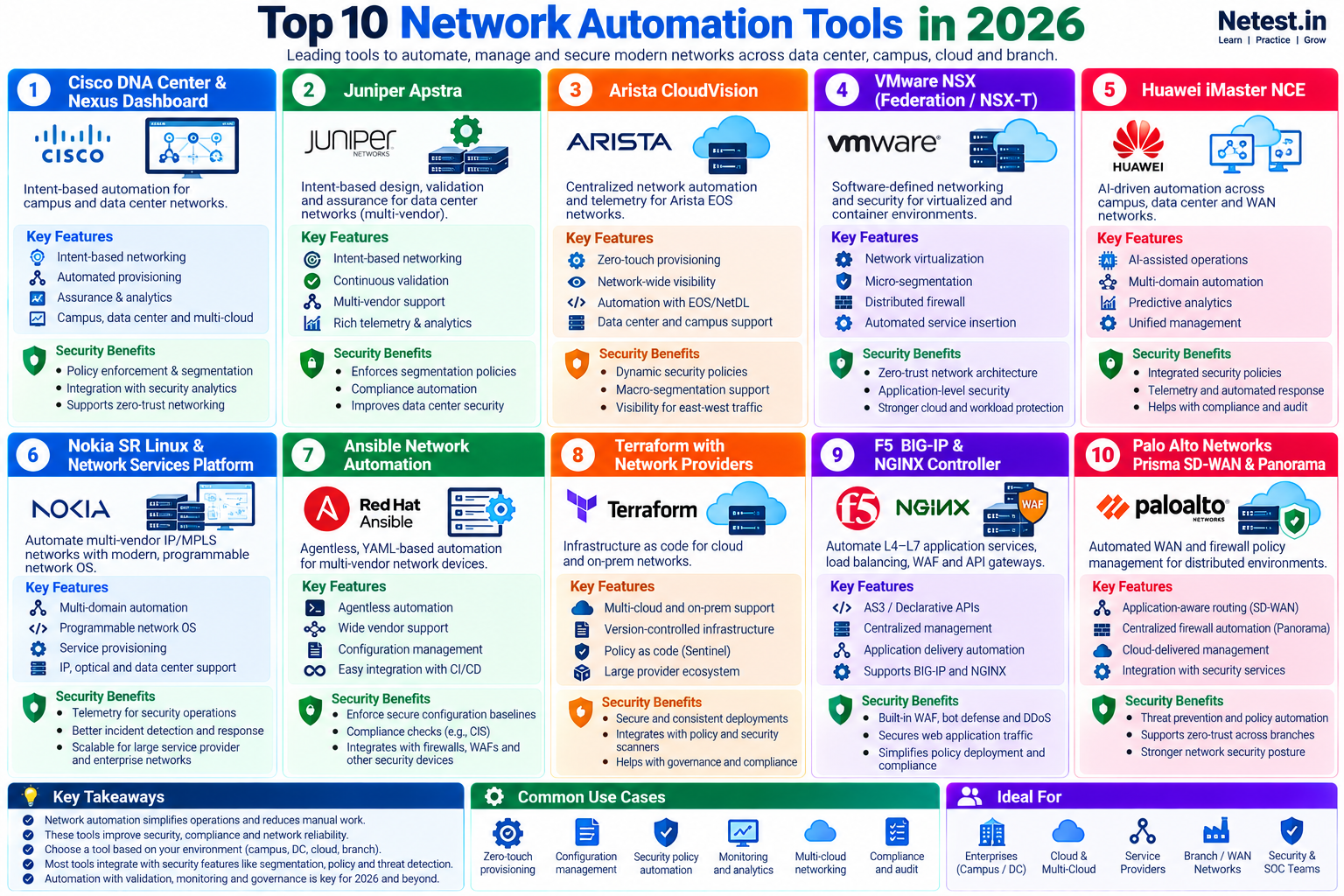
How to Compare Network Automation Tools
Network automation products solve different layers of the problem. A controller optimized for one vendor’s campus fabric is not a direct substitute for an agentless configuration tool, and neither necessarily replaces an infrastructure-as-code workflow for cloud networking.
Environment coverage
Map campus, data center, branch, WAN, cloud, security and application delivery domains before shortlisting tools.
Operating model
Decide whether intent-based control, declarative resources, playbooks or API-driven orchestration best fits the team.
Safety and evidence
Look for pre-change validation, approvals, scoped credentials, rollback, drift detection, telemetry and auditable results.
Top Network Automation Tools 1–5
1. Cisco Catalyst Center and Nexus Dashboard
Best fit: Cisco-focused campus and data center environments. Catalyst Center supports intent-based campus policy, provisioning and assurance, while Nexus Dashboard coordinates data center fabric operations and visibility.
Security value: Central policy, segmentation, identity integrations and analytics can support zero-trust and compliance workflows. Confirm the required licenses, supported platforms and cross-domain integrations for the planned release.
2. Juniper Apstra
Best fit: Intent-based data center fabric design and operations, including environments that need multi-vendor support. Apstra focuses on defining intended state, validating designs and continuously checking the deployed fabric.
Security value: Consistent segmentation policy and telemetry help expose drift and strengthen change assurance. Validate hardware support and external security integrations during a proof of concept.
3. Arista CloudVision
Best fit: Arista EOS environments that need centralized provisioning, network-wide state, telemetry and repeatable change control across data center or campus networks.
Security value: Macro-segmentation and detailed state history can support policy enforcement and incident investigation. Third-party and multi-cloud coverage may require additional integrations.
4. VMware NSX Automation
Best fit: Software-defined networking and security for virtualized and containerized workloads. NSX APIs and policy constructs automate logical networks, gateways and service insertion.
Security value: Distributed firewalling and micro-segmentation place controls close to workloads. Check current product naming, packaging, platform compatibility and migration guidance before committing.
5. Huawei iMaster NCE
Best fit: Controller-led automation across campus, data center and WAN domains, especially where unified management and AI-assisted operations are priorities.
Security value: Centralized policy, telemetry and analytics can support compliance and automated response. Availability, integrations and permitted deployment options can vary by region.
Top Network Automation Tools 6–10
6. Nokia SR Linux and Network Services Platform
Best fit: Service-provider and large-enterprise IP, MPLS, optical and data center operations. SR Linux exposes programmable interfaces, while NSP provides multi-domain service automation and assurance.
Security value: Automated provisioning and telemetry can feed operational and SOC workflows. Confirm which security functions are native and which depend on partner products.
7. Red Hat Ansible Automation Platform
Best fit: Agentless, multi-vendor configuration and operational workflows expressed as readable YAML playbooks. Mature collections cover many network and security platforms.
Security value: Version-controlled playbooks can enforce baselines, collect evidence and automate firewall or WAF changes. Build tests, peer review and rollback around every production workflow. Start with our Ansible network automation guide.
8. Terraform with Network Providers
Best fit: Declarative lifecycle management for cloud networking and supported on-premises or SD-WAN resources. Plans expose proposed infrastructure changes before application.
Security value: Policy as code and CI checks can catch unsafe routes, security groups and resource settings. Protect state files, pin providers and understand each provider’s lifecycle behavior. Review our Terraform fundamentals.
9. F5 BIG-IP and NGINX Automation
Best fit: L4–L7 application services such as load balancing, traffic policy, WAF and API delivery. Declarative APIs help teams deploy repeatable application configurations.
Security value: Automated WAF and traffic controls can reduce inconsistent application protection. Keep controller, schema, service and platform versions aligned.
10. Palo Alto Networks Prisma SD-WAN and Panorama
Best fit: Distributed branch, WAN and firewall policy operations. Prisma SD-WAN handles application-aware connectivity, while Panorama centralizes policy and device management.
Security value: Consistent policy deployment, threat-prevention profiles and cloud-managed operations can improve branch security. Test rule ordering, templates and rollback across representative sites.
Network Automation Tools Comparison
This matrix compares primary fit rather than declaring one universal winner. Exact capabilities depend on edition, integrations and release.
| Tool | Primary environment | Automation model | Notable strength |
|---|---|---|---|
| Cisco Catalyst Center / Nexus Dashboard | Cisco campus and data center | Intent and controller APIs | Integrated policy, assurance and fabric operations |
| Juniper Apstra | Data center fabrics | Intent-based networking | Design validation and continuous assurance |
| Arista CloudVision | Arista data center and campus | Central state and APIs | Telemetry and change control |
| VMware NSX | Virtual and container workloads | Policy and APIs | Micro-segmentation and distributed services |
| Huawei iMaster NCE | Campus, data center and WAN | Controller and analytics | Multi-domain management |
| Nokia SR Linux / NSP | Provider and large IP/MPLS networks | Programmable NOS and orchestration | Service automation across network domains |
| Ansible | Multi-vendor devices and services | Agentless playbooks | Readable, flexible operational workflows |
| Terraform | Cloud and supported network resources | Declarative infrastructure as code | Plans and resource lifecycle management |
| F5 BIG-IP / NGINX | Application delivery | Declarative APIs | L4–L7 services and security policy |
| Prisma SD-WAN / Panorama | Branch, WAN and firewalls | Central policy and cloud management | Application-aware routing and security operations |
How to Choose the Right Network Automation Tool
Mostly one vendor?
A vendor controller can expose deeper assurance, topology and policy capabilities than a general-purpose tool.
Many vendors?
Ansible or an orchestration layer can standardize common workflows while preserving platform-specific modules where needed.
Cloud-first?
Terraform can manage declared resources, with Ansible or APIs handling post-provisioning and operational actions.
Score each candidate against API quality, supported versions, source-of-truth integration, idempotency, pre-checks, rollback, secrets handling, RBAC, audit logs, telemetry, community or vendor support, licensing and staff skills. Run a proof of concept using one real workflow and a failure scenario—not only a successful demo.
For a staged adoption plan, follow the network automation roadmap. Teams building foundational skills can also use the Python network automation lab path.
Secure Network Automation Checklist
- Keep intended configuration in version control and require peer review for production changes.
- Use least-privilege service accounts, short-lived credentials and an approved secrets manager.
- Validate syntax, topology assumptions, policy impact and device reachability before deployment.
- Start with a limited canary group, define stop conditions and test rollback before scaling.
- Collect change records, diffs, controller events and post-change health evidence in a central audit trail.
- Separate ownership so two tools cannot silently manage the same object or policy.
- Continuously compare intended and observed state to detect drift or out-of-band changes.
Network Automation Tools Frequently Asked Questions
What is the best network automation tool in 2026?
There is no universal best tool. The right choice depends on your network domains, vendors, source of truth, workflows, security controls and team skills.
Is Ansible or Terraform better for network automation?
Ansible is often stronger for device configuration and operational workflows, while Terraform is designed to declare and manage infrastructure resources and their lifecycle. Many teams use both.
What should enterprises evaluate before choosing a network automation platform?
Evaluate platform coverage, APIs, multi-vendor support, validation, rollback, secrets handling, role-based access, audit logs, integrations, licensing and the operating skills required.
Can network automation improve security?
Yes. Automation can enforce approved baselines, reduce configuration drift, accelerate policy deployment and produce audit evidence, but unsafe workflows can also spread errors quickly.
Can multiple network automation tools be used together?
Yes. A common architecture combines a source of truth, an orchestrator, vendor controllers, infrastructure as code, CI/CD validation and monitoring, with clearly defined ownership boundaries.