SONiC vs. Cisco NX-OS vs. Arista EOS: Which Data Center NOS Wins in 2026?
A real-world comparison of three leading network operating systems for modern leaf-spine, EVPN-VXLAN and AI data center fabrics, with clear recommendations for enterprise, white-box and GPU environments.
In This Lesson
Meet the three contenders, compare the operational trade-offs that matter, then match each platform to the teams and fabrics where it is strongest.
Quick Learning Map
Use three decisions to turn a product comparison into an operating-model choice.
Set your constraints
Balance hardware freedom, licensing, support expectations and the cost of building in-house expertise.
Match the team
Choose the Linux and automation model of SONiC, familiar Cisco operations, or EOS simplicity and consistency.
Validate the fabric
Test EVPN-VXLAN, telemetry, failure recovery and RoCE behavior on the exact hardware and software release.
SONiC, Cisco NX-OS and Arista EOS at a Glance
All three can run serious EVPN-VXLAN fabrics. The meaningful differences are hardware choice, operational consistency, automation culture, support model and long-term total cost.
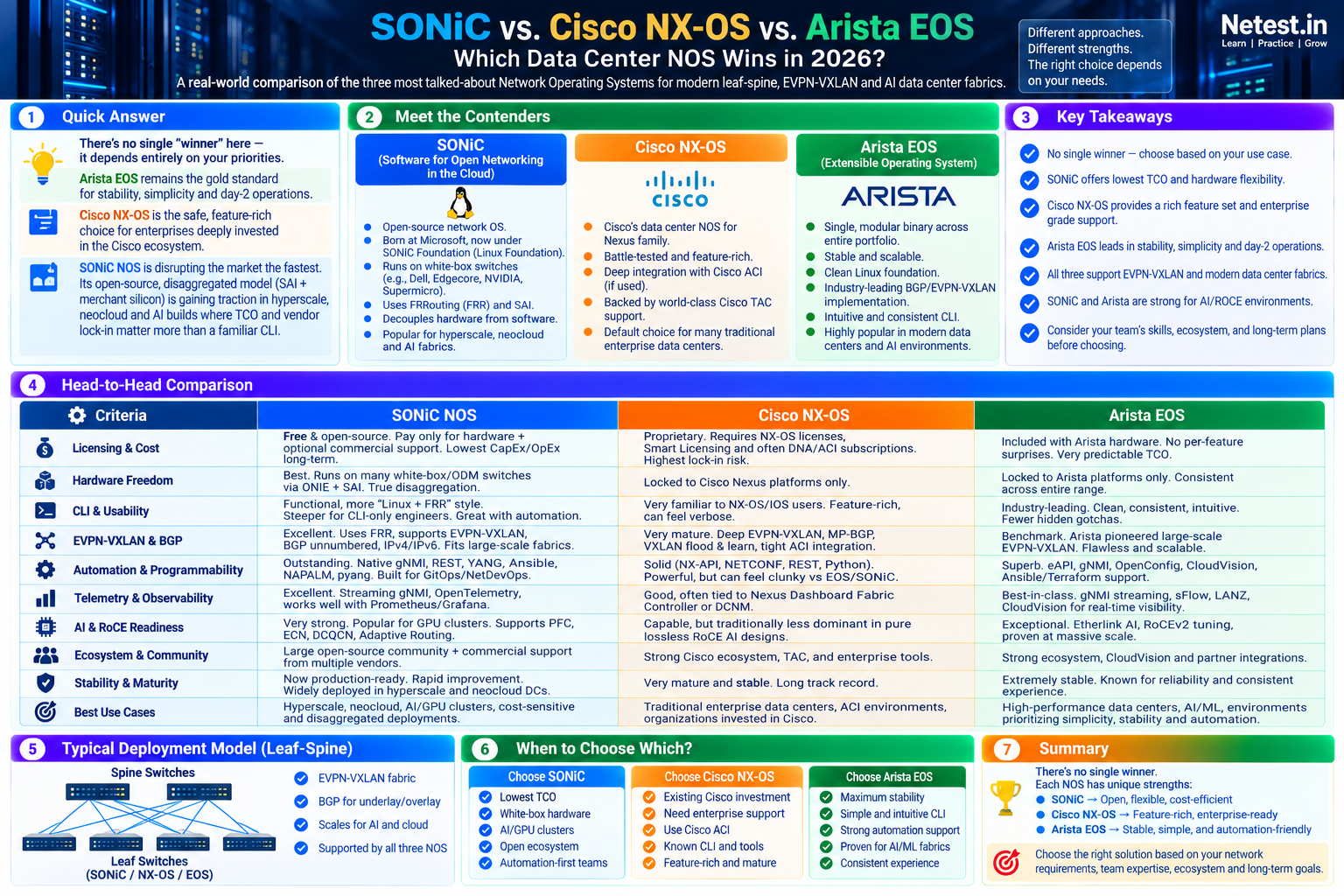
The Short Answer: There Is No Single Winner
The best NOS depends on what your team values most. Arista EOS remains the benchmark for stability, a clean operating experience and low-friction day-2 operations. Cisco NX-OS is the safe, feature-rich choice for enterprises deeply invested in Nexus, Cisco ACI and Cisco support. SONiC is disrupting the market through open-source software, merchant silicon and true hardware-software disaggregation.
Choose SONiC for openness
Prioritize white-box hardware, lower lock-in, strong automation and control over long-term platform economics.
Choose NX-OS for continuity
Preserve Cisco skills, Nexus operations, ACI integrations and an established enterprise support path.
Choose EOS for simplicity
Optimize for a consistent platform, mature EVPN-VXLAN, strong telemetry and predictable day-2 operations.
Meet the Contenders
Each NOS starts from a different philosophy: open disaggregation, an integrated enterprise ecosystem, or a tightly controlled and consistent operating platform.
SONiC: Software for Open Networking in the Cloud
Platform model: SONiC began at Microsoft and is now governed through the SONiC Foundation under the Linux Foundation. It is an open-source NOS that runs across supported white-box and vendor platforms from companies such as Dell, Edgecore, NVIDIA and Supermicro.
Why it is different: SONiC decouples hardware from software. FRRouting supplies key control-plane functions, while the Switch Abstraction Interface connects the software stack to merchant ASICs from multiple vendors. That makes it attractive for hyperscale, neocloud and cost-sensitive AI fabrics.
Cisco NX-OS
Platform model: Cisco’s long-standing data center NOS is purpose-built for the Nexus family. It is mature, feature-rich, deeply integrated with Cisco tooling and closely aligned with ACI when that architecture is part of the design.
Why it is different: NX-OS offers a familiar operational model for Cisco teams and access to broad enterprise support. For organizations already standardized on Nexus hardware, ACI, NDFC and Cisco processes, that ecosystem can outweigh higher licensing and lock-in.
Arista EOS: Extensible Operating System
Platform model: EOS uses a consistent, modular software architecture across Arista’s portfolio. It combines a Linux foundation with a clean CLI, mature BGP and EVPN-VXLAN implementation, programmable APIs and tight CloudVision integration.
Why it is different: Arista emphasizes consistency, stability and operational clarity. EOS is widely chosen for high-performance data centers and AI environments where teams value strong automation without giving up an intuitive day-2 experience.
The Shared Deployment Model: Leaf-Spine and EVPN-VXLAN
SONiC, NX-OS and EOS can all support a modern leaf-spine data center architecture. Spine switches provide the underlay path, leaf switches connect workloads and services, and BGP EVPN distributes VXLAN reachability across the overlay.
Underlay
Build resilient IP reachability between leaf and spine nodes, commonly with BGP or an IGP and equal-cost multipath.
Overlay
Use MP-BGP EVPN to advertise MAC, IP, prefix and VTEP information for VXLAN services.
Operations
Validate convergence, telemetry, upgrade behavior and troubleshooting workflows before standardizing the fabric.
Head-to-Head Data Center NOS Comparison
This matrix compares the operational character of each platform. Exact features, scale and support depend on the selected hardware, software release, license and vendor distribution.
| Criteria | SONiC NOS | Cisco NX-OS | Arista EOS |
|---|---|---|---|
| Licensing and cost | Open source, with costs concentrated in hardware, engineering and optional commercial support. Often the lowest long-term platform cost at scale. | Proprietary licensing tied to Nexus hardware, with Smart Licensing and optional controller or ACI subscriptions. Highest ecosystem lock-in of the three. | Software is supplied with Arista hardware. The commercial model is comparatively predictable, though hardware remains single-vendor. |
| Hardware freedom | Strongest choice. Runs on a qualified range of white-box, ODM and vendor switches through ONIE and SAI. | Runs on Cisco Nexus platforms. | Runs on Arista platforms, with a highly consistent experience across the portfolio. |
| CLI and usability | Functional and automation-friendly, but its Linux, containers and FRR model can feel less familiar to CLI-only engineers. | Familiar to IOS and NX-OS operators, with broad features and some operational complexity. | Clean, consistent and intuitive. Often considered the easiest of the three for day-2 troubleshooting. |
| EVPN-VXLAN and BGP | Strong FRR-based EVPN-VXLAN, BGP unnumbered and IPv4/IPv6 support for large leaf-spine fabrics. | Mature MP-BGP EVPN, VXLAN and ACI options across supported Nexus designs. | A benchmark implementation with strong scalability, mature tooling and clear troubleshooting workflows. |
| Automation and programmability | Native Linux access plus gNMI, REST, YANG, Ansible and OpenConfig-oriented workflows make it well suited to GitOps and NetDevOps. | NX-API, NETCONF, REST and Python provide capable automation, especially inside Cisco environments. | eAPI, gNMI, OpenConfig, CloudVision, Ansible and Terraform integrations deliver a polished automation experience. |
| Telemetry and observability | Strong streaming telemetry and easy integration with open systems such as Prometheus, Grafana and OpenTelemetry pipelines. | Solid telemetry, frequently paired with Nexus Dashboard or NDFC for integrated fabric operations. | Best-in-class visibility through streaming telemetry, sFlow, LANZ and CloudVision state history. |
| AI and RoCE readiness | Very strong for GPU clusters, with support for lossless Ethernet features such as PFC, ECN and DCQCN on qualified platforms. | Capable on supported Nexus hardware, though less dominant in greenfield, pure-play AI backend fabrics. | Exceptional for high-performance AI networks, with mature RoCEv2 operations and proven large-scale deployments. |
| Stability and maturity | Proven at hyperscale. Consistency varies by distribution and hardware qualification; vendor-backed Enterprise SONiC reduces that variability. | Long track record and strong reliability when teams standardize on well-tested releases and designs. | Renowned for stability and a consistent software architecture across platforms. |
| Support model | Community support or paid support from a hardware or Enterprise SONiC vendor. Best for teams comfortable owning more of the integration. | Cisco TAC and a broad global partner ecosystem. | Arista TAC, CloudVision and a strong engineer-to-engineer support reputation. |
| Vendor lock-in | Lowest, subject to the qualified hardware and SAI matrix of the chosen distribution. | Highest because the NOS, hardware and optional ACI stack are tightly integrated. | Moderate to high because EOS is tied to Arista hardware, but the operating model is comparatively straightforward. |
| Best use cases | Hyperscale, neocloud, AI/GPU clusters, cost-sensitive fabrics and teams committed to automation. | Traditional enterprise data centers, existing Nexus estates and ACI-centric organizations. | High-performance enterprise and AI data centers prioritizing stability, simplicity and observability. |
Which Data Center NOS Should You Choose?
Choose Arista EOS if...
You want the strongest blend of stability, straightforward EVPN-VXLAN, polished automation and minimal day-2 friction. EOS fits high-performance enterprise data centers and is particularly compelling for teams building RoCE-based AI fabrics.
Choose Cisco NX-OS if...
Your data center already runs Nexus, depends on Cisco ACI or NDFC, and has established Cisco operational practices. Familiar tools, TAC coverage and integration can be more valuable than the savings promised by a platform change.
Choose SONiC if...
You are building at scale, optimizing total cost or deliberately adopting white-box switching. SONiC is especially attractive for teams with NetDevOps or SRE skills and for AI training clusters that value merchant silicon, hardware choice and automation.
The Rise of SONiC: Why It Is Gaining Ground
SONiC has moved from a hyperscaler-developed platform to a serious contender in enterprise and service-provider evaluations. Five trends explain the momentum.
- AI infrastructure growth: GPU cloud and neocloud operators are scrutinizing the premium attached to branded switching stacks.
- True disaggregation: teams can select the ASIC, switch platform and NOS more independently than with a vertically integrated system.
- SAI standardization: a common abstraction layer lets supported SONiC distributions work across multiple merchant-silicon families.
- DevOps-native operations: Linux, containers, FRR, gNMI and YANG align with the tools already used by platform and SRE teams.
- Enterprise hardening: commercial distributions add qualification, lifecycle management and vendor support that reduce the rough edges of upstream builds.
Final Verdict
EOS is the most engineer-friendly, NX-OS is the most enterprise-familiar, and SONiC is the most open and flexible. The market is moving toward merchant silicon and disaggregated networking, but openness pays off only when a team is ready to operate through automation, Linux fundamentals and disciplined validation.
For teams that value predictable, plug-and-play stability above everything else, Arista EOS remains the safest all-round choice for many data centers in 2026. Cisco NX-OS remains highly defensible inside a mature Cisco estate. SONiC is the strongest disruptor and can be the best strategic choice when hardware freedom, scale economics and AI-fabric performance matter most.
Official Documentation and Further Reading
Capabilities change by hardware and release. Use these primary sources to verify the features, limitations and lifecycle of the exact platform being evaluated.
- SONiC Foundation developer resources — architecture, build, testing and community documentation for SONiC and SAI.
- Cisco Nexus 9000 VXLAN BGP EVPN design and implementation guide — official NX-OS fabric design guidance.
- Arista EOS user manual — current EOS documentation covering EVPN, VXLAN, routing, automation and visibility.
Data Center NOS Frequently Asked Questions
Is SONiC production-ready for enterprise data centers?
Yes, especially when deployed as a vendor-backed Enterprise SONiC distribution. Upstream community builds can suit labs and expert teams, while most enterprises benefit from a validated hardware and support matrix.
Which NOS is best for EVPN-VXLAN leaf-spine?
All three support modern EVPN-VXLAN fabrics. Arista EOS is often favored for operational simplicity, SONiC offers strong open and disaggregated options through FRR, and Cisco NX-OS provides mature capabilities with deep Nexus and ACI integration.
Is SONiC cheaper than Arista EOS or Cisco NX-OS?
SONiC can reduce acquisition and licensing costs by combining merchant-silicon hardware with open or commercially supported software, but the real total cost also depends on engineering skills, support, qualification, operations and lifecycle management.
Does SONiC have a harder learning curve?
It can for teams accustomed only to traditional network CLIs because SONiC exposes more Linux, containers, FRR and automation concepts. Teams already comfortable with Linux, Ansible or gNMI usually adapt faster.
Which NOS is best for AI and RoCE GPU fabrics?
Arista EOS and SONiC are both strong choices for high-performance AI fabrics. Validate the exact switch ASIC, RoCE features, congestion-control design, optics, telemetry, vendor support and team operating model.