Why CCNP Enterprise Is Still Relevant in the Age of AI and Automation
AI can generate configurations and spot anomalies, but engineers still need the routing, design and troubleshooting depth to decide whether those answers are safe and correct.
In This Lesson
Separate the hype from the practical value of CCNP Enterprise, see where AI helps and where engineering judgment remains essential, then build a study plan that combines certification depth with automation.
Quick Learning Map
CCNP knowledge and automation create value when they are joined by validation and ownership.
Understand the network
Learn routing, switching, virtualization, assurance, security and enterprise design deeply enough to reason about failure.
Automate repeatably
Use APIs, Python, Ansible and controllers to turn sound operational intent into consistent workflows.
Validate and own
Test the result, observe the network, assess risk and take responsibility for the production outcome.
CCNP Enterprise in the AI Era at a Glance
The certification is most useful as proof of durable technical depth. AI and automation extend that knowledge; they do not replace the need to understand topology, protocol state, policy and failure domains.
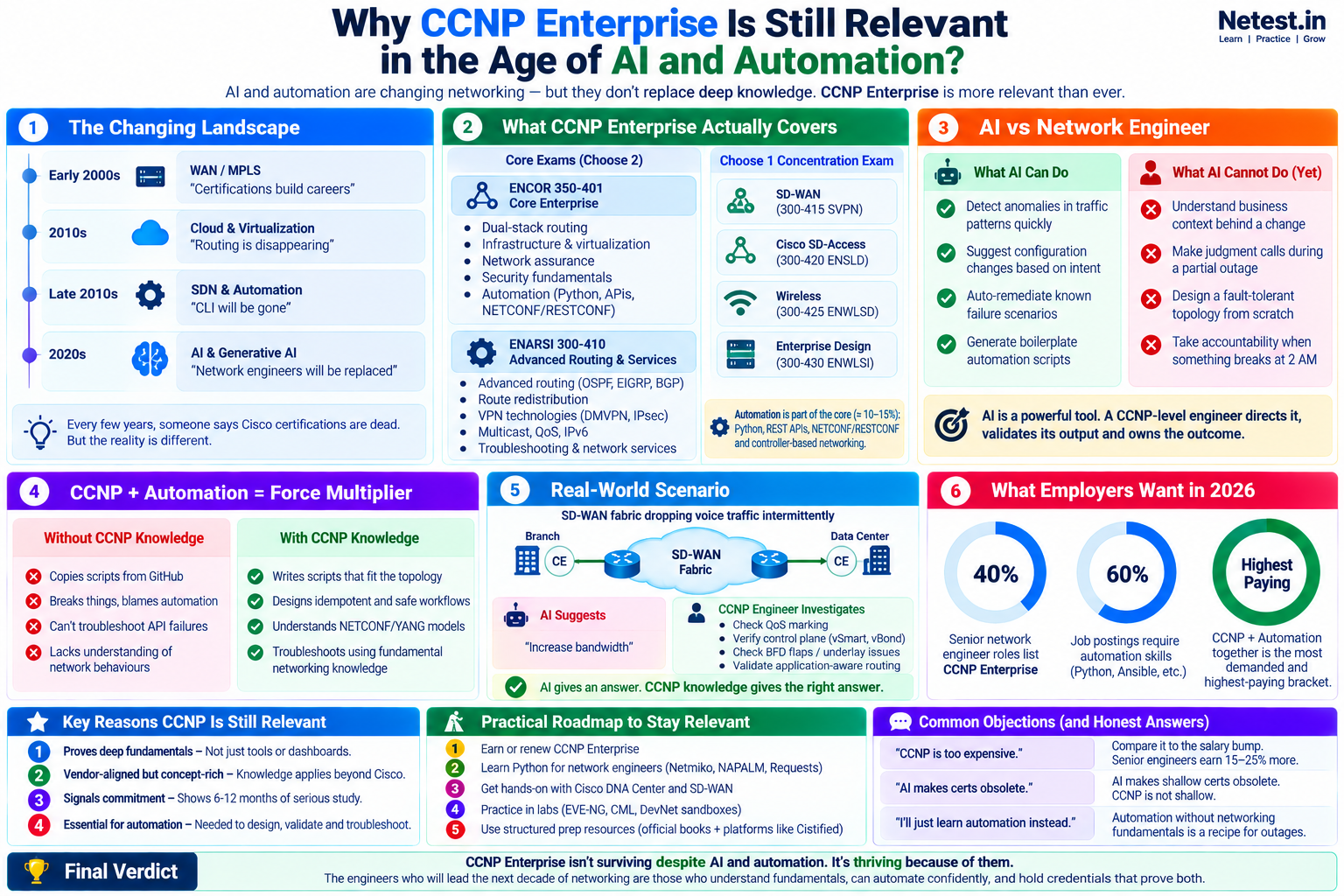
The Certification Everyone Said Would Die
Each major shift in networking has produced the same prediction: certifications will become irrelevant. Software-defined networking was expected to remove the need for CLI knowledge, cloud was expected to make routing invisible, and now generative AI is expected to replace network engineers.
The better conclusion is narrower. Repetitive configuration work is becoming easier to automate, while the ability to explain why a network behaves as it does becomes a stronger differentiator. CCNP Enterprise remains relevant because it develops the knowledge needed to evaluate a proposed change, identify hidden dependencies and troubleshoot when the happy path fails.
What CCNP Enterprise Actually Covers
The CCNP Enterprise path combines a core exam with a concentration exam. The result is broader than traditional router configuration: it connects infrastructure fundamentals with assurance, security, controllers and programmability.
| Exam area | Representative knowledge | Why it matters with AI |
|---|---|---|
| ENCOR 350-401 core | Dual-stack architecture, virtualization, infrastructure, assurance, security and automation | Provides the system context required to review AI-generated changes |
| ENARSI 300-410 | Advanced routing, route redistribution, VPN technologies and infrastructure services | Builds the troubleshooting depth needed for ambiguous failures |
| Enterprise concentration | Options can focus on SD-WAN, enterprise design, wireless, automation or related specializations | Connects automation to a real operational domain and its constraints |
Automation is already part of the enterprise track. Candidates encounter APIs, Python concepts, data formats, controllers and model-driven interfaces such as NETCONF and RESTCONF alongside the networking fundamentals those tools act upon.
AI vs Network Engineer: Capability Is Not Accountability
AI is useful precisely because it can process telemetry and generate options quickly. The boundary appears when a tool must understand incomplete organizational context, weigh conflicting risks or own a production decision.
What AI can do well
- Detect unusual traffic or telemetry patterns
- Summarize logs and suggest likely causes
- Draft configurations and automation code
- Recommend changes from stated intent
- Automate known remediation workflows
What still needs an engineer
- Translate business needs into safe technical intent
- Judge trade-offs during a partial outage
- Design failure domains and resilience
- Recognize missing or misleading context
- Approve, validate and own the outcome
Where CCNP depth helps
- Explain protocol state and convergence
- Trace interactions across network layers
- Challenge an incorrect recommendation
- Design verification and rollback steps
- Distinguish symptoms from root causes
AI may flag slow OSPF convergence, but an engineer must still examine adjacency state, LSA behavior, area design, SPF timing, interface loss and the operational cost of the proposed fix.
CCNP + Automation Is a Force Multiplier
Certification knowledge and automation are complementary skills. The engineer supplies a correct model of the network; automation applies that model consistently and at scale.
| Task | Automation without sufficient context | CCNP-level knowledge plus automation |
|---|---|---|
| Use an existing script | Copies code without understanding assumptions or blast radius | Adapts inventory, transport, policy and error handling to the topology |
| Deploy a change | Treats successful execution as proof that the change is correct | Uses pre-checks, idempotency, staged rollout, post-checks and rollback |
| Troubleshoot an API | Stops at authentication or payload errors | Understands the data model, device state and network behavior behind the response |
| Use AI output | Accepts a plausible answer at face value | Tests the recommendation against protocol evidence and business intent |
Real-World Scenario: Intermittent Voice Loss on SD-WAN
Imagine an SD-WAN fabric begins dropping voice traffic intermittently. A controller surfaces the incident and an AI assistant recommends increasing bandwidth. That may be worth testing, but it is only one hypothesis.
- Validate classification: confirm that voice traffic is identified and marked correctly end to end.
- Check policy: inspect application-aware routing, preferred colors, SLA classes and fallback behavior.
- Test the underlay: look for loss, latency, jitter, BFD instability and path-specific impairment.
- Verify control health: confirm expected control connections and controller reachability rather than assuming the fabric is stable.
- Correlate time and scope: determine whether the issue follows a site, tunnel, circuit, application class or change window.
- Measure before expanding capacity: prove sustained congestion before treating more bandwidth as the root-cause fix.
The tool produced an answer. The engineer turns that answer into a falsifiable hypothesis, gathers evidence and protects the network from an unnecessary or incomplete change.
What Employers Value in 2026
Job requirements vary by region, seniority and employer, so no single percentage describes the entire market. The recurring pattern is more useful: senior network roles often combine strong routing and troubleshooting fundamentals with automation, API and controller experience.
Depth
Employers need engineers who can reason through OSPF, BGP, QoS, VPNs, campus design and failure behavior without depending on one dashboard.
Leverage
Python, Ansible, APIs and source-controlled workflows help one engineer apply a safe standard across many devices and sites.
Evidence
A certification can help a candidate reach the interview, while labs, change examples and troubleshooting stories demonstrate practical ability.
Why CCNP Enterprise Still Commands Respect
It tests durable fundamentals
Products and interfaces change quickly. Route selection, convergence, segmentation, resiliency and failure isolation remain core engineering problems.
It is vendor-aligned but concept-rich
Cisco terminology is central, yet routing policy, QoS, overlays, telemetry and automation concepts transfer to other enterprise platforms.
It signals sustained study
Preparing seriously requires structured learning, labs and repeated troubleshooting. That commitment can complement—not replace—work experience.
How to Stay Relevant: A Practical Roadmap
- Build or renew enterprise networking depth. Study the current CCNP Enterprise blueprint and connect every objective to a lab or packet-level explanation.
- Learn Python for network engineers. Start with data types, files, JSON, HTTP requests and error handling before moving to libraries such as Netmiko or NAPALM.
- Add Ansible and source control. Use inventories, variables, templates, idempotent modules, Git review and secrets hygiene.
- Practice controller-based networking. Work with SD-WAN and intent-based campus concepts, APIs, assurance and telemetry.
- Build failure-focused labs. Use CML, EVE-NG, packet captures or vendor sandboxes to create faults, gather evidence and verify recovery.
- Practice exam conditions responsibly. Use legitimate study resources and timed practice to identify weak domains; avoid brain dumps that bypass learning.
- Create a small portfolio. Publish sanitized diagrams, validation scripts, lab notes and before/after evidence that demonstrate how you think.
Common Objections and Honest Answers
“CCNP is too expensive.”
Compare the complete cost with your target roles and training budget. Self-study and labs can reduce preparation cost, but only pursue the exam when it supports a specific career objective.
“AI makes certifications obsolete.”
AI weakens the value of memorization. It increases the value of a rigorous mental model that lets an engineer verify generated answers and recognize unsafe assumptions.
“I will learn automation instead.”
Automation without networking fundamentals can distribute an error faster. Learn enough of both to define correct intent and prove the result.
Final Verdict: More Relevant, Not Less
CCNP Enterprise remains relevant because AI changes the work without removing the engineering responsibility. The strongest network professionals understand protocols and architecture deeply, automate repeatable work safely, and validate every important outcome.
The credential alone is not the destination. Treat it as a framework for building the judgment that makes automation trustworthy—and makes an engineer valuable when a tool's confident answer is not the correct one.
CCNP Enterprise in the AI Era Frequently Asked Questions
Is CCNP Enterprise still worth it in 2026?
Yes, when it supports a real networking role and is paired with hands-on practice. CCNP Enterprise validates routing, infrastructure, assurance, security and automation knowledge that helps engineers judge and troubleshoot AI-assisted changes.
Will AI replace CCNP-level network engineers?
AI can detect patterns, draft configurations and automate known tasks, but engineers still define intent, assess business risk, design failure domains, validate output and own production outcomes.
Does CCNP Enterprise include automation?
Yes. The enterprise track includes automation and programmability topics such as APIs, Python concepts, controller-based networking and model-driven interfaces alongside routing, switching, assurance and security.
Should I learn Python and Ansible before or after CCNP Enterprise?
Learn basic Python and automation alongside CCNP study. Build enough networking depth to understand the intended state, then automate small, testable tasks and add validation and rollback controls.
Is CCNP Enterprise enough to get a network engineering job?
The certification can strengthen a candidate profile, but employers also evaluate hands-on troubleshooting, design judgment, communication, labs and automation experience. It is evidence of knowledge, not a substitute for operational practice.