IPv6 Address Types: Global, Link-Local, ULA and Multicast
Understand why IPv6 is needed, how a 128-bit address is written, and when to use global unicast, unique local, link-local, multicast, anycast, loopback, and unspecified addresses.
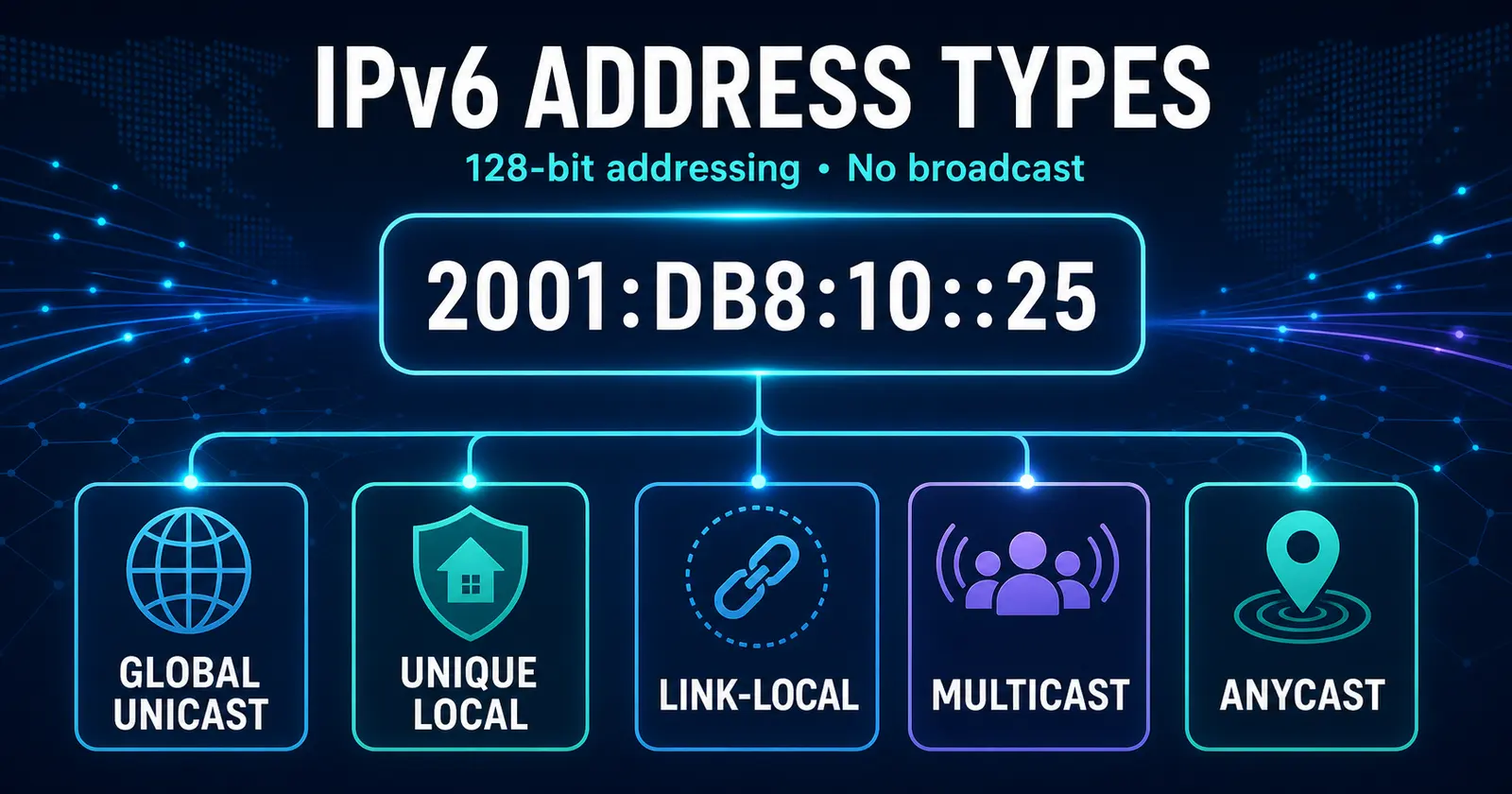
IPv6 Addressing Fundamentals
Learn the address types first, practice correct compression, then see how modified EUI-64 can form an interface identifier.
In This Lesson
Learn to recognize the IPv6 address types a host and router use in normal operation. Prefix clues, scope, and purpose will help you choose the correct address for routing, neighbor discovery, and services.
Quick Learning Map
Keep this three-step view in mind as you work through the detailed lesson.
Recognize the prefix
Use the leading bits to identify global, link-local, ULA, multicast, and other forms.
Respect the scope
Know whether an address is valid on one link, inside an organization, or across the internet.
Apply it correctly
Match the address type to routing, discovery, service, and migration tasks.
IPv6 Address Types: Global, Link-Local, ULA and Multicast at a Glance
Use this summary to establish the big picture before moving into the detailed explanations, commands, and checks.
Core focus
Learn to recognize the IPv6 address types a host and router use in normal operation.
Key connection
Recognize the prefix → Respect the scope → Apply it correctly
Practical outcome
Prefix clues, scope, and purpose will help you choose the correct address for routing, neighbor discovery, and services.
What are the main IPv6 address types?
The main IPv6 types are global unicast for internet-routable addressing, link-local for communication on one link, unique local for private internal scope, multicast for one-to-many delivery and anycast for reaching the nearest instance. IPv6 has no broadcast address.
IPv6 Address Types Explained: Unicast, Multicast,: Quick Summary
IPv6 uses 128-bit hexadecimal addresses. It provides an enormous address space, removes broadcast, uses Neighbor Discovery instead of ARP, and supports several address scopes for local, private, public, group, and nearest-destination communication.
1. Why IPv6 Is Needed
IPv4 provides 232, or 4,294,967,296, possible addresses. Classful allocation wasted large blocks, while Internet growth, mobile devices, cloud platforms, and connected equipment consumed addresses faster than early designers expected.
VLSM, CIDR, NAT, and PAT extended the life of IPv4, but they did not expand its address field. IPv6 uses 128 bits, giving 2128 possible values—approximately 3.4 × 1038.
2. IPv4 vs IPv6
| Feature | IPv4 | IPv6 |
|---|---|---|
| Address length | 32 bits | 128 bits |
| Notation | Dotted decimal | Colon-separated hexadecimal |
| Broadcast | Supported | Not used; multicast performs group delivery |
| Local discovery | ARP | Neighbor Discovery using ICMPv6 |
| Automatic addressing | Usually DHCPv4 or manual | SLAAC, DHCPv6, or manual |
| Address conservation | NAT/PAT is common | Large address space normally permits end-to-end addressing |
| Header | Variable 20–60 bytes with checksum | Fixed 40-byte base header with extension headers and no header checksum |
3. IPv6 Address Format
An IPv6 address contains eight 16-bit fields called hextets. Each hextet has four hexadecimal digits.
Leading zeros may be removed from each hextet, and one consecutive run of all-zero hextets may be replaced by ::. Because :: can appear only once, the address remains unambiguous.
4. IPv6 Address Types at a Glance
| Type | Common prefix or value | Purpose | Routed? |
|---|---|---|---|
| Global unicast | 2000::/3 | Publicly routable unicast communication | Yes |
| Unique local | FC00::/7, normally FD00::/8 | Private-style internal communication | Inside the intended organization |
| Link-local | FE80::/10 | Communication and control traffic on one link | No |
| Unspecified | ::/128 | Indicates that a source address is not yet known | No |
| Loopback | ::1/128 | A node sends traffic to itself | No |
| Multicast | FF00::/8 | One-to-many group delivery | Depends on scope |
| Anycast | Uses unicast address space | Delivery to the nearest routed instance | Yes |
5. Unicast Address Types
Global Unicast
Global unicast addresses are the IPv6 equivalent of public IPv4 addresses. The currently allocated global range is mainly within 2000::/3. Use 2001:DB8::/32 only in documentation and labs.
Unique Local
Unique local addresses use FC00::/7. Locally assigned prefixes use the L bit set to 1, so operational examples normally begin with FD, followed by a pseudo-random 40-bit global ID and a 16-bit subnet ID.
Link-Local
Every IPv6-enabled interface has a link-local address. Routers do not forward these addresses. Neighbor Discovery and many routing protocols use them, and a zone identifier such as %12 may identify the outgoing interface on a host.
Loopback and Unspecified
::1/128 is loopback. ::/128 is unspecified and must not be assigned to an interface. It can appear as a temporary source before a node has selected an address.
FEC0::/10 was deprecated by RFC 3879. Do not use it in new networks; use unique local addressing when an internal prefix is appropriate.6. Multicast Addresses
IPv6 multicast starts with FF00::/8. Flags and scope fields describe how the group is used and how far packets may travel.
| Address | Meaning |
|---|---|
FF02::1 | All IPv6 nodes on the local link |
FF02::2 | All IPv6 routers on the local link |
FF02::5 | All OSPFv3 routers on the local link |
FF02::6 | OSPFv3 designated and backup designated routers |
FF02::1:FF00:0/104 | Solicited-node multicast range used by Neighbor Discovery |
IPv6 does not use broadcast. Multicast lets a sender target the required group instead of interrupting every node on a segment.
7. Anycast Addresses
An anycast address is assigned to multiple interfaces, usually on different nodes. Routing directs a packet to the topologically nearest instance according to the active route.
Anycast has no dedicated prefix; it uses normal unicast address space. It is widely used for distributed DNS, content services, gateways, and resilient service endpoints.
8. SLAAC, Neighbor Discovery, and Migration
- SLAAC: Router Advertisements provide prefix and gateway information so a host can configure itself.
- Neighbor Discovery: ICMPv6 messages replace ARP and support router discovery, address resolution, and duplicate-address detection.
- Interface IDs: A host may use privacy addresses, stable addresses, DHCPv6, manual configuration, or modified EUI-64. See the EUI-64 guide.
- Dual stack: Devices run IPv4 and IPv6 together during migration.
- Tunneling and translation: These techniques connect incompatible address families where native dual-stack connectivity is unavailable.
IPv6 Address Types Explained: Unicast, Multicast,: Frequently Asked Questions
Why was IPv6 created?
IPv6 was created primarily to provide a vastly larger address space than IPv4 and to support continued Internet growth without depending on large-scale address sharing.
Does IPv6 use broadcast?
No. IPv6 replaces broadcast-dependent functions with multicast and Neighbor Discovery.
What is the difference between link-local and global unicast?
A link-local address works only on the local link and is not routed, while a global unicast address can be routed across IPv6 networks and the Internet.
Is site-local addressing still used?
No. The old FEC0::/10 site-local range was deprecated. Unique local addresses from FC00::/7 are used for private-style internal addressing.