The Difference: ARP vs GARP Explained
ARP and Gratuitous ARP both communicate IPv4-to-MAC mappings on a local network, but they solve different problems. Learn how normal address resolution differs from a proactive GARP announcement.
In This Lesson
Start with the purpose of each protocol, follow their frame flows, compare them side by side, and finish with the operational situations in which GARP matters.
Quick Learning Map
Keep these three actions in mind as you study both flows.
Resolve an unknown MAC
ARP broadcasts a request when a host knows the local IPv4 address but not the matching MAC address.
Cache the reply
The owner replies with its MAC address, allowing the requester to create or refresh an ARP cache entry.
Announce a changed mapping
GARP proactively advertises the sender’s own mapping so neighboring devices can refresh their caches.
ARP vs GARP at a Glance
Normal ARP asks for missing information. Gratuitous ARP announces information without waiting for a question.
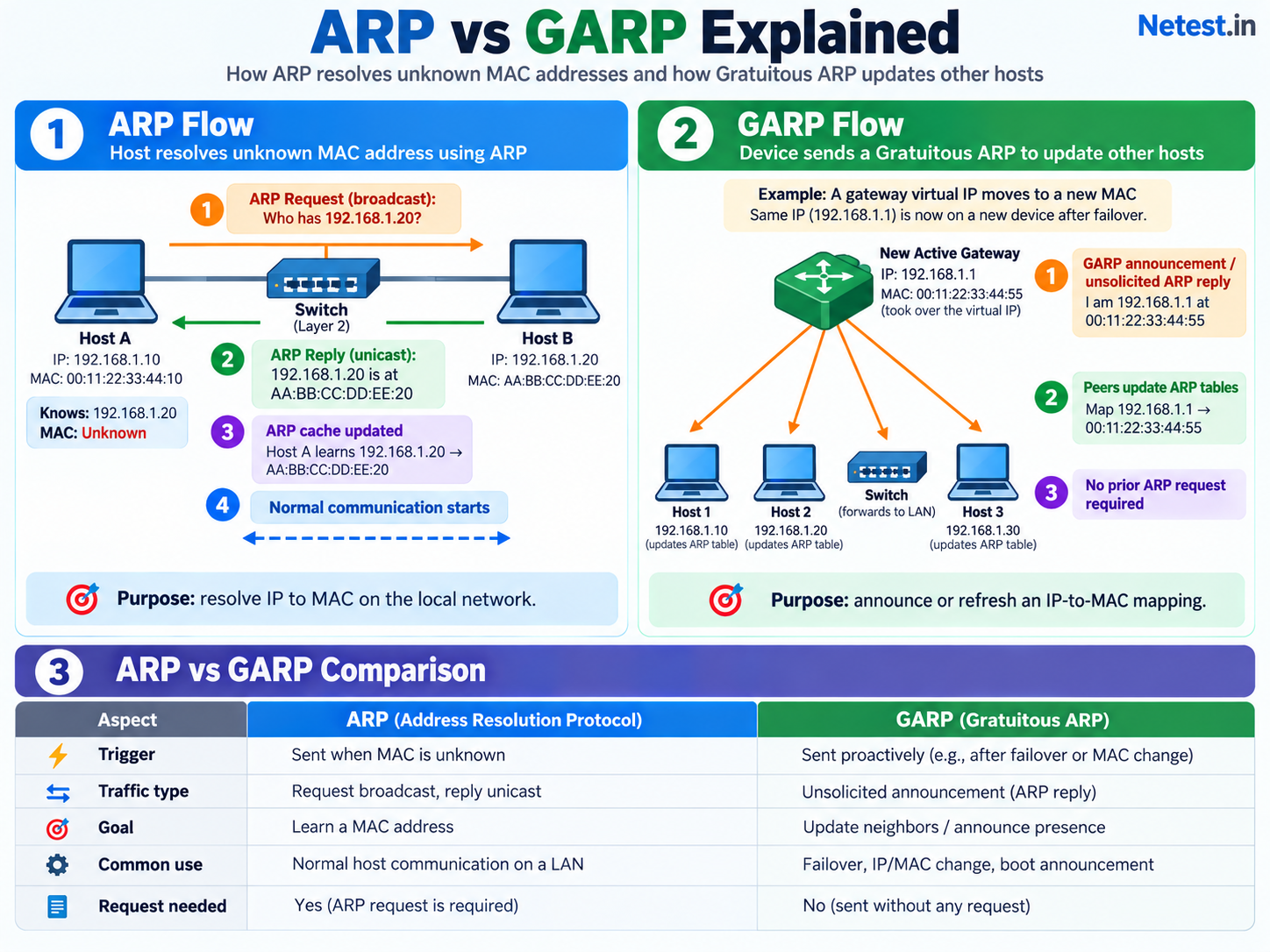
ARP (Address Resolution Protocol)
Ethernet frames need a destination MAC address, while applications usually identify destinations by IP address. On an IPv4 LAN, ARP bridges that gap by resolving a local IPv4 address—or the IPv4 address of the next-hop gateway—to a MAC address.
1. Check the cache
The sender first checks whether a usable IP-to-MAC mapping already exists in its ARP cache.
2. Broadcast a request
If the mapping is missing, it asks the local segment, “Who has this IPv4 address?”
3. Receive the reply
The device that owns the address normally replies directly with its MAC address.
The requester stores the learned mapping for a limited time and can then send normal Ethernet frames. ARP is local in scope: routers do not forward the Layer 2 broadcast. When the destination is on another IP network, the host resolves the MAC address of its default gateway instead.
GARP (Gratuitous ARP)
Gratuitous ARP is an unsolicited ARP message in which a device advertises its own IPv4-to-MAC mapping. No neighboring host needs to ask first. Devices that receive the announcement can learn or refresh the mapping in their ARP caches.
This proactive behavior is useful when a mapping may have changed or when a device wants to announce its presence. Depending on the operating system and implementation, a gratuitous message may be encoded as an ARP request or an ARP reply. The defining characteristic is that it advertises the sender’s own mapping without a prior request.
When Gratuitous ARP Is Used
Device startup
A host may announce its mapping when an interface comes online. The message can also help expose a duplicate IPv4 address if another node already uses it.
MAC address change
If a device keeps the same IPv4 address but its MAC changes, GARP can prompt peers to replace the old cached mapping.
Gateway failover
After an HSRP, VRRP, GLBP, cluster, or load-balancer failover, the new active node can advertise the virtual IPv4 mapping.
In a first-hop redundancy event, hosts may still have a cached entry for the previous active gateway. A GARP announcement helps the LAN converge quickly by associating the virtual IP address with the MAC address currently responsible for forwarding traffic.
ARP vs GARP (Gratuitous ARP)
The most useful distinction is the trigger: normal ARP reacts to missing information, while GARP proactively distributes information.
| Aspect | ARP | GARP |
|---|---|---|
| Primary purpose | Resolve an IPv4 address to a MAC address on the local network. | Announce or refresh the sender’s own IPv4-to-MAC mapping. |
| Trigger | Sent when the required mapping is unknown or stale. | Sent proactively, such as after startup, a MAC change, or failover. |
| Request needed | Yes. The requester asks before learning the normal reply. | No prior request from another host is required. |
| Typical traffic | Broadcast request followed by a commonly unicast reply. | Unsolicited ARP announcement delivered on the local segment. |
| Information learned | The MAC address for a local destination or next hop. | A new, refreshed, or confirmed mapping for the announcing device. |
| Common use | Routine IPv4 communication on an Ethernet LAN. | Failover, mobility, duplicate-address detection, or presence announcement. |
Operational and Troubleshooting Notes
- Check the ARP cache on affected hosts before and after a failover to confirm the expected mapping.
- Confirm that the sender and receivers share the intended VLAN or Layer 2 broadcast domain.
- Use a packet capture to verify the advertised sender IP, target IP, sender MAC, and Ethernet destination.
- Investigate duplicate-IP warnings instead of assuming every unsolicited ARP is a harmless failover message.
- Use Dynamic ARP Inspection and related switch protections where appropriate; ARP itself does not authenticate mappings.
For related concepts, see IP Address vs MAC Address, How DHCP Works, and First Hop Redundancy Protocol Explained.
ARP and Gratuitous ARP Frequently Asked Questions
What is the main difference between ARP and GARP?
ARP resolves an unknown local IPv4 address to a MAC address after a request. GARP proactively announces or refreshes the sender’s own IP-to-MAC mapping without a prior request.
Does Gratuitous ARP require an ARP request?
No. A Gratuitous ARP announcement is sent without a prior request from another host.
Why is Gratuitous ARP used during gateway failover?
It tells hosts that the virtual IP address is now associated with the active gateway’s MAC address, helping them refresh stale ARP cache entries.
Is an ARP request broadcast or unicast?
A normal ARP request is broadcast on the local Layer 2 segment because the sender does not yet know the destination MAC address. The normal reply is commonly unicast to the requester.
Can ARP or GARP cross a router?
Normally no. ARP operates on the local Layer 2 broadcast domain. A host resolving a remote destination uses ARP for its local default gateway, not for the remote host.