Control Plane vs Data Plane
The control plane learns how the network is connected and decides which paths should be used. The data plane—also called the forwarding plane—uses that knowledge to process and move packets. They perform different jobs, but every routed network depends on them working together.
This guide covers control plane vs data plane in networking with practical router examples. Think of it as control plane and data plane explained for beginners, including how control plane and data plane work together from route learning to packet forwarding.
What Is the Difference Between Control Plane and Data Plane?
Learns and decides
Runs routing and control protocols, maintains topology information, selects best routes and builds forwarding knowledge.
Looks up and forwards
Uses the forwarding table to process transit packets, apply policies, rewrite headers and send traffic through the correct interface.
A control plane vs forwarding plane comparison means the same thing: forwarding plane is another common name for the data plane.
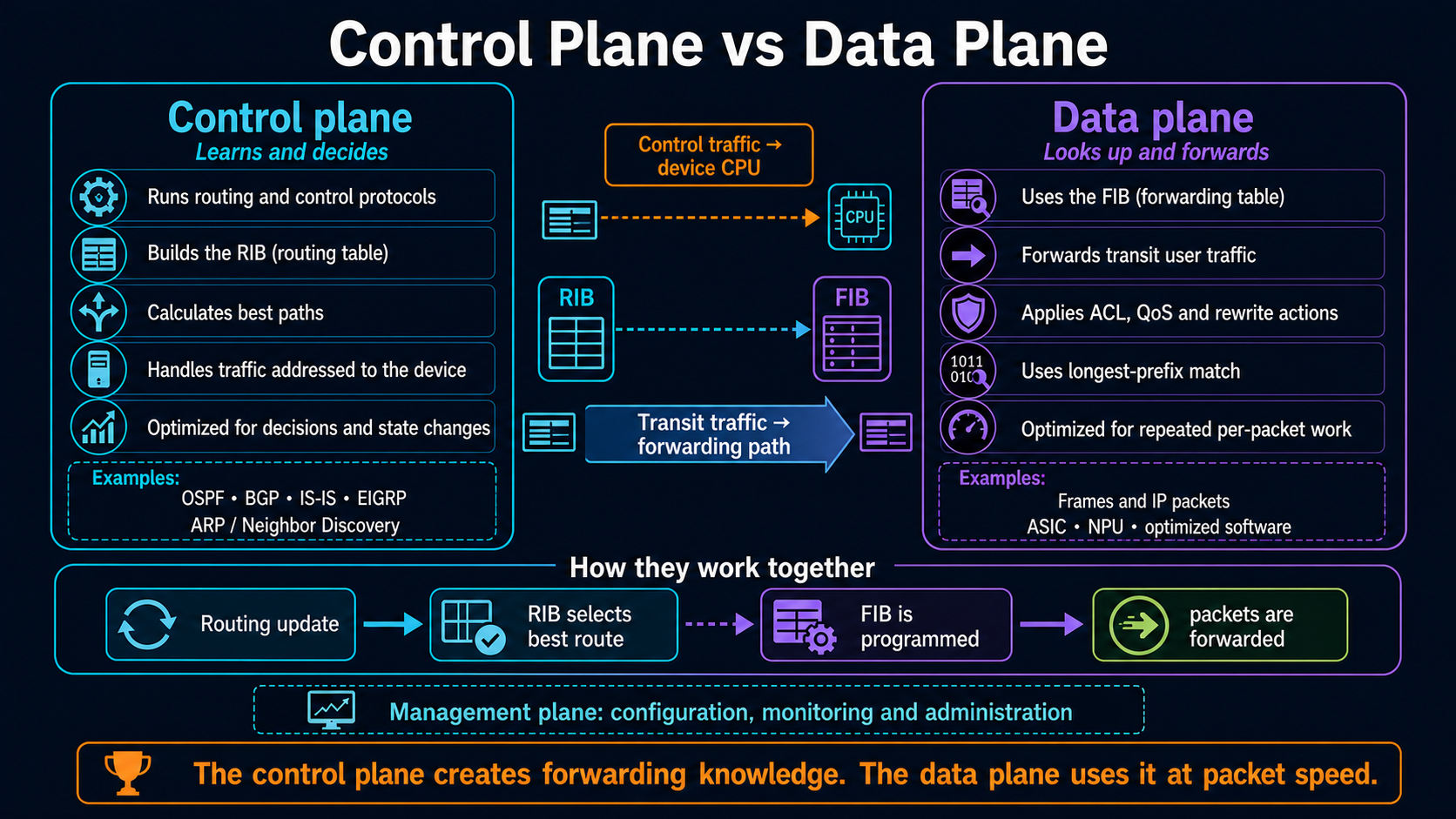
Control Plane vs Data Plane Comparison
| Feature | Control plane | Data plane |
|---|---|---|
| Main job | Learn topology, exchange reachability and calculate paths. | Process and forward packets using programmed state. |
| Common name | Control or decision plane. | Data or forwarding plane. |
| Main tables | Routing Information Base (RIB) and protocol databases. | Forwarding Information Base (FIB), adjacency and platform forwarding tables. |
| Traffic examples | OSPF hellos and LSAs, BGP updates, ARP/ND processing and packets addressed to the device. | Transit user packets and frames moving through the device. |
| Processing style | Event-driven calculations and state management. | Repeated high-rate lookup and packet actions. |
| Typical resources | Route processor or general-purpose CPU. | ASIC, NPU, forwarding processor or optimized software. |
| Failure effect | New routes may stop converging or device services may be affected. | Traffic may be dropped, delayed or forwarded incorrectly. |
What Is the Network Control Plane?
The network control plane creates and maintains the information a device needs to make forwarding possible. It reacts when an interface changes state, a routing update arrives, a neighbor becomes reachable or a policy changes.
Run routing protocols
OSPF, IS-IS, EIGRP and BGP exchange reachability and topology information with other devices.
Build the RIB
Connected, static and learned routes are evaluated, and the preferred route is installed in the routing table.
Resolve neighbors
ARP for IPv4 and Neighbor Discovery for IPv6 help associate next-hop network addresses with link-layer information.
Program forwarding state
Selected paths are converted into information the packet forwarding plane can use efficiently.
The control plane does not normally carry a user's transit traffic from one interface to another. It processes traffic that is addressed to the device or needed to operate the network.
What Is the Network Data Plane?
The data plane is responsible for the packet-by-packet work. When a transit packet arrives, the device evaluates the required forwarding and policy information, then sends or drops the packet.
- Inspect the ingress packet. Validate the frame or packet and apply relevant ingress features.
- Perform a forwarding lookup. For IP routing, use a longest-prefix match in the FIB.
- Apply packet policies. Process configured ACL, QoS, security or service actions supported by the platform.
- Rewrite for the next link. Update the required Layer 2 information and routed-packet fields.
- Transmit through the egress interface. Queue and send the packet toward its next hop.
How the Control Plane and Data Plane Work Together
A route change is occasional compared with the number of packets a device may forward. The control plane handles the change and updates forwarding state. The data plane then reuses that state for every matching packet until the network information changes again.
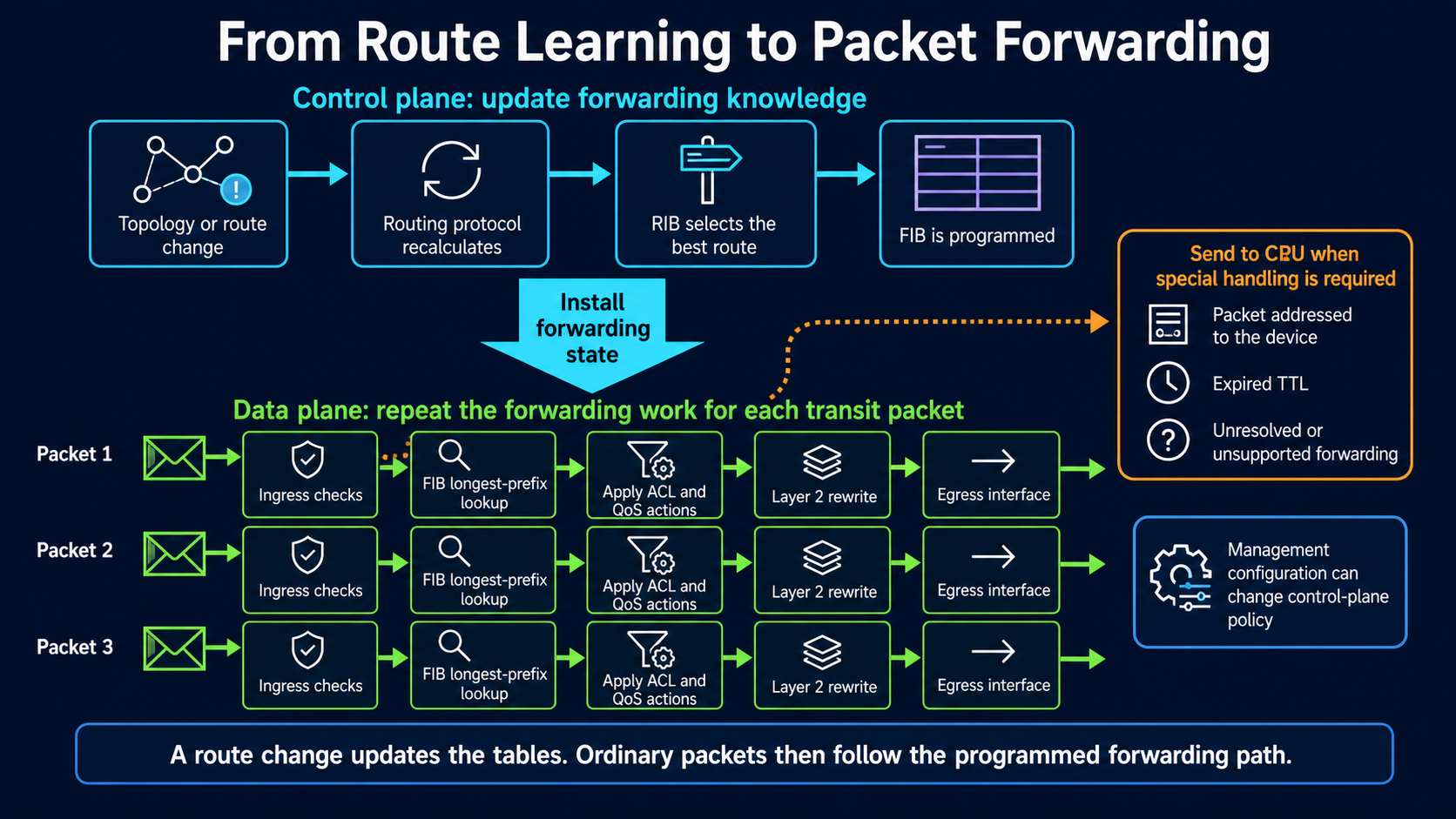
- A link event or routing update changes network knowledge.
- The relevant control protocol recalculates and the RIB selects a best path.
- The device programs the FIB and related forwarding information.
- Transit packets use that information without repeating the routing-protocol calculation.
- If forwarding state changes, the control plane updates what the data plane uses.
RIB vs FIB: Routing Table and Forwarding Table
The RIB and FIB make the plane relationship easier to see:
RIB: control-plane view
The Routing Information Base stores routes learned from connected interfaces, static configuration and routing protocols. It represents the device's routing knowledge and selected paths.
FIB: data-plane view
The Forwarding Information Base is organized for efficient destination lookup. It contains usable forwarding information derived from selected routes.
On Cisco platforms, Cisco Express Forwarding (CEF) uses the FIB and adjacency information for normal Layer 3 forwarding. On many switching platforms, forwarding entries are programmed into hardware; other platforms use optimized software.
Where Does the Management Plane Fit?
The management plane is related to the other planes but has a different purpose: configuring, observing and administering the device. Examples include SSH, SNMP, NETCONF, RESTCONF, logging and telemetry.
| Action | Plane | Why |
|---|---|---|
| An administrator changes an OSPF cost over SSH. | Management plane | The configuration enters through an administrative interface. |
| OSPF recalculates the best route. | Control plane | A routing protocol updates topology and route selection. |
| Packets use the resulting forwarding entry. | Data plane | Transit traffic follows the programmed path. |
Some platforms combine management and control functions on the same processor. That physical design does not remove the logical difference between their responsibilities.
Control Plane vs Data Plane Examples
Router example
OSPF learns a new prefix and the RIB chooses the best next hop. The FIB is updated. Later packets matching that prefix are forwarded through the selected interface.
Multilayer switch example
The control plane runs routing protocols and maintains network state. The forwarding hardware performs IP lookups, applies an ACL and rewrites the Layer 2 header.
Device-destined packet
An SSH connection addressed to the router itself reaches management/control processing instead of being handled as ordinary transit traffic.
Expired TTL
A transit IPv4 packet whose TTL reaches zero cannot continue normally. The device handles the exception and can generate an ICMP Time Exceeded response.
Control Plane and Data Plane in SDN
In a traditional router, control and forwarding functions are commonly present in the same device, even if they use separate processors. Software-defined networking (SDN) separates the control function from individual forwarding devices and makes it logically centralized in a controller or controller system.
| Architecture | Control function | Forwarding function |
|---|---|---|
| Traditional distributed network | Each device runs protocols and makes local routing decisions. | Each device forwards traffic using its locally programmed tables. |
| Software-defined network | A logically centralized controller calculates or distributes policy and state. | Network devices enforce installed rules and forward traffic locally. |
Examples such as SD-WAN architecture make this separation visible: controllers distribute routing and policy information, while edge devices carry the application traffic.
Why Plane Separation Matters
- Performance: repeated packet work can be optimized separately from route calculation.
- Scalability: forwarding hardware or distributed processors can handle large traffic volumes.
- Resilience: some platforms can continue forwarding existing entries during a short control-plane disruption, although this depends on architecture and features.
- Security: the device CPU can be protected with control-plane policing while data-plane ACLs filter transit traffic.
- Troubleshooting: engineers can determine whether a failure involves route learning, table programming or packet forwarding.
Control Plane and Data Plane FAQs
What is the difference between the control plane and data plane?
The control plane learns reachability and creates forwarding knowledge. The data plane uses programmed tables and actions to process transit packets.
Is the data plane the same as the forwarding plane?
Yes. Both terms normally describe the functions responsible for processing and forwarding traffic.
What is an example of control-plane traffic?
OSPF hellos, BGP updates and other protocol packets addressed to the network device are common examples.
What is an example of data-plane traffic?
A user packet entering one interface and leaving another interface on the way to its destination is transit data-plane traffic.
What is the difference between the RIB and FIB?
The RIB is the control-plane routing table. The FIB is optimized forwarding information derived from selected routes.
Where does the management plane fit?
It handles device configuration, monitoring and administration through services such as SSH, SNMP, NETCONF and RESTCONF.
How does SDN change the planes?
SDN separates the control function from individual forwarding devices and makes control logically centralized while devices continue forwarding traffic locally.
Can a data-plane packet reach the CPU?
Yes. Packets addressed to the device or requiring special handling can be delivered or punted to the CPU instead of following the normal transit path.
References and Related Study
This is an original explanation based on the attached reference notes and cross-checked against current networking architecture documentation.