WAF vs Firewall: What's the Difference?
"Firewall" and "WAF" get used almost interchangeably, but they guard different things. A regular firewall checks where traffic is coming from and going to. A web application firewall reads what a web request is actually trying to do. Here's what that means in practice, and whether you need one or both.
In This Lesson
Choose controls by the traffic and attack surface they can actually understand. This comparison keeps network filtering, application inspection, and layered defense clearly separated.
Quick Learning Map
Keep these three decisions in view as you work through the detailed lesson.
Identify the layer
Decide whether the risk lives in network flows or HTTP application behavior.
Apply the right control
Use firewalls for network policy and a WAF for web-request inspection.
Combine coverage
Layer controls so one device is not expected to solve every security problem.
The Short Answer
A network firewall is like a security guard checking IDs at the building entrance: it looks at where you're from and where you're going, then lets you through or turns you away. A WAF is more like a guard standing inside the lobby watching what visitors actually do once they're in the building: are they trying to pick a lock, sneak into a restricted room, or copy files they shouldn't touch?
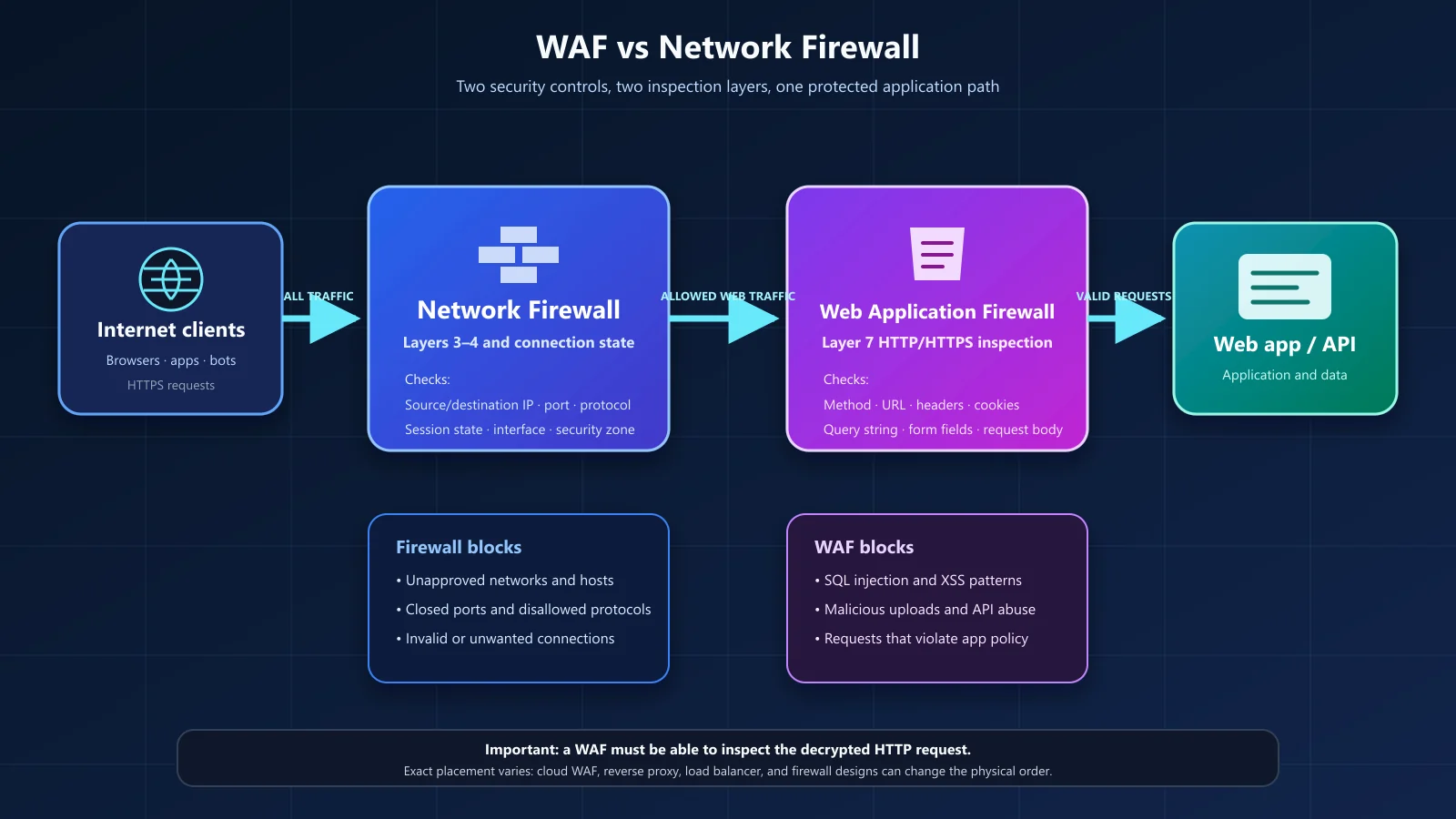
Put simply: a firewall filters traffic by address and port. A WAF filters traffic by what's inside the web request itself.
1. What Is a Firewall?
A firewall sits between your network and the outside world, and it makes decisions based on rules: which IP addresses are allowed in, which ports can be reached, and which protocols are permitted. Anything that doesn't match an allowed rule gets dropped before it ever reaches your servers.
This is why a firewall works at the network layer, not the content layer. It doesn't read the text of a web page request or check whether a login form is being abused — it just checks the traffic's "envelope": source, destination, port, and protocol.
- Good at: blocking unauthorized access attempts, closing off unused ports, stopping known-bad IP ranges, and separating trusted zones from untrusted ones.
- Not built for: understanding what a web application is actually doing with the requests it receives.
2. What Is a WAF?
A web application firewall sits in front of a specific website or API and inspects HTTP and HTTPS traffic in detail. Instead of just checking the source and destination, it looks at the actual content of each request: the form fields, the query parameters, the headers, the cookies, and the request body.
That level of detail is what lets a WAF catch attacks that look like completely normal web traffic on the surface. A network firewall would happily let a malicious login attempt through, because it's still just HTTP traffic to port 443. A WAF is built to notice that the "username" field actually contains a database command.
- Good at: catching SQL injection, cross-site scripting, malicious file uploads, bot abuse, and API misuse.
- Not built for: replacing a network firewall — it's not designed to manage general network access control.
3. Key Differences at a Glance
| Area | Network Firewall | Web Application Firewall |
|---|---|---|
| OSI layer | Layer 3 and Layer 4 (IP, TCP/UDP) | Layer 7 (HTTP/HTTPS content) |
| What it checks | Source/destination IP, port, protocol | Request body, headers, cookies, form fields, query strings |
| What it protects | The whole network and every device on it | One website, web app or API |
| Typical placement | Network perimeter, between untrusted and trusted zones | In front of the specific web server or API gateway |
| Common attacks stopped | Port scans, unauthorized access, network-layer floods | SQL injection, cross-site scripting, malicious uploads, API abuse |
4. What Each One Actually Blocks
What a Network Firewall Typically Stops
- Unauthorized access: traffic from IP addresses or networks that were never given permission to connect.
- Port scanning: attempts to probe which services are open and listening.
- Man-in-the-middle attempts: some network-level interception patterns, depending on the firewall's other features.
- Basic network-layer floods: a share of low-level traffic floods, though large DDoS attacks usually need dedicated protection on top.
What a WAF Typically Stops
- SQL injection: attackers slipping database commands into form fields or URLs to steal or corrupt data.
- Cross-site scripting (XSS): malicious scripts injected into pages that then run in another user's browser.
- Malicious file uploads: attempts to upload scripts or executables disguised as normal files.
- API and bot abuse: scripted requests hammering an API or scraping a site far outside normal usage patterns.
Neither one is "better." They're just watching for different things, at different points in the traffic's journey.
5. WAF vs Next-Generation Firewall (NGFW)
A next-generation firewall builds on a traditional firewall by adding more context: it can look at which application is generating traffic, apply identity-based rules, and often bundle in intrusion prevention and basic content filtering. Some NGFWs include WAF-like modules, which can cover a lot of ground for smaller sites.
The trade-off is depth. A dedicated WAF is built and tuned specifically for web application traffic, so it tends to catch application-layer attacks with more precision and fewer false positives than a general-purpose device trying to do everything at once. For a business with a serious public-facing application, a purpose-built WAF alongside a firewall is usually the safer combination.
6. Do You Need Both?
If you run any kind of public website, customer login, or API, the honest answer is usually yes. Here's why one alone isn't enough:
- A firewall by itself won't notice an attacker abusing your login form or API through completely allowed ports like 443 — to the firewall, that traffic looks totally normal.
- A WAF by itself isn't designed to manage general network access, segment internal systems, or control which devices can talk to which services.
They cover different layers of the same stack, so together they close a gap that neither one covers alone.
7. How to Choose
- Start with a firewall if you don't have basic network perimeter protection yet — it's the foundation.
- Add a WAF as soon as you're running a public-facing website, login page, or API that handles real user or business data.
- Consider an NGFW if you want firewall and light application-layer filtering in one device, and your web application isn't a high-value target.
- Go with a dedicated WAF if your application handles sensitive data, payments, or high traffic, where deeper, more accurate filtering is worth the extra layer.
WAF vs Firewall: What's the Difference? Frequently Asked Questions
What is the difference between a WAF and a firewall?
A firewall filters traffic by IP address, port and protocol. A WAF reads the actual content of web requests and blocks attacks aimed specifically at web applications, such as SQL injection and cross-site scripting.
Do I need both a WAF and a firewall?
Most businesses running a public website or API benefit from both. The firewall keeps unwanted traffic off the network in general, and the WAF catches attacks that slip through disguised as normal web traffic.
What is the difference between a WAF and an NGFW?
An NGFW combines network filtering with extra context like application awareness and identity, and some models include WAF-like features. A dedicated WAF focuses specifically and more deeply on protecting one web application or API.
What attacks does a WAF stop that a firewall cannot?
A WAF is built to catch SQL injection, cross-site scripting, malicious file uploads, and abusive API calls, because these attacks arrive inside normal-looking HTTP requests that a network firewall isn't designed to inspect.
Can a firewall stop a DDoS attack?
A network firewall can absorb and filter some network-layer flood traffic, but large volumetric DDoS attacks usually need dedicated DDoS protection. Application-layer DDoS traffic is better handled by a WAF or a purpose-built mitigation service.