What Is DNS Security?
DNS security protects the system that turns names such as example.com into IP addresses. It helps stop attackers from redirecting users, hiding malicious traffic, stealing data through DNS, or making services unavailable.
This DNS security explained guide covers how DNS works, common DNS security threats, and the controls businesses can combine for reliable DNS protection.
What Is DNS Security and How Does It Work?
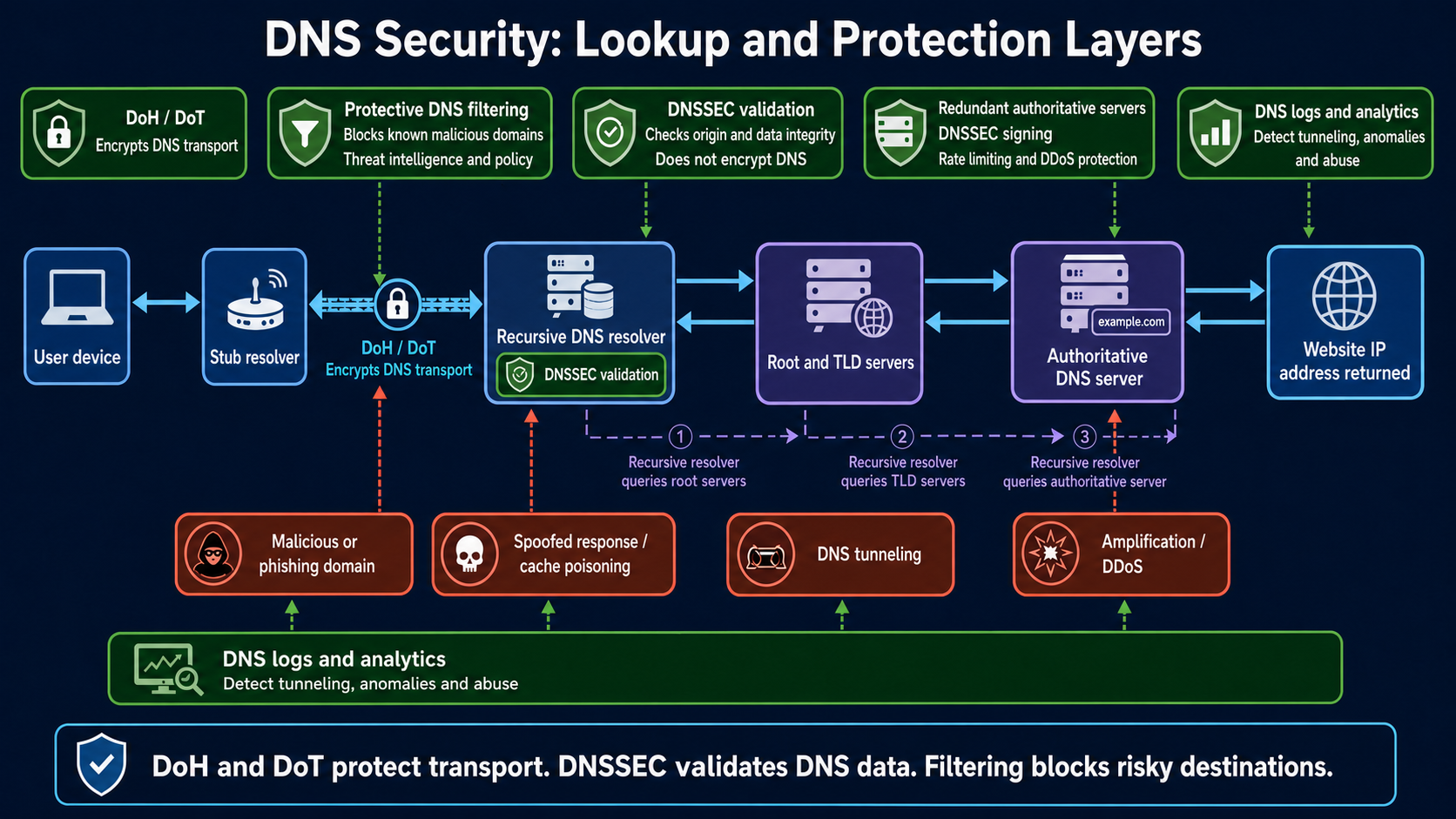
No single product creates secure DNS. Effective DNS cybersecurity uses different controls for different risks: DNSSEC checks authenticity and integrity, DoH or DoT encrypts client-to-resolver traffic, and protective DNS filtering blocks known or suspected malicious domains.
How a DNS Lookup Works
- The device asks its configured resolver. A stub resolver sends a query to a recursive DNS resolver.
- The recursive resolver checks its cache. If a valid cached answer exists, it returns it immediately.
- If needed, the resolver follows the hierarchy. It asks root, top-level domain (TLD), and authoritative DNS servers to find the answer.
- The authoritative server answers. It supplies the requested record, such as an A or AAAA record, and its time to live.
- The resolver caches and returns the result. The device can then connect to the destination IP address.
A recursive DNS resolver performs the lookup for the client and caches results. An authoritative DNS server publishes the official records for a domain. Both roles need protection, but their risks and configurations differ.
Common DNS Security Threats
DNS spoofing and cache poisoning
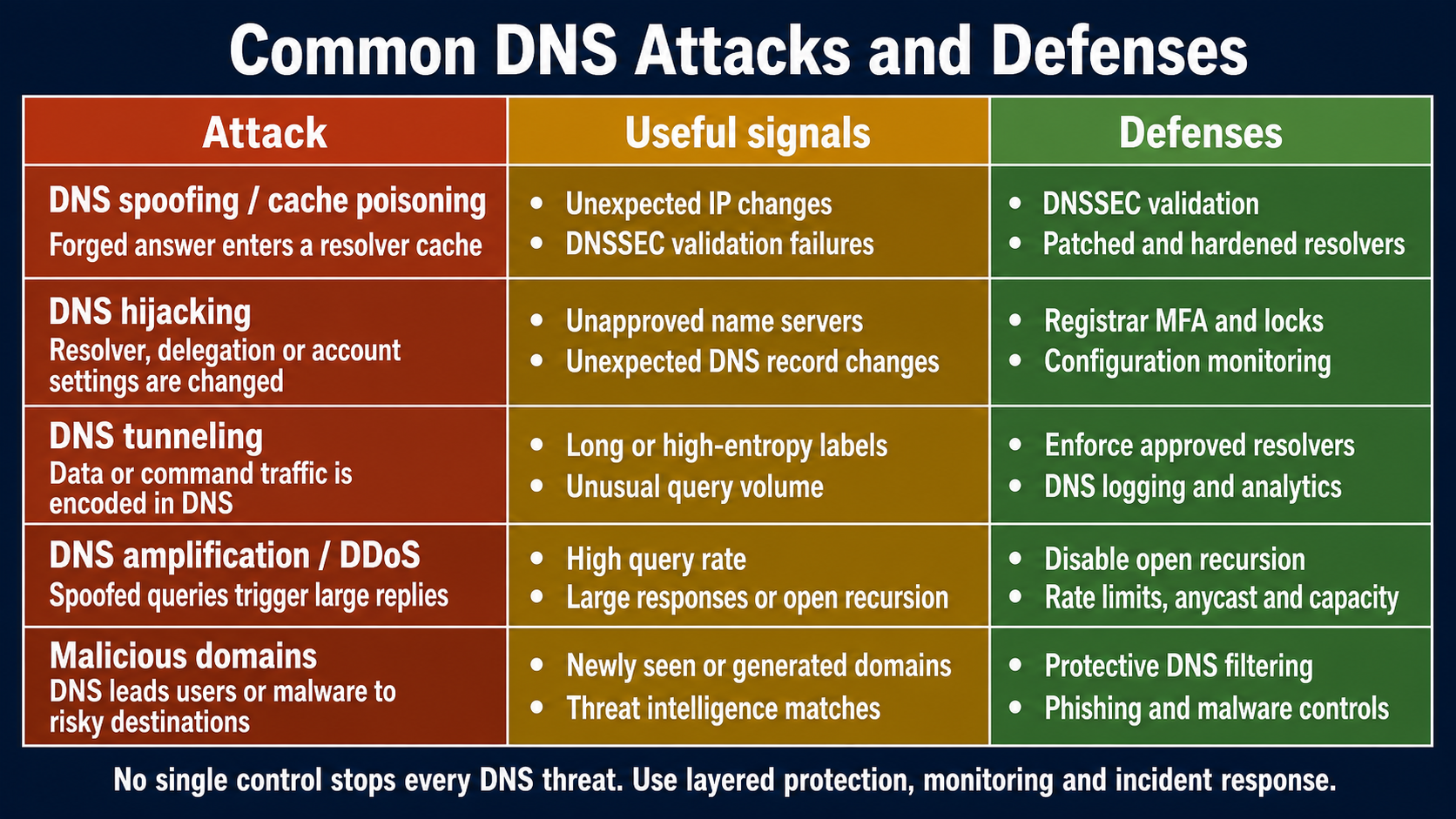
A forged answer is accepted and cached, so users may be sent to an attacker-controlled IP address. DNSSEC validation and patched, well-configured resolvers reduce this risk. See the step-by-step DNS cache poisoning guide.
DNS hijacking
An attacker changes resolver settings, DNS records, delegation, or a registrar account. Strong MFA, registrar locks, change monitoring, and least privilege help protect ownership.
DNS tunneling
Encoded data is hidden inside DNS queries and responses for command-and-control or data theft. Long or high-entropy labels, unusual record types, and unexpected query volume are useful signals. See the DNS tunneling detection and prevention guide.
Amplification and reflection DDoS
An attacker spoofs a victim's address and sends small queries that trigger larger replies. Prevent open recursion, use response rate limiting where appropriate, and build distributed capacity.
NXDOMAIN and random-subdomain floods
Large numbers of nonexistent or unique names can overload recursive and authoritative infrastructure and bypass caches. Rate controls, analytics, and scalable authoritative DNS help.
Malicious domains
Phishing, malware, and command-and-control systems rely on domain names. DNS threat protection can block destinations using threat intelligence, reputation, and organization policy.
DNSSEC: What It Protects—and What It Does Not
Domain Name System Security Extensions (DNSSEC) add digital signatures to DNS data. A validating resolver can follow a chain of trust and check that signed data came from the expected zone and was not modified.
| DNSSEC does | DNSSEC does not |
|---|---|
| Provide origin authentication for signed DNS data. | Encrypt the query or response. |
| Provide integrity protection for signed records. | Hide which domain a user requested. |
| Help detect forged answers when validation is enabled. | Block every malicious domain or stop DDoS by itself. |
Encrypted DNS: DoH vs DoT vs DNSSEC
| Technology | Main purpose | Protection scope | Does not solve |
|---|---|---|---|
| DNS over HTTPS (DoH) | Encrypt DNS using HTTPS, commonly on TCP 443. | Client to chosen resolver. | Authenticity of DNS records or resolver trust. |
| DNS over TLS (DoT) | Encrypt DNS using TLS, normally on TCP 853. | Client to chosen resolver. | Authenticity of DNS records or malicious destinations. |
| DNSSEC | Validate signed DNS data. | DNS data from signed zone through chain of trust. | Query privacy or confidentiality. |
DoH and DoT protect transport; DNSSEC validates data. They are complementary. Enterprises should also govern encrypted DNS so devices do not silently bypass approved resolvers, logging, or security policy.
DNS Filtering vs DNS Security
DNS filtering evaluates requested domains and blocks or redirects them based on threat intelligence, category, reputation, or policy. It can provide phishing protection, malware protection, and content filtering before a connection starts.
DNS security is the larger discipline. It includes filtering plus DNSSEC, encrypted DNS, secure server configuration, registrar protection, access control, logging, threat hunting, DDoS resilience, incident response, and recovery.
DNS Security Best Practices for Businesses
Use approved resolvers
Direct endpoints to managed recursive services, restrict unauthorized outbound DNS, and define a deliberate DoH and DoT policy.
Prevent open recursion
Allow recursive service only for intended clients. Separate recursive and authoritative roles where practical.
Deploy DNSSEC carefully
Validate signed answers on recursive resolvers and sign public zones where appropriate, with tested key rollover and delegation processes.
Filter using current intelligence
Block known phishing, malware, command-and-control, and policy-prohibited destinations. Document overrides and false-positive handling.
Log and monitor DNS
Look for new or algorithmically generated domains, long labels, unusual record types, high NXDOMAIN rates, and abnormal client volume.
Harden and patch servers
Remove unused features, limit administrative access, patch promptly, protect secrets, and test configurations before deployment.
Protect domain administration
Use phishing-resistant MFA where possible, registrar locks, least privilege, separate accounts, and alerts for nameserver or record changes.
Restrict updates and transfers
Control dynamic updates and zone transfers with access rules and authenticated mechanisms such as TSIG when supported.
Design for availability
Use redundant authoritative servers, diverse networks or providers, capacity planning, rate controls, and tested failover procedures.
Prepare an incident playbook
Know how to disable a malicious record, restore a zone, rotate credentials or keys, contact providers, and preserve useful logs.
DNS Security for Cloud and Zero Trust Environments
Cloud, branch, and remote users may query DNS from many locations. Enterprise DNS security solutions should cover on-premises networks, virtual networks, roaming endpoints, containers, and software-as-a-service access without creating blind spots.
In a Zero Trust architecture, DNS signals support context and threat prevention, but DNS is not proof of identity. Combine secure DNS with identity and access management, MFA, endpoint security, segmentation, and a secure web gateway. DNS telemetry can enrich detection while approved resolvers consistently enforce policy.
Practical DNS Security Checklist
- Inventory every recursive and authoritative DNS service.
- Confirm no resolver provides recursion to the public internet unless intentionally designed for it.
- Review domain registrar MFA, locks, contacts, and recovery processes.
- Test DNSSEC validation and monitor failures before broad enforcement changes.
- Set an explicit DoH and DoT policy for managed devices.
- Centralize useful DNS logs with privacy, retention, and access controls.
- Baseline query volume, NXDOMAIN rates, domains, label length, and record types.
- Test DDoS capacity and authoritative failover.
- Review filtering exceptions and incident-response steps regularly.
DNS Security FAQs
What is DNS security and how does it work?
It combines controls that validate DNS data, encrypt selected DNS transport, block risky domains, harden servers and accounts, monitor behavior, and maintain service availability.
Why is DNS security important?
Almost every web, email, cloud, and application connection depends on DNS. Abuse can redirect users, deliver malware, hide attacker traffic, steal data, or interrupt access.
What are common DNS security threats?
They include spoofing and cache poisoning, hijacking, tunneling, malicious domains, reflection or amplification DDoS, and random-subdomain floods.
Does DNSSEC encrypt DNS queries?
No. DNSSEC provides origin authentication and integrity for signed DNS data. DoH or DoT encrypts the client-to-resolver connection.
What is the difference between DoH and DoT?
Both encrypt DNS transport. DoH uses HTTPS, commonly on port 443; DoT uses TLS on a dedicated port, normally 853.
What is DNS filtering vs DNS security?
Filtering blocks destinations according to policy or threat intelligence. DNS security also covers data validation, encrypted transport, infrastructure hardening, monitoring, resilience, and response.
How can a business secure its DNS servers?
Use approved resolvers, prevent open recursion, patch and harden systems, deploy DNSSEC appropriately, restrict updates and transfers, protect registrar accounts, monitor logs, and design for redundancy.
Can DNS security prevent every cyber attack?
No. It is a valuable layer, but it should work with identity, endpoint, email, web, network, and cloud security controls.
References and Related Study
This original guide was developed from the supplied notes and cross-checked against current standards and security guidance.