DMVPN Introduction: Definition, Architecture and Phases
Understand why DMVPN exists, how its technologies work together, what changes between Phase 1, Phase 2 and Phase 3, and when the design is appropriate for an enterprise WAN.
What Is DMVPN?
Dynamic Multipoint Virtual Private Network (DMVPN) is a Cisco overlay architecture that connects a central hub to many branch spokes through a routed transport such as the Internet, MPLS, or another IP WAN. It combines multipoint GRE, NHRP, a routing protocol, and optional IPsec protection.
DMVPN is not a single protocol. It is a design framework in which each technology solves a different problem: GRE creates the overlay, NHRP discovers transport endpoints, routing exchanges private prefixes, and IPsec protects the traffic.
In This Lesson
Why Do We Need DMVPN?
A traditional point-to-point tunnel design requires a separate tunnel and peer definition for each relationship. As branches increase, hub configuration, addressing, crypto policy, and operational effort grow quickly. A full mesh also requires every site to know every other site's transport address in advance.
Reusable spoke template
A new branch can use the same logical configuration pattern and register its current NBMA address with the hub.
Fewer hub interfaces
One mGRE tunnel can represent many peers instead of creating one tunnel interface for every branch.
Dynamic peer discovery
NHRP resolves a tunnel address to the peer's underlay address when direct communication is required.
Optional path optimization
Phase 2 and Phase 3 can remove the hub from steady-state spoke-to-spoke forwarding.
Read the Hub-and-Spoke Topology
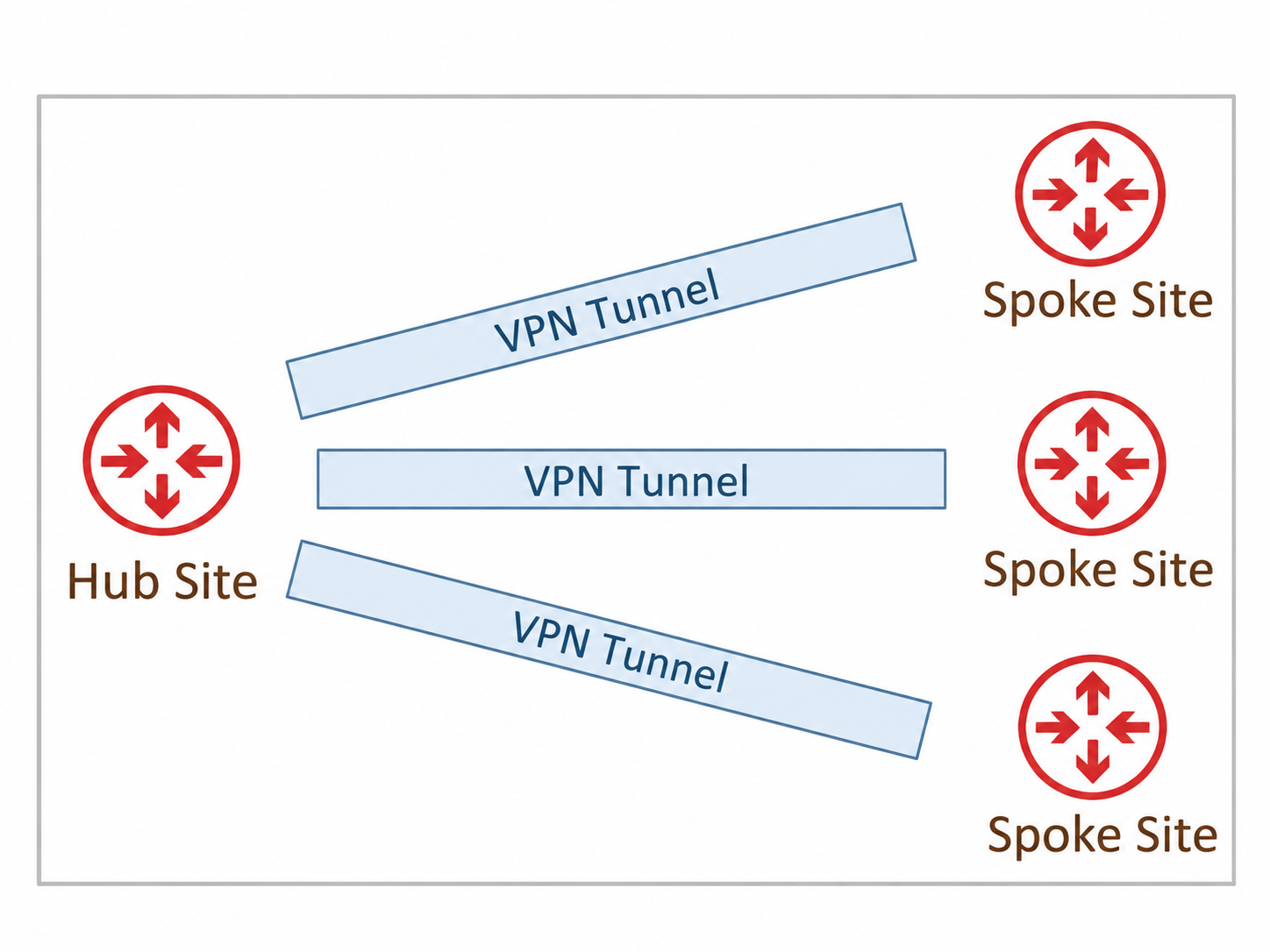
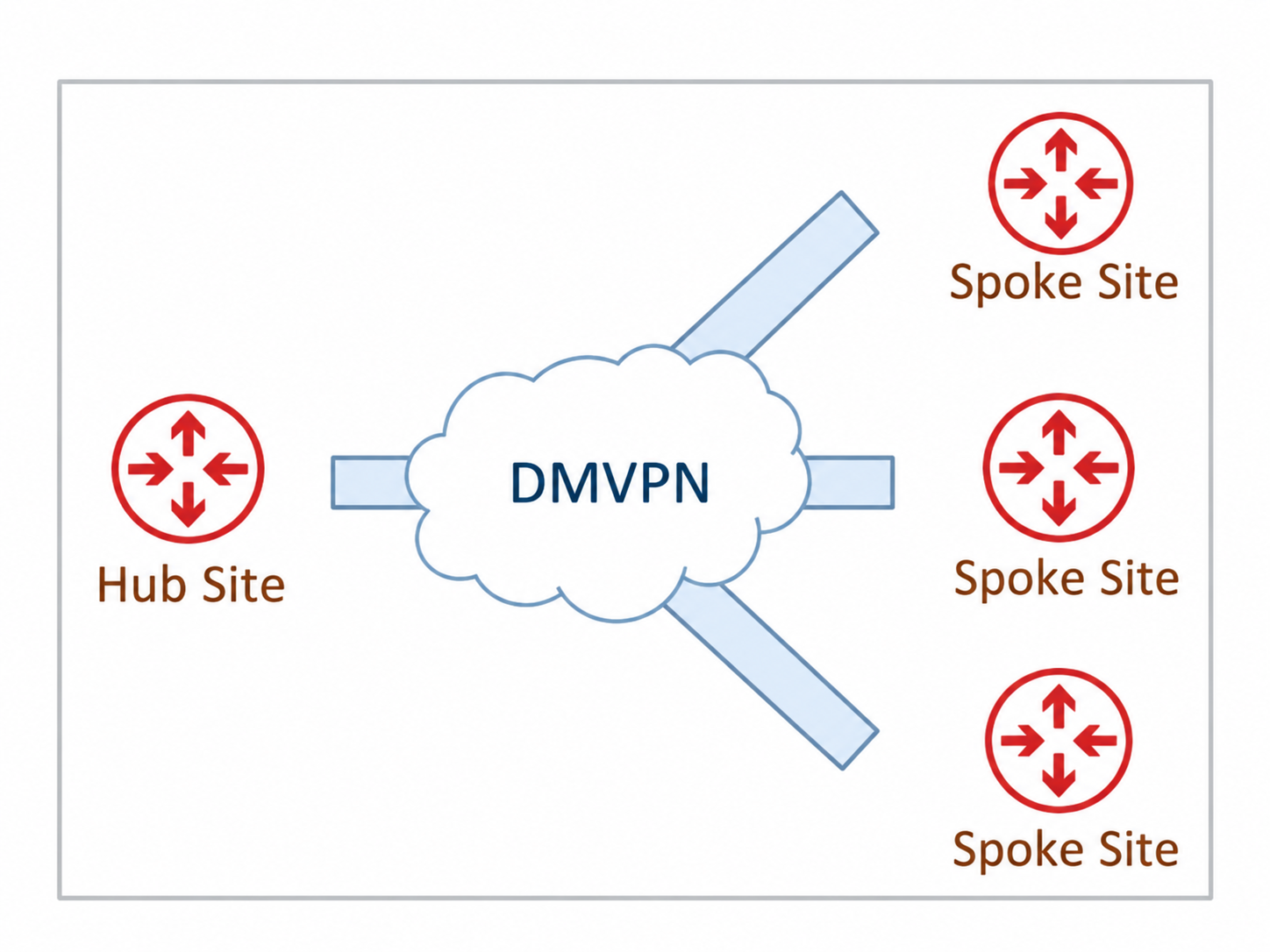
The NBMA address identifies where a router is reachable on the transport network. The tunnel address identifies the router inside the overlay. NHRP maintains the relationship between them.
Core DMVPN Components
| Component | Responsibility | Key point |
|---|---|---|
| mGRE | Allows one tunnel interface to reach multiple dynamic destinations | It provides encapsulation, not encryption |
| NHRP | Maps overlay tunnel addresses to underlay NBMA addresses | The hub commonly acts as the NHS |
| Routing protocol | Advertises branch LAN prefixes across the overlay | Next-hop behavior determines the phase workflow |
| IPsec | Provides confidentiality, integrity, and peer authentication | Applied with a tunnel-protection profile |
| Underlay | Routes packets between tunnel sources and destinations | Must work before DMVPN can work |
DMVPN Phase 1, Phase 2 and Phase 3
| Phase | Tunnel design | Spoke-to-spoke path | Routing behavior | Best fit |
|---|---|---|---|---|
| Phase 1 | Hub mGRE; spoke point-to-point GRE | Always through hub | Hub remains the next hop | Simple centralized forwarding |
| Phase 2 | mGRE on hub and spokes | Direct after NHRP resolution | Remote spoke must remain the route next hop | Smaller networks needing direct paths |
| Phase 3 | mGRE plus redirect and shortcut | Initial packet via hub, then direct | Hub can advertise summaries or a default | More scalable branch overlays |
Phase 2 depends on the routing table already pointing to the remote spoke. Phase 3 can keep the hub as the routing next hop and use NHRP redirect and shortcut to optimize the forwarding plane.
Common DMVPN Use Cases
- Connect many branch offices to one or two regional hubs through Internet or private IP transport.
- Allow voice, replication, or application traffic to use direct branch-to-branch paths when required.
- Support spokes whose public transport address may change while the hub retains a stable address.
- Protect GRE and routing traffic with a scalable IPsec tunnel profile.
- Build a migration or backup overlay without defining a static tunnel for every site pair.
Technical Requirements and Design Checks
Recommended Learning Path
Frequently Asked Questions
Is DMVPN a VPN protocol?
DMVPN is an architecture combining multiple technologies. mGRE builds the overlay, NHRP supplies mappings, routing advertises private prefixes, and IPsec optionally supplies security.
Does DMVPN require IPsec?
The GRE and NHRP overlay can operate without IPsec, but untrusted transports normally require IPsec to protect confidentiality, integrity, and peer identity.
Which phase should a new design use?
Phase 3 is generally preferred when route summarization and scalable direct forwarding are important. The correct choice still depends on platform support, routing design, operational familiarity, and migration constraints.