Wi-Fi 8: The Next Evolution in Wireless Connectivity
Why IEEE 802.11bn is prioritizing predictable performance, lower tail latency, fewer packet losses, and coordinated access points over another headline speed race.
In This Lesson
Understand what Wi-Fi 8 is trying to fix, how its draft technologies may work, where reliability matters most, and whether you should wait or deploy Wi-Fi 7 now.
Quick Learning Map
Use this three-step model to separate Wi-Fi 8's real engineering goals from product-launch hype.
Measure the bad moments
Look beyond average throughput to 95th-percentile latency, packet loss, roaming disruption, and performance at range.
Coordinate the network
Let neighboring access points share information and airtime so overlapping cells behave more like one system.
Match the use case
Value Wi-Fi 8 most where congestion, mobility, or real-time traffic makes inconsistency expensive.
Wi-Fi 8 at a Glance
IEEE P802.11bn is an active draft amendment for Ultra High Reliability. It aims to improve the experience users actually feel: fewer bad latency spikes, fewer lost frames, stronger performance at range, and smoother transitions between coverage areas.
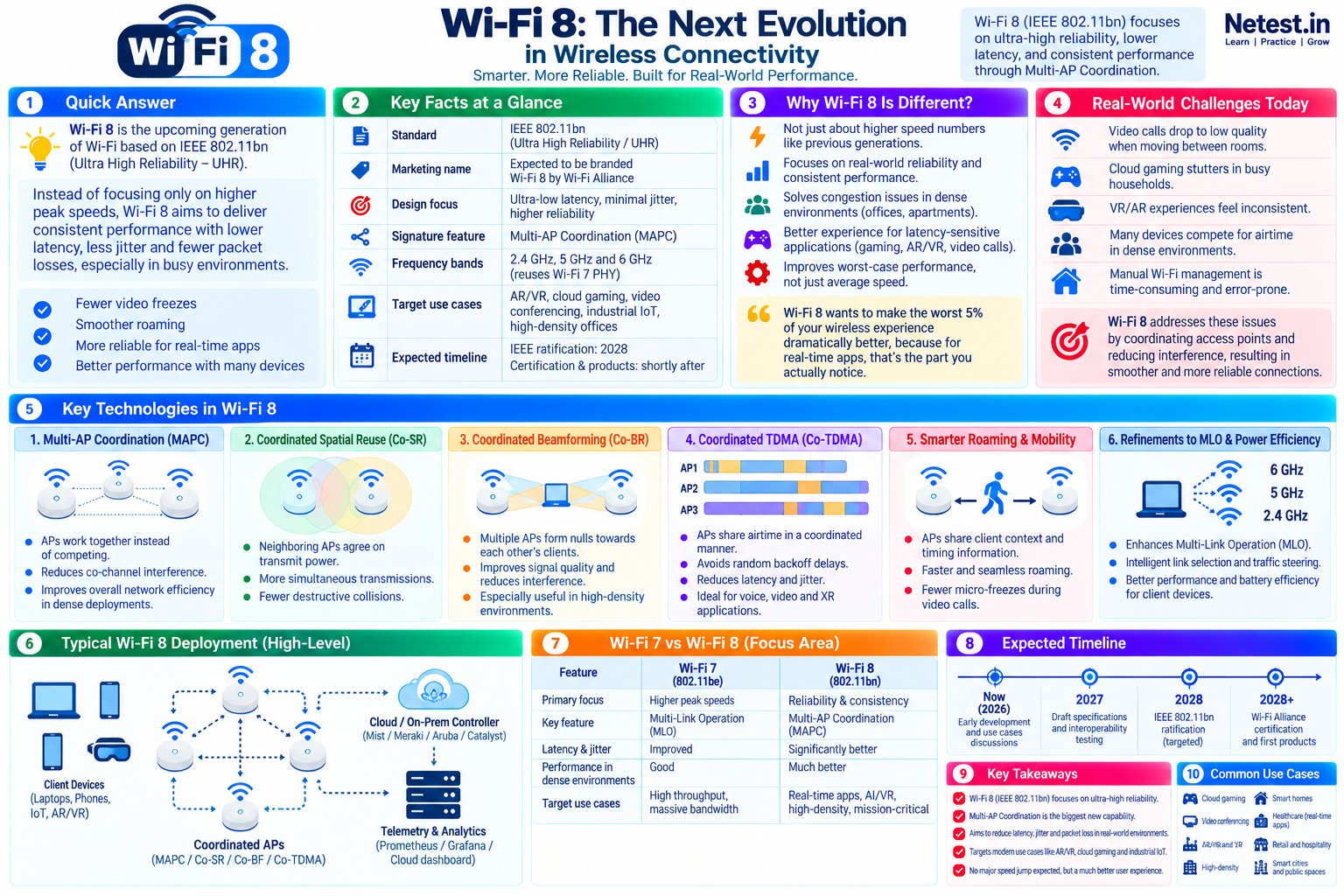
What Is Wi-Fi 8?
Wi-Fi 8 is the generation associated with IEEE P802.11bn, the amendment titled Enhancements for Ultra High Reliability. The project changes both MAC and PHY behavior and covers isolated networks as well as overlapping basic service sets, where neighboring access points and clients contend for the same spectrum.
Standard
IEEE P802.11bn, currently an active draft amendment rather than a finished standard.
Primary goal
More reliable, predictable operation across range, congestion, overlapping cells, and mobility events.
Operating bands
The project covers 1 GHz to 7.250 GHz and preserves coexistence in the familiar 2.4, 5, and 6 GHz bands.
Why Wi-Fi 8 Focuses on Reliability, Not Just Speed
Peak link rate is measured under favorable conditions. Real users notice something different: a video call that freezes during a roam, a cloud game that stutters when the house becomes busy, or an industrial client that retransmits at the wrong moment. Those failures are driven by contention, interference, tail latency, packet loss, and mobility as much as raw bandwidth.
- Video meetings: short delay spikes can create robotic audio or frozen frames even when average throughput is high.
- Cloud gaming and XR: jitter and inconsistent response time can matter more than another few hundred megabits per second.
- High-density networks: dozens of independently competing access points can waste airtime and raise collision risk.
- Mobile clients: roaming carts, headsets, scanners, and phones need predictable transitions between cells.
That is why Wi-Fi 8 is best understood as an effort to improve the worst part of the performance distribution, not merely the best result on a speed test.
Key Technologies Being Developed for Wi-Fi 8
IEEE 802.11bn remains under development, so feature names and final requirements can change. The current task-group work includes several ways to coordinate neighboring access points, refine roaming, and make channel access more deterministic.
Multi-AP Coordination (MAPC)
Core idea: access points exchange coordination information so they can manage overlapping coverage as a group instead of behaving only as independent contenders.
Expected benefit: less destructive interference, more useful simultaneous transmissions, and better performance consistency in offices, campuses, and multi-dwelling buildings.
Coordinated Spatial Reuse (Co-SR)
Core idea: neighboring access points coordinate transmit-power or channel-reuse decisions before transmitting in overlapping areas.
Expected benefit: more concurrent use of the same channel without allowing one cell to overwhelm clients in another.
Coordinated Beamforming (Co-BF)
Core idea: participating access points coordinate beams and nulls so energy intended for one client creates less interference for another.
Expected benefit: better signal quality and spatial efficiency in carefully designed, high-density deployments.
Coordinated Time Sharing
Core idea: coordinated access points can organize transmission opportunities so critical traffic spends less time waiting through unpredictable contention.
Expected benefit: lower tail latency and jitter for voice, video, XR, control traffic, and other time-sensitive applications.
Roaming and Mobility Refinements
Core idea: reduce disruption as a client moves between basic service sets and improve the context available during transition decisions.
Expected benefit: fewer call freezes and lost packets for mobile users, clinical devices, scanners, autonomous systems, and industrial clients.
MLO, Power, and Peer-to-Peer Improvements
Core idea: build on Multi-Link Operation while adding more efficient link use, access-point power-saving mechanisms, and improved peer-to-peer behavior.
Expected benefit: more predictable multi-link performance and better energy efficiency where the final amendment enables it.
Wi-Fi 8 vs Wi-Fi 7: What Changes?
Wi-Fi 7, based on IEEE 802.11be, introduced Extremely High Throughput features such as 320 MHz channels, Multi-Link Operation, 4096-QAM, and preamble puncturing. Wi-Fi 8 builds from that foundation but shifts more attention to reliable performance across difficult conditions.
| Comparison area | Wi-Fi 7 (802.11be) | Wi-Fi 8 (802.11bn draft) |
|---|---|---|
| Primary emphasis | Extremely High Throughput and wider, more flexible use of available spectrum. | Ultra High Reliability: throughput at range, lower tail latency, fewer losses, mobility, and efficiency. |
| Multi-AP operation | Access points still primarily make independent channel-access decisions. | Coordinated operation across overlapping cells is a major area of task-group work. |
| Multi-Link Operation | Introduced MLO so capable devices can use or manage multiple links. | Expected to refine multi-link behavior for reliability, efficiency, and more predictable link use. |
| Latency goal | Can reduce latency through faster links and MLO, but high contention still creates tail-latency spikes. | The project scope explicitly targets a 25% reduction in 95th-percentile latency in at least one mode. |
| Packet loss and roaming | Improved over earlier generations but not centered on a formal UHR target. | The project targets reduced MPDU loss, especially during transitions between coverage areas. |
| Everyday result | Higher potential throughput with capable clients and clean spectrum. | Designed to make busy, overlapping, and mobile environments feel more consistent. |
Where Wi-Fi 8 Could Make the Biggest Difference
Dense offices and campuses
Coordinated neighboring APs could reduce co-channel interference and make capacity more predictable across many overlapping cells.
AR, VR, and cloud gaming
Interactive rendering benefits from controlled jitter, low tail latency, and fewer bursts of lost packets.
Healthcare
Roaming clinical devices, real-time telemetry, and communications need careful designs with stable mobility and bounded disruption.
Industrial and warehousing
Scanners, cameras, AGVs, AMRs, and control systems often move continuously and cannot tolerate repeated retries or long handoffs.
Apartment buildings
Overlapping 5 GHz and 6 GHz cells make coordinated reuse attractive, although cross-vendor coordination will depend on final interoperability rules.
Real-time collaboration
Voice, video, remote desktop, and shared spatial applications feel better when the worst latency spikes are reduced.
Wi-Fi 8 will not replace good RF design. Channel planning, power levels, wired backhaul, PoE, controller design, client behavior, and spectrum regulations will still determine the outcome. For current enterprise design fundamentals, see the Cisco Catalyst 9800 WLC architecture guide.
Wi-Fi 8 Release Date: The Current IEEE 802.11bn Timeline
As of October 21, 2026, IEEE 802.11bn is an active draft project. Draft 2.0 completed its initial Working Group ballot in September 2026, and the task group continues resolving comments and refining PHY and MAC behavior.
| Milestone | Current status or target | What it means |
|---|---|---|
| Draft 1.0 | Approved in 2025 | The first full task-group draft entered Working Group review. |
| Draft 2.0 ballot | Closed September 2, 2026 | The ballot received 76.5% approval and generated comments for further resolution. |
| Draft 3.0 ballot | Targeted January 2027 | A revised draft is expected to circulate after additional comment resolution. |
| Final IEEE 802.11 WG approval | Targeted March 2028 | The Working Group expects to complete its approval process if the draft remains on schedule. |
| RevCom and standards-board approval | Targeted May 2028 | This is the current target for final IEEE approval of the amendment. |
| Certification and products | Timing not fixed by IEEE | Wi-Fi Alliance certification and vendor launch dates are separate; draft-based products may appear earlier. |
Should You Wait for Wi-Fi 8 or Buy Wi-Fi 7 Now?
Buy Wi-Fi 7 now if...
You are replacing aging Wi-Fi 5 or early Wi-Fi 6 equipment, need 6 GHz capacity now, have compatible clients, or need a supported deployment during 2026 or 2027. Wi-Fi 7 is a finished IEEE generation with certified products available today.
Plan for Wi-Fi 8 if...
Your refresh is scheduled for 2028 or later and the business case depends on dense multi-AP operation, industrial mobility, XR, real-time healthcare traffic, or other applications where tail latency and packet loss matter more than a peak speed-test result.
Keep your current network if...
Your Wi-Fi 6, Wi-Fi 6E, or Wi-Fi 7 environment already meets coverage, capacity, roaming, and application requirements. Fix RF design, backhaul, interference, and client issues before assuming a new standard is the only solution.
Common Wi-Fi 8 Myths
“Wi-Fi 8 will simply be twice as fast.”
No final universal multiplier exists. The project emphasizes measurable gains in difficult conditions, including throughput at range, 95th-percentile latency, and MPDU loss.
“Wi-Fi 8 needs a brand-new frequency band.”
No. The project covers frequencies from 1 GHz to 7.250 GHz and explicitly includes coexistence in the 2.4, 5, and 6 GHz unlicensed bands.
“Wi-Fi 7 devices will stop working.”
No. Backward compatibility and coexistence with legacy IEEE 802.11 devices are part of the approved project scope, although older clients will not gain every new capability.
“Any mix of access points will coordinate automatically.”
Do not assume that. Useful coordination requires compatible implementations, management, security, timing, and interoperability behavior. The final standard and certification details will determine what works across vendors.
Final Take: Better Wi-Fi Will Be Measured by Consistency
Wi-Fi 8 represents a useful change in emphasis. Peak throughput still matters, but the active IEEE project is explicitly measuring the failures people notice: poor performance at range, 95th-percentile latency, lost frames, transitions between coverage areas, power use, and behavior in overlapping networks.
If Multi-AP Coordination and the other draft mechanisms deliver practical, interoperable gains, the result may feel less dramatic on a speed test and far more important during a meeting, roam, gaming session, clinical workflow, or industrial operation. That is a better definition of progress for modern wireless networks.
Official IEEE Sources and Status Notes
This guide distinguishes approved project goals from draft features and projections. Specifications and dates can change before ratification.
- IEEE SA P802.11bn project page — official scope, reliability targets, frequency range, power goals, and backward compatibility.
- IEEE 802.11 Task Group bn update — current draft status, meeting activity, and milestone targets.
- IEEE 802.11 project timelines — ballot and approval forecasts across active amendments.
Wi-Fi 8 Frequently Asked Questions
What is Wi-Fi 8?
Wi-Fi 8 is the name used for the generation based on IEEE P802.11bn, an active amendment focused on Ultra High Reliability. Its goals include better throughput at range, lower 95th-percentile latency, fewer packet losses, improved roaming, and more efficient operation in overlapping networks.
Is Wi-Fi 8 faster than Wi-Fi 7?
Wi-Fi 8 is not primarily a headline peak-speed upgrade. The draft work targets more consistent performance under difficult conditions, including measurable improvements in throughput at range, tail latency, and packet loss compared with Wi-Fi 7's Extremely High Throughput operation.
When will Wi-Fi 8 be released?
The current IEEE task-group timeline targets final Working Group approval in March 2028 and final standards-board approval in May 2028. Product and Wi-Fi Alliance certification dates are separate and may change, so treat vendor launch estimates as provisional.
Will Wi-Fi 8 use the 6 GHz band?
Yes. The IEEE project covers carrier frequencies from 1 GHz through 7.250 GHz and explicitly preserves coexistence and backward compatibility in the 2.4 GHz, 5 GHz, and 6 GHz unlicensed bands.
Should I wait for Wi-Fi 8 instead of buying Wi-Fi 7?
Most homes and businesses that need an upgrade now should buy mature Wi-Fi 7 equipment that meets their requirements. Waiting makes more sense for a future high-density, industrial, healthcare, or XR deployment where predictable latency, roaming, and coordinated multi-AP operation justify a 2028-or-later refresh.