Next.js AVIF and Windows Flaws Enable Unauthenticated RCE
Understand the two unrelated critical vulnerabilities, identify which Next.js deployments are exposed, and turn the August 2026 security release into an emergency patch and monitoring plan.
In This Lesson
Move from the disclosure summary to an exposure decision: separate the two root causes, compare exact affected ranges, test the conditions that matter, patch, and monitor for suspicious routing or image-processing activity.
Quick Learning Map
The shared release date does not make these the same bug. Use three decisions to avoid under-scoping the response.
Inventory
Find every Next.js deployment, its exact version, host operating system, router configuration, and image formats.
Classify
Evaluate the Windows routing preconditions separately from the attacker-influenced AVIF processing path.
Remediate
Upgrade to 15.5.24 or 16.3.3, apply interim controls where necessary, validate, and monitor.
Next.js Critical RCE Flaws at a Glance
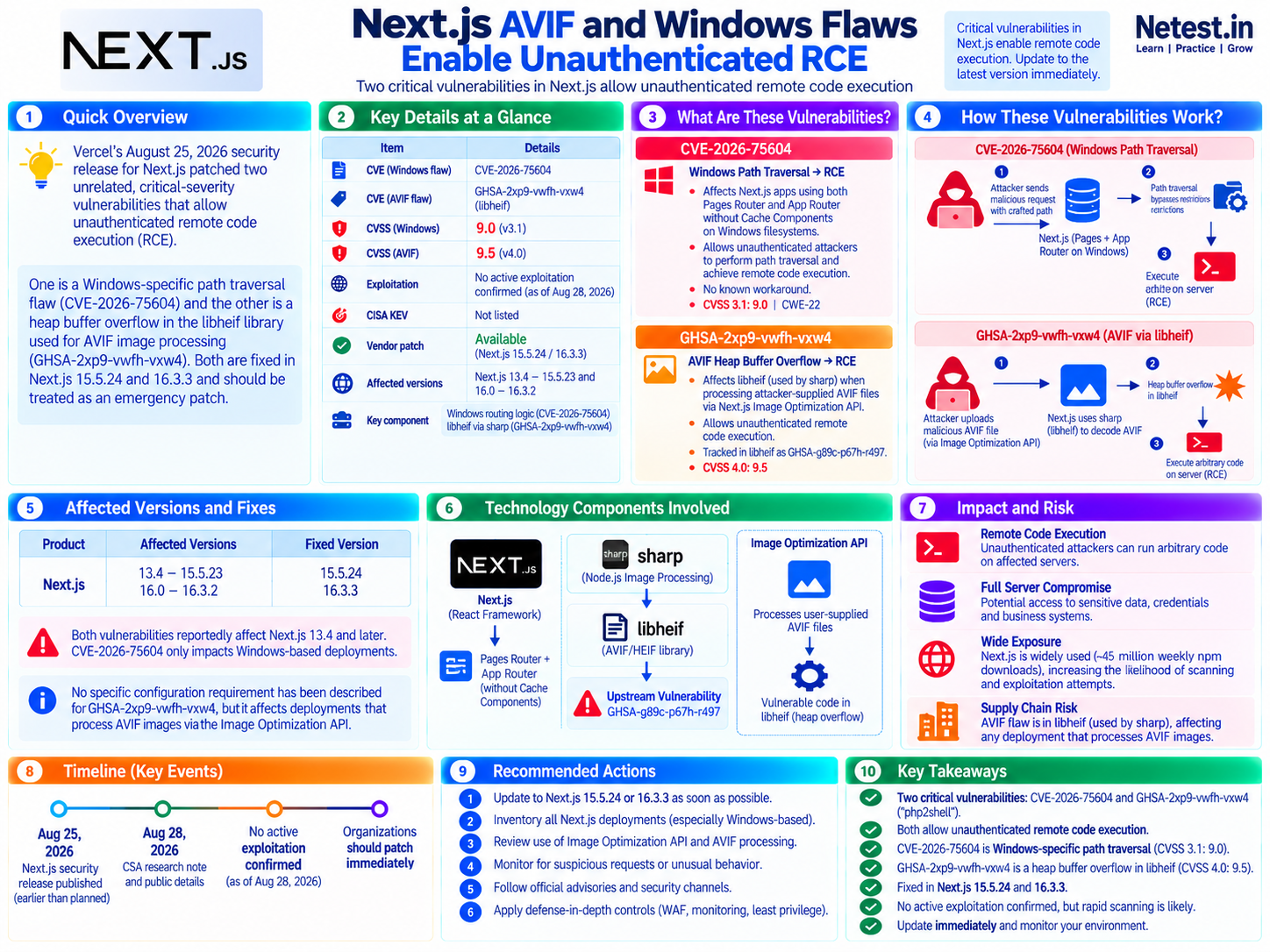
One flaw is specific to Windows routing behavior; the other is a transitive dependency failure in the AVIF decoding path. Both can be reached without authentication under the stated conditions.
Key Takeaways
- Two independent critical flaws: Vercel's August 25, 2026 release addressed both CVE-2026-75604 and GHSA-2xp9-vwfh-vxw4.
- Unauthenticated server compromise: successful exploitation can lead to remote code execution with confidentiality, integrity, and availability impact.
- Different exposure conditions: the first path depends on Windows plus a specific router configuration; the second depends on attacker-influenced AVIF processing through sharp and libheif.
- Emergency upgrade: fixed Next.js releases are 15.5.24 and 16.3.3. The Windows flaw has no known workaround.
- High scanning likelihood: public technical material, framework ubiquity, and no-authentication-required access make rapid reconnaissance and exploit development plausible.
Why the Two Flaws Must Be Triaged Separately
Next.js is widely deployed for server-rendered React applications, routing, and built-in image optimization. The Image Optimization API can resize, re-encode, and cache images obtained from remote or user-influenced locations, which places external input near server-side file and memory operations.
The August 2026 release was accelerated after an additional critical issue was identified in an upstream dependency. That issue was the AVIF decoding flaw; it was released alongside a Windows path traversal fix that was already queued.
Platform-specific flaw
CVE-2026-75604 arises from Windows pathname semantics and Next.js routing behavior when Pages Router and App Router are combined without Cache Components.
Supply-chain flaw
GHSA-2xp9-vwfh-vxw4 originates in libheif, which sharp uses when Next.js decodes AVIF content through the Image Optimization API.
One patch decision
Despite different roots, both vendor-level fixes arrive in Next.js 15.5.24 and 16.3.3, making upgrade the clearest complete response.
Vulnerability Comparison
| Attribute | CVE-2026-75604 | GHSA-2xp9-vwfh-vxw4 |
|---|---|---|
| Issue | Windows path traversal to RCE | AVIF decode heap overflow to RCE |
| Severity | CVSS 3.1: 9.0 (Critical) | CVSS 4.0: 9.5 (Critical) |
| Root cause | Windows pathname handling divergence (CWE-22) | Heap buffer overflow in upstream libheif |
| Trigger conditions | Windows host, Pages Router plus App Router, and Cache Components not enabled | Image Optimization API processes attacker-influenced AVIF input with AVIF output enabled |
| Affected Next.js versions | 13.4–15.5.23 and 16.0–16.3.2 | 10.0.0 through versions before 15.5.24 and 16.3.3 |
| Fixed versions | 15.5.24 and 16.3.3 | 15.5.24 and 16.3.3 |
| Interim option | No known workaround; upgrade | Disable AVIF optimization until upgraded |
| Public technical material | Public proof of concept reported | Python AddressSanitizer proof of concept reported |
Both attack paths require no authentication and no user interaction. A successful exploit can compromise the affected server, but an inventory must evaluate the distinct platform and feature conditions shown above.
CVE-2026-75604: Windows Path Traversal to RCE
CVE-2026-75604 has a CVSS 3.1 score of 9.0 with vector AV:N/ and maps to CWE-22, improper limitation of a pathname to a restricted directory.
The advisory describes affected applications as those that run on a Windows filesystem, use both the Pages Router and App Router, and do not enable Cache Components. Windows interprets path separators, drive letters, and reserved device names differently from POSIX systems. Under the vulnerable routing behavior, attacker-controlled path segments can escape the intended application directory and ultimately reach code execution.
Scope
Next.js 13.4 through 15.5.23 and 16.0 through 16.3.2 on Windows under the stated router configuration.
Exploit signal
Public proof-of-concept code and rapid edge-provider virtual patches indicate active research attention.
Required response
There is no known configuration workaround. Move to 15.5.24 or 16.3.3 and verify the deployed runtime, not only the lockfile.
GHSA-2xp9-vwfh-vxw4: AVIF Parsing to RCE
The second issue has a CVSS 4.0 score of 9.5 and begins in libheif's handling of crafted AVIF containers. The upstream advisory describes nested identity-derivation and auxiliary item references that can create duplicate alpha-plane entries with different bit depths, leading to out-of-bounds heap writes during image scaling.
Next.js reaches the vulnerable code through a dependency chain: the Image Optimization API invokes sharp, and sharp invokes libheif to decode AVIF input. A deployment that accepts attacker-influenced image URLs and has AVIF output enabled can therefore expose the memory-corruption primitive over the network without authentication.
Dependency chain
Next.js Image Optimization API → sharp → libheif AVIF decoder.
Practical precondition
AVIF optimization must be enabled and attacker-influenced AVIF content must reach the server-side decoder.
Interim control
If the upgrade cannot be completed immediately, disable AVIF optimization while scheduling the fixed release.
The patched Next.js releases disabled AVIF optimization pending propagation of a corrected libheif build through the dependency chain. This reflects a supply-chain boundary: the vulnerable decoding logic is upstream rather than authored by the Next.js team.
Exposure Triage: Ask the Right Questions
- Find the running versionRecord the exact Next.js version from the deployed artifact and runtime. Do not rely only on a developer workstation or an unbuilt manifest.
- Identify the host platformDetermine whether each instance runs on Windows, Linux, macOS, a container, or a managed platform whose underlying execution environment is documented.
- Map router usageCheck whether the application contains both Pages Router and App Router routes, and confirm the Cache Components setting.
- Inspect image configurationDetermine whether AVIF is enabled, which remote image origins are permitted, and whether unauthenticated users can influence image URLs or upload content.
- Trace transitive packagesInventory sharp and libheif builds packaged into the deployed application or platform image, not just direct dependencies.
- Include indirect ownershipAsk vendors and managed-service owners about embedded Next.js applications that the security team does not deploy directly.
Immediate Response Actions
- Upgrade immediately: move affected production applications to Next.js 15.5.24 or 16.3.3 as appropriate.
- Prioritize Windows: treat CVE-2026-75604 as the highest-priority subset because no workaround is available.
- Disable AVIF when patching is delayed: remove AVIF optimization as an interim measure, then validate that the deployment no longer processes AVIF through the affected path.
- Apply edge defenses: use available CDN or WAF virtual patches for defense in depth while the application upgrade is completed.
- Rebuild and redeploy: produce fresh artifacts, invalidate vulnerable images and containers, confirm the running version, and test routing plus image optimization.
- Expand the inventory: include third-party, subsidiary, staging, preview, and vendor-managed Next.js deployments exposed to untrusted traffic.
package.json without rebuilding, redeploying, and confirming the live server version does not remove exposure.Monitoring and Strategic Controls
Routing telemetry
Review requests for traversal sequences, unusual encodings, Windows path syntax, repeated routing errors, and suspicious follow-on process activity.
Image telemetry
Review Image Optimization API access for unusual AVIF files, unknown remote origins, malformed image bursts, decoder crashes, and memory-safety alerts.
Host signals
Investigate unexpected child processes, file writes, new accounts, credential access, persistence, or outbound connections from application servers.
Longer-term lessons
- Monitor transitive dependencies: software composition analysis should include native libraries used by direct packages, especially parsers for untrusted binary content.
- Track exposure by platform: mixed Windows and Linux fleets can have different vulnerability states even when application code is identical.
- Apply emergency patch SLAs: unauthenticated vulnerabilities in routine features such as routing and image processing warrant action outside a normal maintenance cycle.
- Preserve incident evidence: if telemetry suggests exploitation, isolate the system, retain volatile and disk evidence, rotate exposed secrets, and follow the incident-response plan.
CSA Resource and Control Alignment
This incident fits a recurring pattern: a widely deployed application platform exposes an unauthenticated path to code execution while public technical material accelerates scanning. CSA's analyses of Langflow path traversal and RCE issues describe comparable emergency-patching, least-exposure, and WAF-limitation concerns.
The response also aligns with the Threat and Vulnerability Management and Application and Interface Security domains of CSA's AI Controls Matrix v1.1. The relevant practices include dependency inventories, emergency patch processes, authentication boundaries, and input validation for internet-facing services. These controls matter even when Next.js is conventional web infrastructure supporting an AI-enabled product rather than an AI system itself.
References
- The Hacker News: Next.js Patches Critical AVIF and Windows Flaws Enabling Unauthenticated RCE.
- Next.js: August 2026 Security Release.
- Next.js advisory: unauthenticated RCE on Windows-hosted servers.
- CVE Program: CVE-2026-75604.
- Next.js advisory: unauthenticated RCE in the Image Optimization API when AVIF files are used.
- libheif advisory: heap buffer overflow through duplicate alpha planes.
- Fastly: virtual patch for CVE-2026-75604.
- Cloudflare: emergency WAF release.
- Cyber Security News: critical Next.js vulnerabilities.
- Security Online: Next.js CVE-2026-75604 analysis.
- Public CVE-2026-75604 proof of concept.
- CSA: CVE-2026-5027 Langflow path traversal to unauthenticated RCE.
- CSA: CVE-2026-33017 Langflow RCE.
- Cloud Security Alliance: AI Controls Matrix v1.1.
Source note: This lesson adapts the supplied research note by the Cloud Security Alliance AI Safety Initiative, published August 28, 2026. The source stated that no active exploitation had been confirmed as of August 27, 2026; readers should verify current threat intelligence before making a present-day incident decision.
Next.js AVIF and Windows RCE Frequently Asked Questions
Which Next.js versions fix both critical vulnerabilities?
Next.js 15.5.24 and 16.3.3 contain the vendor fixes described in the August 2026 security release. Organizations in either affected range should upgrade immediately.
Is there a workaround for CVE-2026-75604?
No known workaround was provided for affected Windows-hosted applications. Upgrade to a fixed Next.js release; WAF rules may reduce exposure but are not a substitute for patching.
When is a Next.js deployment exposed to the AVIF libheif flaw?
The practical attack path requires the Image Optimization API to process attacker-influenced AVIF input with AVIF output enabled. Disabling AVIF optimization is an interim mitigation when an immediate upgrade is impossible.
Do the Windows and AVIF vulnerabilities have the same root cause?
No. CVE-2026-75604 is a Windows-specific path traversal problem in Next.js routing behavior. GHSA-2xp9-vwfh-vxw4 is a heap buffer overflow in the upstream libheif decoder reached through sharp.
Was active exploitation confirmed at publication time?
The source report stated that active exploitation had not been confirmed as of August 27, 2026. Public proof-of-concept material and the critical unauthenticated attack paths still justify emergency patching and close monitoring.