What Is an MCP Server? Understanding Model Context Protocol (MCP)
Learn how an MCP server gives AI applications a standard, controlled way to discover current data, use business tools, and perform approved actions.
In This Lesson
Build a clear mental model of MCP, follow a request through the architecture, compare MCP with APIs and RAG, and learn the controls needed for a safe deployment.
Quick Learning Map
Remember MCP as a three-stage bridge between an AI request and an approved business capability.
Discover
The AI application learns which tools, resources, and prompts an MCP server makes available.
Request
The host selects an appropriate capability and sends a structured request through its MCP client.
Control
The server checks permissions, calls the connected system, and returns only the authorized result.
MCP Servers at a Glance
An MCP server is not the AI model itself. It is a program that presents selected data and actions through a standard interface so an AI application can discover and use them under the application's and server's controls.
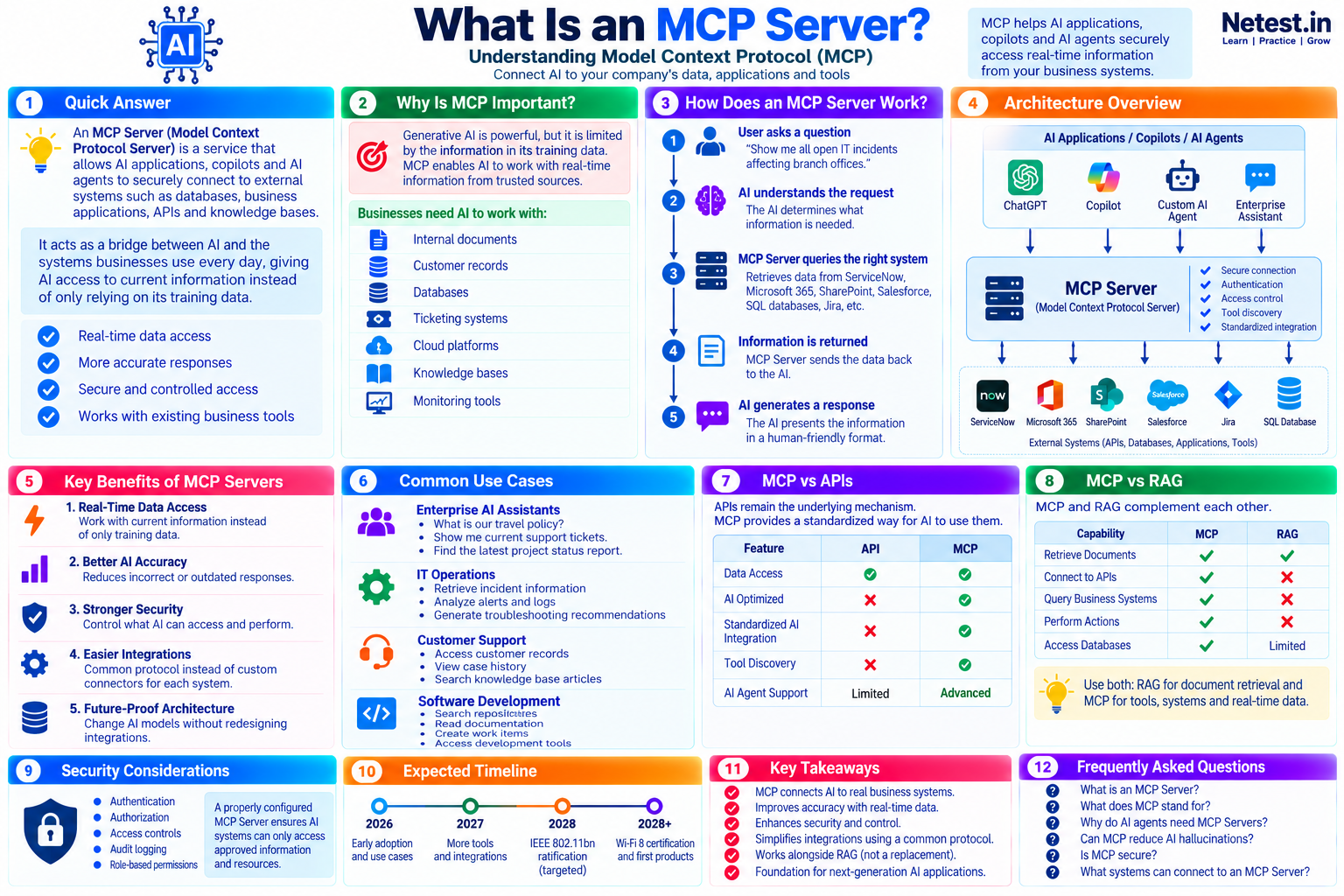
What Is an MCP Server?
An MCP server is a program that provides context and capabilities to an AI application through the Model Context Protocol. It can expose data from files, databases, knowledge bases, APIs, and business applications, as well as carefully scoped actions the application may request.
Think of MCP as a standardized connector between an AI experience and the systems where useful information or work lives. Instead of teaching every AI application a different proprietary integration, a team can describe available capabilities in a common protocol.
What does MCP stand for?
MCP stands for Model Context Protocol. It is an open protocol for exchanging context and capabilities between AI applications and external systems. The protocol defines messages and behavior; it does not dictate which model an organization must use or how a connected business application stores its data.
MCP Architecture: Host, Client, and Server
MCP uses a client-server design, but three roles matter when tracing a request.
MCP host
The AI application that coordinates the user experience, model, permissions, and one or more MCP client connections.
MCP client
The component inside the host that maintains a dedicated connection to one MCP server and exchanges protocol messages.
MCP server
A local or remote program that advertises approved capabilities and fulfills valid requests using connected data or services.
A desktop application can launch a local server through standard input/output, while a remote enterprise service can accept many clients through Streamable HTTP. In both cases, the server role is defined by the protocol behavior rather than by where the program runs.
How Does an MCP Server Work?
Suppose a user asks, “Show me all open IT incidents affecting branch offices.” A typical flow looks like this:
- The user asks a question. The request begins in an AI application such as a copilot, coding assistant, or enterprise agent.
- The host interprets the need. It determines that current incident data is required rather than relying only on model training.
- The client discovers and selects a capability. It identifies an approved server tool or resource that can retrieve incident records.
- The server validates and queries the connected system. It applies authorization and input checks before calling ServiceNow, Jira, a database, or another source.
- The result returns to the AI application. The application uses the structured result to produce a useful response, subject to its own policies and user confirmations.
What Can an MCP Server Provide?
MCP servers can expose three core server-side primitives. A well-designed server publishes only the capabilities needed for its purpose.
Tools
Executable functions that retrieve information or perform an action, such as searching tickets, querying a database, creating a work item, or updating a record.
Resources
Contextual data addressed through the server, such as file contents, documentation, schemas, repository history, database records, or API responses.
Prompts
Reusable templates or instructions that help users and AI applications structure a repeatable interaction with the available context.
These primitives are complementary. A database-focused server might expose its schema as a resource, safe read operations as tools, and an analyst-oriented prompt with examples of useful questions.
Why MCP Is Important for AI Applications
Generative AI is powerful, but a model's training does not automatically include a company's current tickets, private documents, cloud inventory, customer records, or operational tools. MCP creates a consistent integration layer for that missing context.
- Current information: retrieve authorized data at request time instead of depending only on static training.
- Reusable integrations: expose one well-defined server to compatible hosts rather than rebuilding the same connector for every assistant.
- Tool discovery: let clients inspect available capabilities and their input schemas.
- Controlled actions: place validation, permission checks, confirmations, and logging around operations.
- Model flexibility: separate business-system integrations from a single model or user interface.
MCP can improve relevance and reduce errors caused by missing or stale context, but it does not guarantee a correct answer. Data quality, tool design, model behavior, and human review still matter.
Common MCP Server Use Cases
Enterprise assistants
Answer policy questions, find current project reports, and summarize authorized internal knowledge across approved sources.
IT operations
Retrieve incidents, inspect monitoring data, review logs, and assemble troubleshooting evidence for an engineer.
Customer support
Bring together customer records, case history, entitlements, and knowledge articles inside a support workflow.
Software development
Search repositories, read documentation, inspect build results, create work items, and use approved development tools.
Data analysis
Expose governed schemas and read-only queries so analysts can investigate business data without sharing broad database credentials.
Network operations
Read inventory, configurations, alerts, and topology information, then prepare changes for review through controlled automation.
MCP vs API: Does MCP Replace APIs?
MCP does not replace APIs. APIs remain a common way for applications to exchange data and invoke services. An MCP server often calls those same APIs, SDKs, command-line tools, or databases behind the scenes.
| Feature | Traditional API | MCP |
|---|---|---|
| Primary purpose | Application-to-application interface | Standard context and capability exchange for AI applications |
| Discovery | Usually documentation or a separate schema | Protocol methods expose available tools, resources, and prompts |
| AI-oriented metadata | Varies by API | Capability names, descriptions, and input schemas are part of the integration |
| Underlying access | Direct service endpoint | Often wraps an API, SDK, database, file system, or local process |
| Best relationship | Use APIs for the service interface and MCP as a standardized AI-facing layer where it adds value. | |
If you are new to service interfaces, start with the REST APIs and authentication guide.
MCP vs RAG: Different Jobs That Work Together
Retrieval-Augmented Generation (RAG) finds relevant content and places it in the model's context before generation. MCP standardizes how an AI application connects to capabilities. An MCP server can expose a RAG search service as a tool or its results as resources.
| Capability | MCP | RAG |
|---|---|---|
| Retrieve documents | Can expose retrieval as a tool or resource | Core purpose |
| Connect to business systems | Yes, through server integrations | Not by itself |
| Perform approved actions | Yes, through tools | Not the primary function |
| Standardize capability discovery | Yes | No |
| Work together | Use RAG for relevant knowledge retrieval and MCP to present retrieval plus other tools through one protocol. | |
MCP Security Considerations
An MCP connection can cross important trust boundaries. A server may read sensitive information or trigger actions, so “connected” must never mean “fully trusted.” Security must be designed across the host, client, server, identity provider, and downstream service.
- Authenticate every protected connection: verify the identity of users, clients, and services with an appropriate mechanism.
- Authorize each capability: enforce least privilege and check access again when a tool or resource is requested.
- Never pass tokens through blindly: validate token issuer, audience, scope, expiry, and intended resource; keep downstream credentials separated.
- Validate tool inputs and outputs: use strict schemas, allowlists, size limits, timeouts, and safe error handling.
- Require confirmation for consequential actions: show what will change before deleting data, sending messages, deploying code, or modifying infrastructure.
- Protect local servers: install only trusted packages, pin versions, restrict filesystem and network access, and treat server updates as software-supply-chain events.
- Log and monitor: record discovery, access decisions, tool calls, failures, and administrative changes without leaking secrets.
How to Evaluate an MCP Server Before Deployment
Use a small, read-only pilot before allowing an MCP server to make production changes.
- Define the business question. Identify the exact task, users, systems, and success measure.
- Inventory exposed capabilities. Review every tool, resource, prompt, downstream API, filesystem path, and network destination.
- Set identity and permission boundaries. Map users to minimal scopes and separate read, write, and administrative operations.
- Test hostile and accidental inputs. Include prompt injection, malformed arguments, oversized results, timeouts, and downstream failures.
- Add approvals and rollback. Keep humans in the loop for high-impact actions and make recovery procedures explicit.
- Monitor production behavior. Track call volume, denials, latency, errors, unusual access patterns, and tool changes.
The Future of MCP Servers
MCP is evolving from an early integration pattern into a broader ecosystem for connecting AI applications with data, tools, and workflows. The current specification revision at the time of this update is 2026-07-28, which emphasizes stateless requests, explicit discovery, cacheable capability listings, and stronger transport and authorization behavior.
The durable idea is not that one protocol eliminates every integration problem. It is that AI applications benefit from a shared way to discover capabilities, exchange structured requests, and apply consistent controls across many systems.
Official MCP Sources
MCP changes over time. Use the versioned specification and official documentation when designing or reviewing an implementation.
- MCP architecture overview — hosts, clients, servers, transports, discovery, and protocol primitives.
- MCP server features — official overview of prompts, resources, and tools.
- MCP security best practices — current threats and implementation guidance.
MCP Server Frequently Asked Questions
What is an MCP server?
An MCP server is a program that exposes approved tools, resources, and prompts to an AI application through the Model Context Protocol. It can run locally or remotely and lets an MCP client discover and use those capabilities.
What does MCP stand for?
MCP stands for Model Context Protocol, an open protocol for exchanging context and capabilities between AI applications and external systems.
How does an MCP server work?
An MCP host creates a client connection to the server, discovers its available capabilities, selects an appropriate tool or resource, sends a structured request, and returns the result to the AI application for use in its response or workflow.
Why do AI agents use MCP servers?
MCP gives AI agents a consistent way to discover and use approved tools and current data without every AI application requiring a completely different custom integration.
Does MCP replace APIs?
No. An MCP server often calls existing APIs, databases, or SDKs. MCP adds an AI-oriented discovery and interaction layer; it does not replace the underlying service interfaces.
What is the difference between MCP and RAG?
RAG retrieves relevant content to improve a model response. MCP standardizes how an AI application discovers and uses tools, resources, and prompts. They can be used together.
Can MCP reduce AI hallucinations?
MCP can reduce errors caused by missing or stale context when it supplies trusted current data, but it cannot guarantee correctness or eliminate hallucinations. Results still need validation and appropriate guardrails.
Is an MCP server secure?
MCP provides a framework that can be implemented securely, but a server is not automatically safe. Operators must use authentication, authorization, least privilege, input validation, user confirmation for sensitive actions, audit logging, and protected credential handling.